Search This Blog

Showing posts with label Autism Speaks. Show all posts

Thursday, June 18, 2026

Autism Speaks and ASAN Against the Education Offload

 In The Politics of Autism, I write about social services, special education, and the Individuals with Disabilities Education Act. 

Project 2025 proposed to turn IDEA into a "no strings" block grant, effectively gutting the law and destroying protections that disability families have long relied upon. During the 2024 race, Trump denied any connection to the project, but now he proclaims it, praising OMB director Russ Vought "of Project 2025 fame."

Trump and Vought are now accomplishing their goal of ravaging the law. Instead of shifting it to a block grant, they have tried firing most of the staff who enforce it. 

From Autism Speaks:

Autism Speaks opposes the decision to move responsibilities of the Office of Special Education and Rehabilitative Services (OSERS) to the Department of Health and Human Services and the Office for Civil Rights (OCR) to the Department of Justice. This restructuring reverses decades of bipartisan consensus about where special education oversight belongs.

For families, it’s important to know that students’ rights under IDEA and other federal disability laws have not changed. However, moving the federal offices that help make sure schools follow through on those rights to agencies that have not done this work before could affect how families get support when problems arise. This administrative change risks weakening how special education is safeguarded, coordinated, and enforced across our education system.

It creates uncertainty for states and school districts, as decades of work that defined roles, oversight, and implementation of special education programs are redistributed to departments without experience in meeting the school-based needs of students with disabilities. It weakens accountability, by separating responsibility for special education and civil rights enforcement from the Department of Education, where expertise resides and enforcement is closely coordinated alongside general education policy. And it fragments the administration of the services and protections that students and families rely on by dividing special education oversight among multiple departments, making coordination more difficult and increasing the risk of inconsistent support.

From the Autistic Self Advocacy Network:

Moving OSERS and OCR to different parts of the government makes it harder for schools to get the funding that they need. Disabled students might not get the resources they need. Many students with disabilities will not be included because of this. All of the offices that have moved to other departments should be moved back to the Department of Education.

The Department of Education said that moving these offices will not hurt parents and students. This is not true. Moving these offices will make it much harder for disabled students and parents to get the help that they need. If a disabled student is not allowed their accommodations, it will be harder for them or their family to get help.

ASAN’s Policy Director, Greg Robinson, said, “Students with disabilities deserve protection. Students with disabilities deserve civil rights. Students with disabilities deserve a government that helps them and cares about them.”

The Department of Education made a bad decision. This decision will hurt students with disabilities. ASAN wants the government to keep OCR and OSERS in the Department of Education.


Friday, November 21, 2025

Autism and Health Organizations Denounce the Lies on the CDC Website

In The Politics of Autism, I analyze the myth that vaccines cause autism. This bogus idea can hurt people by allowing diseases to spread   Examples include measlesCOVID, flu, and polio.  A top antivaxxer is HHS Secretary RFK JrHe is part of the "Disinformation Dozen." He helped cause a deadly 2019 measles outbreak in Samoa.

He has now hijacked the CDC website.

Autistic Self Advocacy Network:

Yesterday, the Centers for Disease Control radically rewrote a website addressing false claims linking vaccines to autism. Previously, the CDC had correctly stated that a strong scientific consensus has concluded that vaccines are not associated with autism. The website now falsely claims that this statement is “not evidence-based” and that “studies supporting a link between vaccines and autism have been ignored by health authorities”. These are lies.

A statement from the American Public Health Association and other groups, including the Autism Society:

Our organizations, representing autistic individuals, their families, medical professionals and public health workers, are alarmed that the Centers for Disease Control and Prevention is promoting the outdated, disproven idea that vaccines cause autism.

Medical researchers across the globe have spent more than 25 years thoroughly studying this claim. All have come to the same conclusion: Vaccines are not linked to autism.

This false rumor distracts from pressing, urgent issues in children’s health. Amplifying this claim and encouraging unnecessary investigations only worsens parents’ fears; it will not lead to better therapies, improved support for caregiving families, or changes in health care, education, and society in ways that would help children with autism thrive. Rather than devoting needed resources right now to support people with autism and their families in every community, our taxpayer-funded health agencies are using public resources to spread harmful rumors. Autistic people are valued members of society and, like all of us, deserve research that helps health care and other systems address genuine needs. 

Today, our organizations reject this latest attempt to create fear around routine childhood immunizations. Vaccines rank among our greatest medical success stories. Thanks to vaccines, serious diseases that once made thousands sick every year and caused life-long health issues have become rare. We cannot risk losing this progress. Together, we call on the CDC to return to its long history of promoting evidence-based information in the service of protecting the health and well-being of all Americans
 Autism Speaks:

As an organization long invested in rigorous autism research and in supporting autistic people and their families, we believe this change undermines decades of clear scientific consensus. More than 20 years of high-quality research involving millions of children has demonstrated no causal link between vaccines and autism. The few studies that have implied otherwise are extremely limited, methodologically flawed, and have not been reproducible.

Two of the changes are especially concerning:
  • It dismisses robust, established evidence. The updated CDC page elevates weak, outdated studies, such as a 20-year-old parent survey of 77 respondents. These highlighted studies do not meaningfully challenge the overwhelming body of research on autism.
  • It relies on long-discredited correlations.
The page repeats the claim that autism prevalence “correlates” with the rise in childhood vaccines. This does not mean causation, and this argument has been repeatedly debunked.

Autism Science Foundation:

We are appalled to find that the content on the CDC webpage “Autism and Vaccines” has been changed and distorted, and is now filled with anti-vaccine rhetoric and outright lies about vaccines and autism. The CDC’s previous science and evidence-based website has been replaced with misinformation and now actually contradicts the best available science. The new statement on the site that says ““vaccines do not cause autism” is not an evidence-based claim” shows a lack of understanding of the term “evidence”.

Wednesday, October 15, 2025

Trump's Attack on Special Ed

 In The Politics of Autism, I discuss the issue's role in presidential politics. Many posts have discussed Trump's bad record on disability issues. As his words and actions have shown, he despises Americans with disabilitiesHe told his nephew Fred that severely disabled people -- such as Fred's son -- should "just die."

Project 2025 proposed to turn IDEA into a "no strings" block grant, effectively gutting the law and destroying protections that disability families have long relied upon. During the 2024 race, Trump denied any connection to the project, but now he proclaims it, praising OMB director Russ Vought "of Project 2025 fame".

Trump and Vought are now accomplishing their goal of ravaging the law. Instead of shifting it to a block grant, they are firing most of the staff who enforce it.

Eric Garcia at MSNBC:

Over the weekend, the Trump administration fired almost all employees in the Department of Education’s Office of Special Education and Rehabilitative Services. The mass dismissals were part of President Donald Trump and Office of Management and Budget Director Russell Vought’s attempts to pressure Democrats to cave to their demands, as the government shutdown continues. The firings also fit neatly with Trump’s track record on these issues. Throughout his career, Trump has shown little regard for people with disabilities. As president, he has sought to abolish the Department of Education and tapped Linda McMahon, a former WWE executive with scant experience in education, to neuter the department.

The administration’s decision to remove almost all personnel for the special education office is not just a betrayal of students with disabilities. It also is the final nail in the coffin for Republican support of the idea that people with disabilities can and should access public education so that they can empower themselves and live a fulfilling life.

From the Autism Society:
A broad coalition of national, state, and local disability, civil rights, and education organizations is sounding the alarm over sweeping layoffs at the U.S. Department of Education. These cuts have gutted key offices—including the Office of Special Education Programs (OSEP), the Rehabilitation Services Administration (RSA), the Office for Civil Rights (OCR), and the Office of Elementary and Secondary Education (OESE)—threatening decades of progress in protecting students with disabilities.

These wholesale terminations place fundamental education laws in peril and place millions of children with disabilities at risk who receive services under the Individuals with Disabilities Education Act (IDEA), Section 504 of the Rehabilitation Act, and Title IV of the Workforce Innovation and Opportunity Act. These layoffs circumvent the will of Congress and dismantle 50 years of precedent upholding rights for students with disabilities. Without personnel to oversee these laws, the Department cannot provide essential leadership, oversight, guidance, or support to states and schools—jeopardizing students’ access to a free, appropriate public education and hampering the ability of states and localities to serve all students. In addition, the terminations also threaten the vocational rehabilitation system that helps youth and adults with disabilities become employed.

Wednesday, July 16, 2025

Funding Autism CARES

 In The Politics of Autism, I discuss the congressional role in the issue.

KELLY HOOPER and SOPHIE GARDNER at POLITICO:

Advocates from the group Autism Speaks will head to the Capitol today to urge lawmakers to fund recently reauthorized research and service programs in the wake of the GOP megabill’s steep Medicaid cuts.

While the group will acknowledge their concerns about how those cuts could impact autism programs in the states, it plans to focus on the annual appropriations process “since that’s the next thing up, and something that we want to try to ensure that we’re at least maintaining the levels of funding for those programs,” David Sitcovsky, Autism Speaks’ vice president of advocacy, told Lauren.

Congress reauthorized the Autism CARES Act in December, which Autism Speaks says is the primary federal funding source for monitoring, research, services and training programs in the autism community. The law’s programs are spread across the CDC, the Health Resources and Services Administration and the NIH.

The group plans to underscore in their meetings that autism is a lifelong condition — not just a childhood disorder, as often emphasized by Health Secretary Robert F. Kennedy Jr. — for which many people need support as they age.

“It seems like most [of the] conversation about autism has been framed around childhood, and and I think what were really trying to do … is to remind people that [it’s a] lifelong issue, and there are many adults who need better understanding and supportive services now,” said Dr. Andy Shih, Autism Speaks’ chief science officer.

Thursday, May 1, 2025

RFK and Divisions in the Autism Community

In The Politics of Autism, I discuss divisions and factions within the autism community.

To the extent that the stakeholders form a “community,” it is a quarrelsome one. James Madison identified the causes of faction, including a zeal for different ideas and interests.  In autism politics, the factional disagreements are diverse and deep.    Emotions run high because the stakes are high. Few things are more frightening to parents than not knowing whether a child will ever be able to live independently, indeed to survive without them.  For people with autism, the issue involves their very identity.  

Chelsea Cirruzzo and Lauren Gardner at Politico:

Robert F. Kennedy Jr.’s pledge to investigate autism’s “root cause” has split advocates for people with the condition: Some, like Kennedy, want to know what’s causing it, while prominent groups think his search could do more harm than good.

Kennedy’s grim depiction of the most profound cases of autism — many “will never use a toilet unassisted,” he said in April — sparked condemnation from several groups devoted to championing autistic people. They said his remarks perpetuate stigmas associated with a condition that has a broad spectrum of manifestations — and, coupled with his well-known vaccine skepticism, color any attempt by the agency he leads, the Department of Health and Human Services, to conduct further autism research.
But others who say they speak for people with severe autism were heartened that Kennedy is promising to devote HHS’s resources to help them as autism diagnosis rates continue to climb.

“America has a big problem, and we have to face up to it,” said one of them, Jill Escher, president of the National Council on Severe Autism.

...

Her organization also took issue with those, like the Disability Rights Education and Defense Fund and experts quoted in a New York Times op-ed, who said they thought Kennedy’s research plan was rooted in eugenics — the idea that science could be harnessed to prevent autistic people from being born. In a statement, the National Council on Severe Autism said it “categorically” rejected the claim.

That group and others, like the Autism Science Foundation and the Profound Autism Alliance, believe autism’s rise — the most recent Centers for Disease Control and Prevention data says 1 in 31 eight-year-old children has the condition — underscores the need to continue studying potential causes so that people can better understand risk factors and develop treatments for individuals with more severe forms of autism.

The Autism Science Foundation chose not to endorse the statement of its peer groups condemning Kennedy, President Alison Singer told POLITICO, because “there was a focus in that letter that we shouldn’t be focusing science on prevention, and we believe strongly that we should.”
...

Representatives of the Autism Society of America, the Autistic Self Advocacy Network, and Autism Speaks said their organizations have yet to get a meeting with Kennedy or other HHS officials.


Sunday, April 20, 2025

Autism Organizations Speak Out Together

 In The Politics of Autism, I discuss the issue's role in campaign politics.   In the 2016 campaign, a number of posts discussed Trump's bad record on disability issues more generally.   As his words and actions have shown, he despises Americans with disabilities  

He is so bad that organizations that often battle with one another have united against him.

From ASAN:
As national organizations dedicated to advancing the well-being of Autistic individuals, the Autistic Self Advocacy Network, Autism Society of America, Autism Speaks, The Arc of the United States, Autistic Women and Non-Binary Network, Autistic People of Color Fund, and partners across the disability and public health sectors stand united in our call for science-based decision-making and increased investment in the research, programs and services the Autism community needs to live fully.


We are deeply concerned by growing public rhetoric and policy decisions that challenge these shared principles. Claims that Autism is “preventable” is not supported by scientific consensus and perpetuate stigma. Language framing Autism as a “chronic disease,” a “childhood disease” or “epidemic” distorts public understanding and undermines respect for Autistic people.

At the same time, federal proposals to reduce funding for programs like Medicaid, the Department of Education, and the Administration for Community Living threaten the very services that Autistic individuals and their families rely on. Research must be guided by credentialed experts and inclusive of the complexity and diversity of the lived experiences of the Autism community—not redirected by misinformation or ideology. As leaders in the fields of Autism and public health, we are committed to contributing meaningfully to the ongoing dialogue and initiatives led by HHS.

We urge public leaders, institutions, and media to uphold scientific integrity and work together to strengthen—not weaken—the infrastructure of support for the entire Autism community.

Signed By:
Autistic Self Advocacy Network, Colin Killick, Executive Director
Autism Society of America, Christopher Banks, President and CEO
Autism Speaks, Keith Wargo, President and CEO
The Arc of the United States, Katy Neas, Chief Executive Officer
Autistic Women & Nonbinary Network, Sharon daVanport, Executive Director
Autistic People of Color Fund, Ly Xīnzhèn Zhǎngsūn Brown, Founding Executive Director
Autism Empowerment, Karen Krejcha, Co-Founder, Executive Director
Dan Marino Foundation, Mary Partin, CEO

Full List of Endorsing Organizations (Rolling Sign On):
American Association of People with Disabilities
Association of University Centers on Disabilities
National Association of Councils on Developmental Disabilities
TASH
Allies for Independence
Institute for Exceptional Care
Disability Rights Education and Defense Fund (DREDF)
American Association on Health and Disability
Lakeshore Foundation
National Health Law Program
Tourette Association of America
Family Voices National
National Down Syndrome Congress
Bazelon Center for Mental Health Law
American Network of Community Options and Resources (ANCOR)
Epilepsy Foundation
The Center for Learner Equity
Self-Advocates Becoming Empowered
Caring Across Generations
SPAN Parent Advocacy Network (SPAN)
National Disability Rights Network
American Music Therapy Association
Access Ready Inc
Mission Alpha Advocacy

Center for Public Representation

Monday, September 18, 2023

Health Disparity


From Disability Rights Education & Defense Fund (other signers include Autism Speaks, the Autism Society, and the Autistic Self Advocacy Network):
Along with 174 organizations and individuals, DREDF joined a letter to protest a recent decision by an Advisory Committee of the National Institutes on Minority Health and Health Disparities (NIMHD) to not recognize people with disabilities as a health disparity population across the National Institutes of Health (NIH). Such recognition would allow NIH funding to go toward projects that explicitly include a focus on disability health disparities. It would also incentivize efforts to recruit researchers with disabilities and people with disabilities as participants in clinical research. Instead, NIMHD adopted a Working Group’s recommendation to develop and fund an “Office of Disability Research” to identify and work on what the Working Group saw as research “gaps.” The Working Group members were appointed by NIMHD, and did not include any person who openly identified as a person with disabilities. As a result of this decision, the disability community will continue to be denied the tangible benefits and tools that would help end longstanding and preventable barriers, stigma, and bias that deny optimal health to individuals with disabilities.

NIMHD’s given reasoning for its rejection, released barely a week before the proposed Section 504 rule was made public, is based on ableist assumptions about disability that are apparent in both the September 1, 2023 Working Group’s presentation and NIMHD’s discussion following the presentation (approximately l20 minutes beginning at the 3:57 hour mark). The Working Group seemed stymied by the reality that disability arises from different causes, and can medically manifest in different ways, occur at different times, and progress at different rates.

The lack of a single widely accepted definition of disability was seen as a “key gap” because NIMHD could not identify beforehand who would be affected by designating people with disabilities as a health disparity population. The Working Group also defined health disparities as “preventable differences in the burden of disease, injury, violence, or in opportunities to achieve optimal health . . .”, and then stated that “not all health differences in individuals with disabilities meet the criteria of a health disparity.” The Working Group insists on an “all or nothing” approach, which apparently requires all health differences between disabled persons and non-disabled persons to be a preventable difference. This problematic application of the definition of health disparity shows NIMHD’s bias toward separating those who have a disability or chronic condition from those who experience health disparities.

One of the most powerful lessons of Section 504, and a fundamental motivation for the development of a modern cross-disability rights movement in the 70s, was the understanding that the presence of disability invoked a common discriminatory response and could therefore be fought using common legal tools and advocacy. This lesson was patently lost on NIMHD and the Working Group, which seemed unable to recognize that multiple common factors keep people with disabilities from getting equitable and effective healthcare. For the NIMHD, the well-documented impact of healthcare barriers, bias, and discrimination was lost in the specifics of individual diagnoses and medical definitions.

In the end, the Working Group concluded that there were more than twice as many risks as benefits arising from designating people with disabilities as a health disparity population. They called attention to a “high potential for mission creep and loss of focus at NIMHD” because its limited budget and staff could be overwhelmed by funding applications from such a “broad and heterogeneous population.” The Working Group decided to recommend that NIMHD establish a separate Office or Institute focused on disability research that would have a distinct budget.

This recommendation, which was accepted by the NIMHD Advisory Committee, essentially calls for segregated disability health and healthcare disparities research. Lip service was given to the need for “a greater emphasis on the intersection of disabilities and existing populations with health disparities, but it is completely unclear who would lead an intersectional effort or how research efforts would be coordinated among NIMHD and a newly created office. The Advisory Committee’s decision also fails to specify why the Working Group’s recommendations for forming a separate Office of Disability Research could not be carried out after people with disabilities receive designation as a health disparity population.

Even as we recognize Secretary Becerra and his team for getting so much right about the proposed update to the Department of Health and Human Services (HHS) Section 504 rule, we call on the Secretary to further reaffirm the principles of nondiscrimination, full inclusion of people with disabilities, and commitment to health equity by recognizing people with disabilities as a health disparity population.

Tuesday, June 13, 2023

Autism by the Numbers: Age of First Intervention

Uncertainty is a major theme of The Politics of Autism.  In the concluding section, I write:
A key question in autism policy evaluation is simple to pose, hard to answer: How do autistic people benefit? How much better off are they as a result of government action? While there are studies of the short-term impact of various therapies, there is surprisingly little research about the long term, which is really what autistic people and their families care about. As we saw in chapter 4, few studies have focused on the educational attainment of autistic youths. For instance, we do not know much about what happens to them in high school, apart from the kinds of classes that they take. One study searched the autism literature from 1950 through 2011 and found just 13 rigorous peer reviewed studies evaluating psychosocial interventions for autistic adults. The effects of were largely positive, though the main finding of the review is that there is a need for further development and evaluation of treatments for adults.

Autism by the Numbers, created by Autism Speaks in collaboration with the National Autism Data Center at Drexel University, has the potential to transform the way we understand and meet the needs of autistic individuals and their families. This central, authoritative hub of reliable data about people with autism will allow insight into the strengths and weaknesses of systems that exist to improve health, education, employment and advocacy. The Autism by the Numbers Annual Report and Dashboard can also be used to support the creation of precision public health programs specific to the diverse needs of the autistic community.


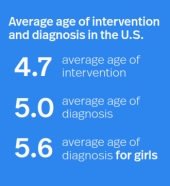
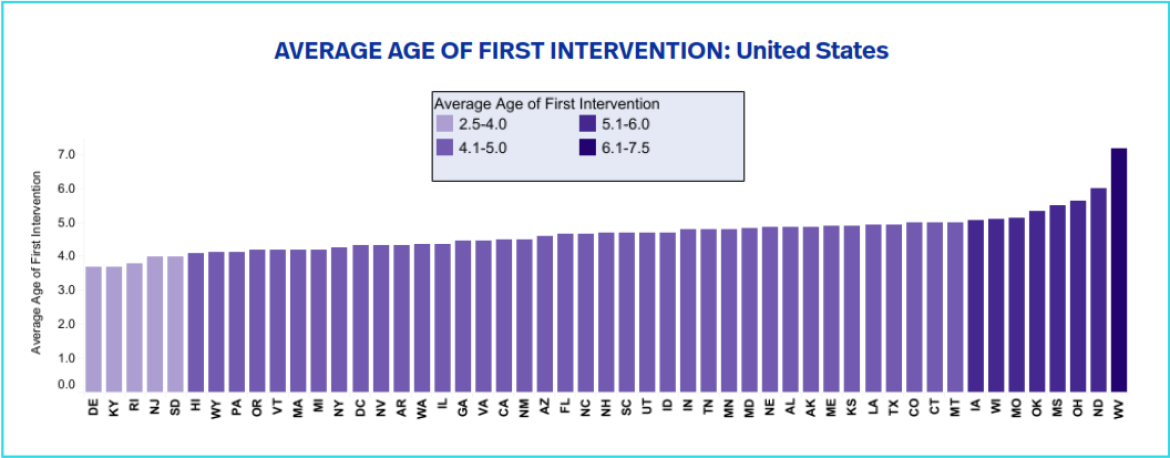
 Autism by the Numbers data also show variation between states in access to diagnosis and early  intervention. 

Infographic showing average age of intervention and diagnosis in the U.S.
  • Average age of first intervention ranges from 3.7 to 7.2 years of age across states.
  • Average age of diagnosis ranges from 3.6 years to 7.6 years across states.
  • Delaware and Kentucky have the youngest age of first intervention, at 3.7 years in each state.
  • Oklahoma (5.3 years), Mississippi (5.5 years), Ohio (5.6 years), North Dakota (6.0 years) and West Virginia (7.2 years) show an average age of intervention above the national average, indicating a possible need to improve screening processes or access to intervention services.

More in-depth research is needed to understand why some states are able to effectively screen for ASD and provide early intervention services, while others experience significant delays in care.

Bar graph showing average age of first intervention by state in the U.S.

Thursday, March 2, 2023

Autism Speaks Honors Grassley

 The Politics of Autism discusses the problem of wandering, which has been the topic of legislation before CongressLast year, the Senate voted to reauthorize Kevin and Avonte's Law and attached it to the National Defense Authorization Act,.

A.J. Taylor at KIOW-FM:

Sen. Chuck Grassley (R-Iowa) received the 2022 “Congressional Leadership Award” this week for his continuous support and advocacy on behalf of individuals with autism. Grassley led the bipartisan effort to reauthorize Kevin and Avonte’s Law with Sen. Amy Klobuchar (D-Minn.). The bill assists communities in locating individuals with autism, Alzheimer’s and other conditions that cause them to wander from safety.

The award, given by Autism Speaks, a non-profit autism awareness organization, is reserved for individuals who have championed steadfast advocacy for individuals with autism and their families. Grassley has prioritized the safety and quality of life for individuals with autism by empowering communities and caregivers to provide adequate care. The award was presented to Grassley by Keith Wargo, the president and CEO of Autism Speaks. Also in attendance was Josh Cobbs, Autism Speaks’ Director of Employment Initiatives, and the Johnson Family from West Des Moines who have long worked to raise awareness for individuals with autism.Senator Grassley receives the Autism Speaks 2022 Congressional Leadership Award. 
I’m humbled to receive this recognition. Legislation like Kevin and Avonte’s law is instrumental in reuniting families, and Autism Speaks is a vital ‘boots on the ground’ organization that facilitates this care. We will continue working to help individuals with autism reach their full potential while honoring those we have lost, like Kevin Curtis Wills of Jefferson, Iowa,” Grassley said.

“Autism Speaks is grateful to Senator Grassley for championing legislation that prioritizes the safety of the autism community. His efforts have led to millions of dollars being delivered to first responders and local organizations in communities across the country to prevent the frightening and sometimes tragic consequences of wandering. We recognize the significance of this in creating a more inclusive world where all individuals with autism can feel supported and understood, and are deeply appreciative,” Wargo said.

Thursday, June 30, 2022

Adults, Children, and Portrayals of Autism


From UC Santa Cruz:
New research from UC Santa Cruz shows incremental improvements in the representation of autistic adults in film, television, books, media coverage, and advocacy organization websites. The study, published in the journal Autism in Adulthood, follows up on a 2011 paper, “Infantilizing Autism,” in Disability Studies Quarterly, which had found that popular portrayals of autism were overwhelmingly focused on children.

The earlier paper had raised alarm about lack of representation of adults with autism, which can limit public awareness of the unique needs of some autistic adults, like employment and housing accomodations. At the time, the authors of the 2011 paper—Jennifer L. Stevenson, Bev Harp, and Morton Ann Gernsbacher—theorized that the bias toward representing children might be due to factors like advocacy organizations being led by parents and clinicians and a predominant focus on initial diagnosis and treatment of autism.

However, since then, the neurodiversity movement has continued to grow, especially as autistic self-advocates have worked to shift focus onto how autistic people can flourish throughout their lives. And a new team of researchers, led by UC Santa Cruz Psychology Professor Nameera Akhtar, wondered whether these efforts, and other potential influences, may have affected representations of autism over the past decade. So, they set out to replicate the 2011 study.

“This is an important issue to track, because autistic adults often say it’s very annoying to them that autism is almost always depicted as having to do with children, and it's like that is making them invisible,” Akhtar said. “They talk about how it’s like they fall off a cliff when they turn 18, because there are very few resources available for them after that. But, of course, you don't stop being autistic and needing accommodations when you become an adult.”

To see how trends in representation may have changed, one place the research team looked was the websites of some well-known autism advocacy and charity organizations. In reviewing online materials from 49 state and regional chapters of the Autism Society of America, the team found that 20% of photographs depicting autistic individuals were of adults, compared to only 5% of photos when the 2011 study had originally reviewed these sites. While children were still heavily favored, this was a statistically significant improvement. And 80% of websites at least mentioned autistic adults and linked to related resources. A review of 16 additional autism charity organization websites found similar results.

The study also looked for trends across the entertainment industry. Researchers analyzed 124 movies and television shows released between 2010 and 2019 that featured autistic characters. They found that 58% of these characters were children, whereas 68% of autistic characters were children in the 2011 paper’s original analysis. The new paper says one factor that could be contributing to this improvement is that production teams are increasingly bringing in consultants to advise on proposed portrayals of autism—likely due to calls for more accurate representation from autistic self-advocates.

However, levels of representation were quite different in the publishing industry. The research team reviewed 484 English-language fiction books published between 2010 and 2017 that included a mention of an autistic character in the book’s description. 81% of these characters were children, compared to the 91% at the time of the 2011 paper’s analysis. This was a statistically significant improvement, despite the lingering disparity. The new paper conducted an additional analysis showing that representation was better among books geared toward adult audiences, in which 67% of autistic characters were children.

The research team also analyzed 90 news stories from print, television, and radio media outlets in the United States that featured one autistic individual and were published between April and May of 2020. 58% of these stories featured autistic children, compared to 79% of stories in a similar analysis for the initial study.

But the new paper notes that even though autistic adults are increasingly represented in news media, they may still be portrayed as childlike. For example, the study showed that one-third of news stories that included autistic adults also mentioned their parents. And prior research has found that non-autistic researchers, parents, and clinicians are more likely to be presented as experts on autism than are autistic adults themselves.

Overall, the authors of the new study say that, while their findings show a shift toward more numerical representation for adults in portrayals of autism, there’s still plenty of room for improvement, including in the capacity of those representations to truly reflect the lived experiences of autistic adults. UCSC Associate Professor of Philosophy Janette Dinishak, a coauthor of the new paper, says she hopes future improvements in representation might include increased attention to the intersectionality of autism with gender, race, ethnicity, and other social categories or identities.

“We need to see a continued increase in the number of representations of autistic adults, along with an improvement in the manner of that representation to reflect the heterogeneity of how autism manifests across a person’s lifespan,” she said. “Autistic people need to be part of the conversation on how to improve that representation, and they also need to be given space to represent themselves.”

Saturday, May 14, 2022

Autism Family Caregivers Act

In The Politics of Autism, I discuss the day-to-day challenges facing autistic people and their families.

A release from Senator Bob Menendez (D-NJ):

U.S. Senators Bob Menendez (D-N.J.) and Susan Collins (R-Maine) today introduced bipartisan, bicameral legislation that would provide autism families the support and training needed to provide quality caregiving to their children.

“Throughout my entire career, I have fought to ensure autistic individuals have the resources to live full and productive lives,” said Sen. Menendez. “I’m proud to lead this bipartisan bill that will deliver real results for children living with autism, their families, and caregivers. This is about dignity and compassion. And most of all, it’s about recognizing that we need to do more to help everyone reach their highest potential by providing the resources needed support that goal.”

“Millions of American families devote enormous time and attention to care for a loved one with autism and to ensure they have the same opportunities as their peers,” said Sen. Collins. “Our bipartisan legislation would support the efforts of these selfless caregivers to improve the wellbeing of children with autism. By providing families with the tools and resources they need to succeed, we can ensure that all children have the ability to reach their full potential and lead rich, fulfilling lives.”

New Jersey has the highest rate of autism, with one in 35 children identified with ASD. One in 44, 8-year-olds nationwide have ASD, according to the CDC.

The Autism Family Caregivers Act would establish a five-year caregiver skills pilot program to award grants to nonprofits, community health centers or hospitals to provide skills training to family caregivers of children with autism. The training will teach family caregivers how to use every day routines and home activities to improve the mental and physical well-being of such children and their caregivers. Caregivers will be trained to address communication skills, daily living skills, social engagement and behavior management. The grants will provide for 25 pilot programs in at least 15 states.

The National Association of Community Health Centers, New Jersey Hospital Association, American Academy of Pediatrics, Autism Society, The Arc and Autism Speaks support the senators’ legislation.

...

Congresswoman Grace Meng (D-N.Y.-06) is the lead sponsor of the bill in the House.

Sen. Menendez is the leading champion in Congress for individuals living with autism and their families. The Senator’s Autism Collaboration, Accountability, Research, Education and Support (Autism CARES) Act of 2019 was passed and signed into law. The bipartisan bill, which builds upon the 2014 Menendez-authored law, shapes federal autism policy and investment in research, early detection, and research to develop new treatments and therapies for those with ASD and other developmental disabilities. The 2019 law also considers the needs of individuals with ASD well into adulthood and “across [their] lifetime.” The Senator was also one of the original authors of the Autism CARES Act of 2006.

Tuesday, March 15, 2022

President's Committee for People with Intellectual Disabilities

 In The Politics of Autism, I discuss the issue's role in presidential politics. 

Last week, President Biden announces his choices for the President’s Committee for People with Intellectual Disabilities. Several have connections to the autism community:

  • Nicole Jorwic is the Chief of Advocacy and Campaigns at Caring Across Generations. Before joining Caring Across, Jorwic was Senior Director of Public Policy and Senior Executive Officer of State Advocacy at The Arc of the United States. Before coming to DC to work on Federal Advocacy, she served as Senior Policy Advisor and Manager of the Employment First Initiative in Illinois. Prior to that appointment, Jorwic was the CEO/President of the Institute on Public Policy for People with Disabilities. She is also an accomplished special education attorney and an advocate for students with disabilities and their families. Jorwic is most importantly a sibling– her brother Chris is 32 and has autism.
  • Cathy Kanefsky’s personal experiences fuel her passion for serving mission-driven organizations. Kanefsky and her husband, Carl, have three sons. Thirty-year-old twins Sam and Adam were born four months early and live with significant physical and intellectual disabilities, including autism. Their 28-year-old son, Stephen, and his wife, Alexandra, are both special education teachers. After 14 years in leadership roles at the March of Dimes, Kanefsky built and led national field operations for Autism Speaks. Following five years as Chief Development Officer at A.I. duPont Hospital for Children, she now serves as the President and CEO of the Food Bank of Delaware. Her determination to help those seeking a better future is the foundation for enhancing job training and employment opportunities at the Food Bank – for all people – including those with intellectual disabilities.
  • M. Brent Leonhard is an Attorney in the Office of Legal Counsel for the Confederated Tribes of the Umatilla Indian Reservation. He has spent his career advocating for the advancement and expansion of the rights of tribal nations and citizens. In 2011, Leonhard was appointed to Attorney General Eric Holder’s Federal/Tribal Domestic Violence Taskforce. In 2015, he was appointed to the U.S. Sentencing Commission’s Tribal Issues Advisory Group. As a parent of an Autistic child, he is intimately familiar with the structural and systemic problems and frustrations those with intellectual or developmental disabilities face. Leonhard is intent on advocating for significant improvements to federal law and policy in this area.
  • Jordyn Zimmerman is a recent graduate from Boston College, where she earned her Masters of Education. Before graduate school, she interned at the National Disability Rights Network and completed her bachelor’s degree in Education Policy at Ohio University. As a nonspeaking autistic student who was denied access to effective augmentative communication until she was 18, Zimmerman has personal experience challenging the educational status quo, which is featured in the 2021 documentary, This Is Not About Me. Zimmerman also serves on the board of CommunicationFIRST and is passionate about ensuring every student is able to access effective communication and exercise their right to a truly inclusive education.

Friday, October 29, 2021

Home Care Update


Robert Holly at Home Health Care News:
President Joe Biden on Thursday went to bat for a significantly trimmed down version of his Build Back Better plan, a massive economic proposal that seeks to expand the country’s social safety net.

“No one got everything they wanted, including me,” the president said in his public remarks. “But that’s what compromise is. That’s consensus. And that’s what I ran on.”

Biden’s update came as the White House unveiled a drastically revised framework for Build Back Better that omits several original goals, including paid family leave and tools to lower drug costs.

The new framework, revised in an effort to achieve full Democrat support, also leaves out free community college and an expansion of the Medicare program.

One thing the $1.75 trillion framework doesn’t leave out: funding for in-home care for America’s older adults.

“The Build Back Better framework will permanently improve Medicaid coverage for home care services for seniors and people with disabilities, making the most transformative investment in access to home care in 40 years, when these services were first authorized for Medicaid,” a White House outline explains.

Specifically, the plan will carve out $150 billion to help reduce waiting lists for in-home care services and improve pay for low-wage in-home care professionals.

A substantial portion of Biden’s public remarks discussed the importance of home-based care, both for seniors and individuals with disabilities. At one point, the president said his home care agenda is “more popular or as popular as anything else we’re proposing.”

Michelle Diament at Disability Scoop:

While the home and community-based services funding is far short of initial expectations, Julia Bascom, executive director of the Autistic Self Advocacy Network, said she’s glad the program is included.

“$150 billion isn’t enough to end waiting lists nationwide, but it’s still the largest investment in HCBS we’ve ever seen and will do a lot of good,” she said. “Our focus is on getting this bill across the finish line, and then making sure each state takes up the additional funding and improves the services they offer.”

Bascom’s group along with others including The Arc and Autism Speaks spent Thursday urging their members to call federal lawmakers to support added spending on home and community-based services and other priorities in the reconciliation bill.


Thursday, July 8, 2021

IACC Public Members


From IACC:
The U.S. Department of Health and Human Services (HHS) today announced the appointments of new and returning members to the Interagency Autism Coordinating Committee (IACC), a federal advisory committee reauthorized under the Autism Collaboration, Accountability, Research, Education, and Support (CARES) Act of 2019. The IACC is a federal advisory committee composed of public stakeholders and federal officials that coordinates federal activities concerning autism spectrum disorder and provides advice to the HHS Secretary on issues related to autism. Committee meetings serve as a public forum for the sharing of community perspectives and concerns about autism. The committee uses this input as it formulates advice and recommendations for the HHS Secretary on matters related to autism research, services, and policy. The committee's responsibilities include developing and annually updating the IACC Strategic Plan for Autism Spectrum Disorder (ASD) and preparing an annual Summary of Advances in ASD Research.

After an open call to the public for nominations of individuals to serve on the committee, Secretary of Health and Human Services, Xavier Becerra, J.D., appointed 20 new and two returning public members to the IACC to provide him with advice to advance research, enhance services, and increase opportunities for people on the autism spectrum. The committee also includes 23 new and returning federal officials representing key federal agencies and departments that serve the autism community across a wide variety of areas, including biomedical research, healthcare, education, and social services. Joshua Gordon, M.D., Ph.D., director of the National Institute of Mental Health, will continue to serve as the chair of the committee. The first meeting of the new committee will take place virtually on July 21-22, 2021 and will be open to the public via webcast. A full roster and biosketches of all the new and returning members can be viewed on the IACC website.

IACC Executive Secretary, Susan Daniels, Ph.D., stated, "We are excited to welcome the largest and most diverse IACC to date, with a wider representation of perspectives from across the autism community than ever before."

Public members appointed include autism self-advocates, parents and family members of children and adults on the autism spectrum, clinicians, researchers, and leaders of autism research, services, and advocacy organizations. Many of the appointed individuals serve multiple roles, such as parent and researcher or self-advocate and leader of an advocacy organization. Appointees hail from across the U.S., including states that have not been represented on the committee previously, such as Louisiana, Maine, Texas, Washington, Vermont, and Wisconsin.

Autism and disability organizations represented by new and returning appointees to the IACC include the Autism Science Foundation, Autistic Self Advocacy Network, Autism Speaks, Champions Foundation, Simons Foundation, and Madison House Autism Foundation. Four federal departments newly joining the IACC —the U.S. Department of Housing and Urban Development, U.S. Department of Justice, U.S. Department of Labor, and U.S. Department of Veteran Affairs—will provide additional expertise in the critical areas of housing, employment, interactions with law enforcement, and care for veterans on the autism spectrum.

Public members appointed by the Secretary to serve on the IACC from 2021-2024 are: