Search This Blog

Showing posts with label Rehabilitation Act. Show all posts

Monday, June 29, 2026

How Many Autistic College Students?

In The Politics of Autism, I discuss the growing number of college students on the spectrum.  


Abstract
How many autistic college students are in the United States? Research to date has not specifically addressed this seemingly straightforward question. Yet, an answer may be critical to the advancement of research, policy, and practice related to autistic students in higher education. This article addresses three related but distinct questions about autistic students’ college enrollment within the United States: (1) What percentage of autistic high school students go on to college? (2) What percentage of students registered with their postsecondary institutions’ Disability Services Offices are autistic? and (3) What percentage of enrolled undergraduates are autistic? To answer these questions, we examined 731 publications, reviewed 16 common survey instruments used at postsecondary institutions, and inspected codebooks from 6 federal datasets. Rather than employing traditional systematic review techniques, we used an iterative, consensus-driven assessment process to ultimately synthesize relevant data from 14 prior publications and 3 original author-generated statistical summaries drawn from a total of 13 distinct sources of underlying data. We conclude that the best available evidence suggests 42.9%–47.0% of autistic high school students continue on to college, 2.8%–4.0% of college students registered with their schools’ Disability Service Offices are autistic, and 0.3%–4.7% of all undergraduates are autistic. Ultimately, our calculations suggest that there are likely between 135,400 and 286,254 autistic undergraduates currently attending college in the United States. These estimates can be used by researchers, policymakers, and educators to highlight the importance of attending to the interests, needs, experiences, and outcomes for autistic students.

Tuesday, May 12, 2026

Inequality and Section 504 Accommodations

 In The Politics of Autism, I discuss the legal rights of people with autism and other disabilities.   Inequality is a big part of the story. 

Kevin Mahnken at the 74:
While intended as a universal benefit, educational support for disabled children is significantly segregated by class, according to a paper released in January. The decade-spanning analysis of state and federal data found that wealthy families were twice as likely as poorer ones to be granted accommodations under the federal law Section 504.

A similar split was present in the vast architecture of special education offered through Individualized Education Programs — though in that case, the dynamic was reversed, with IEP recipients much more likely to come from low-income families than well-off ones.

...

In 2019, a pair of investigations by Wall Street Journal and New York Times revealed that school districts with higher average incomes enrolled conspicuously larger numbers of students with 504 plans. Eligible pupils are typically given extra time to complete assignments and tests, raising concerns that some parents exploited the program to gain unneeded academic perks for their kids.

...

[UCI doctoral student Nick] Ainsworth and his colleagues created the study by gathering academic records for millions of Oregon students between the 2008–09 and 2018–19 school years, then linking them to IRS tax files over the same period. The combined data allowed them to see not only which students were classified as needing IEP vs. 504 services, but which specific disability they reported.

In all, one-quarter of the most disadvantaged students had an IEP, a portion more than three times greater than that of the very wealthiest students. Meanwhile, nearly twice as many students from families near the top of the income scale were assigned a 504 plan than those near the bottom (2.9 percent vs. 1.5 percent).

Paul Morgan, a professor at the University of Albany whose work focuses on disability classification, said those patterns reflected important distinctions in how the two offerings are used.

IEPs provide specialized instruction geared toward each student’s learning goals, sometimes including placement outside general education classrooms. By contrast, 504 plans only require schools to make the requisite modification to give students equal access to learning opportunities. Their looser eligibility standards may allow parents with the resources and wherewithal to access support on behalf of children who aren’t obvious candidates for IEPs, Morgan remarked.

“These are benefits that don’t come with a lot of costs. Your child is typically not leaving the classroom,” he said. “They might be seen as beneficial without much downside in terms of tradeoffs.”

Monday, March 2, 2026

More College Students Seek Accommodations

In The Politics of Autism, I discuss the growing number of college students on the spectrum.  

Mark Arsenault and Steven Rich at NYT:
The number of college students reporting disabilities rose more than 50 percent over the last decade across a wide swath of schools, including at some of the most selective universities in the nation, according to a New York Times analysis of government data.

The rise, which has corresponded with an increase in A.D.H.D., autism and other diagnoses, has also meant an increase in the number of students requiring accommodations, such as more time to take tests. While some colleges and students have embraced the trend, saying it shows schools are opening their doors to students who might previously have been shut out, it has raised worries that some could be gaming the system.

The increases have occurred at all kinds of institutions, from small liberal arts colleges to large research universities commanding global reputations.

At some colleges, more than a third of students have registered physical or mental disabilities, signed off on by doctors. For those students, the schools generally provide the students legally required accommodations that others may not receive, such as special testing rooms and note-taking services.

The proliferation in accommodation plans, known as 504 plans after a section of federal law that prohibits discrimination based on disability, has made even the most academically rigorous universities more welcoming to students with disabilities. Among the top 100 schools that saw the biggest increases in students with disabilities are several in the group known as “Ivy Plus,” some of the most difficult schools in the nation for a student to get into, including Harvard, Cornell and the University of Chicago.

At all three of those schools, 21 percent of students registered as having disabilities in 2024, according to government data. Harvard and the University of Chicago reported less than 3 percent in 2015, the data show. Cornell University increased from 6 percent.

...
Most of the top 100 schools showing the biggest increases over the past decade are not the country’s most famous, selective or exclusive universities.

Among the top 10, Pace University in New York reported that 37 percent of students had a registered disability in 2024; in 2015 the school reported 5 percent. Hampshire College, a liberal arts school in Massachusetts, reported that its percentage climbed to 38 percent from 10 percent in a decade. Scripps College, a women’s liberal arts school in Claremont, Calif., saw increases from 11 percent to 36 percent.

Saturday, January 10, 2026

Legal Literacy and Section 504

In The Politics of Autism, I discuss the civil rights of people with autism and other disabilities. 

Decker, J. R. (2025). Hidden Disabilities: The Urgent Need to Increase Section 504 Legal Literacy. Journal of Disability Policy Studies, 0(0). https://doi-org.ccl.idm.oclc.org/10.1177/10442073251393335 

Abstract:

The hidden disabilities of students and staff in schools—which include medical and psychological conditions—have increased. Therefore, it is imperative that everyone in education is well versed in the law that protects them, Section 504 of the Rehabilitation Act of 1973 (Section 504). The limited research indicates that teachers, school leaders, and other school employees lack Section 504 legal literacy. This article aims to increase awareness of hidden disabilities by explaining what they are and emphasize their significance through a discussion of anxiety, asthma, and allergies. It also intends to address the problem of the lack of Section 504 legal literacy by answering frequently asked questions about Section 504. University instructors, special education directors, and others are invited to share this relevant legal guidance to increase the legal literacy of their students and coworkers. Overall, this article hopes to ensure that students and employees with disabilities in schools—who are not eligible under the Individuals with Disabilities Education Act (IDEA)—receive better support and lawsuits are prevented. 


Thursday, November 27, 2025

Suit to Save IDEA


A release from the Arc of the United States:
The Arc of the United States has joined a major lawsuit challenging federal actions to dismantle the U.S. Department of Education. The case, Somerville Public Schools et al v. Trump et al, argues that because the Department was created by Congress, it cannot be restructured or eliminated without Congressional approval. The lawsuit also asserts that recent mass layoffs and other efforts to stop the Department’s work have stripped away essential protections for students with disabilities.

At the center of the case is a question with national impact: What happens to students with disabilities when the very offices that support them and protect their education rights are gone?

Since early 2025, thousands of Department employees have been laid off, including nearly all staff in the Office of Special Education and Rehabilitative Services (OSERS) and the Office for Civil Rights (OCR). These offices are the backbone of federal enforcement for disability education laws. They:
  • Ensure schools follow the Individuals with Disabilities Education Act (IDEA) and Section 504 of the Rehabilitation Act
  • Distribute education funding to states and schools
  • Investigate discrimination complaints
  • Fund research on effective teaching strategies
  • Support training and retention of special educators
  • Coordinate transition services that help youth with disabilities prepare for employment and independent living
The absence of these offices threatens to unravel decades of progress toward equal educational opportunity.

The Arc joined this lawsuit as a plaintiff to help ensure the Department remains fully functional, open, and accountable to students with disabilities and their families. 
What Is the Somerville v. Trump Case About and Why Did The Arc Join It?

In March 2025, nearly half of the Department of Education’s 4,133 employees were fired, including many responsible for implementing and enforcing federal disability education laws.

A coalition of educators, school districts, and unions filed a lawsuit soon after to stop the mass layoffs and dismantling of the Department. In April 2025, The Arc filed a declaration in support of the lawsuit, explaining how these changes would harm students with disabilities and their families.

In May 2025, a district court judge issued an injunction temporarily stopping the mass firings and dismantling. Two months later, the U.S. Supreme Court allowed the firings and efforts to dismantle the Department of Education to continue while the case proceeds in the U.S. District Court for the District of Massachusetts.

In October 2025, the situation worsened when nearly all remaining staff in the OSERS were laid off during the government shutdown, leaving only a few employees to oversee the nation’s special education and vocational rehabilitation systems. These layoffs were reversed in mid-November as part of a deal to end the shutdown.

The Arc joined the lawsuit as a plaintiff on November 25, 2025.
Why Is the U.S. Department of Education So Important for Students with Disabilities?

The Department of Education plays a central role in protecting the rights of students with disabilities and ensuring that schools have the tools and guidance to meet students’ needs.

The Department’s core responsibilities include:
  • The Office of Special Education and Rehabilitative Services (OSERS) implements and oversees federal laws like IDEA and Section 504, ensuring that every child receives a free and appropriate public education.
  • The Office of Special Education Programs (OSEP) provides teacher training, technical assistance, and guidance to help schools support students with disabilities.
  • The Rehabilitation Services Administration (RSA) helps youth with disabilities transition from school to work and community life.
  • The Office for Civil Rights (OCR) investigates disability discrimination in schools under the Americans with Disabilities Act (ADA) and Section 504, as well as other statutes, allowing families to resolve legal issues without going to court.
When these offices lose staff and resources, families lose access to the federal safety net that ensures their children can learn, participate, and thrive.
How Could Dismantling the Department of Education Affect Students with Disabilities?

Weakening or eliminating the Department of Education will make it harder for students with disabilities to receive the education they are guaranteed under federal law. These cuts could reduce enforcement of disability rights, slow the distribution of IDEA funding, and limit training and guidance that schools and teachers rely on to support their students.

The impact is deeply personal. It affects whether:
  • A child with Down syndrome receives the therapies outlined in their Individualized Education Program (IEP)
  • A teenager with autism has access to vocational and transition services
  • A parent can challenge a school’s failure to provide necessary accommodations
For many, the Department of Education has been the last line of defense against discrimination and neglect. Without it, families face inconsistent state standards, longer wait times, and fewer options for resolving disputes.
What Is The Arc’s Role in Protecting Special Education and Disability Rights?

The Arc joined this lawsuit to defend the rights of students with disabilities to a free, appropriate public education guaranteed by federal law. The Arc’s involvement ensures that the voices of families and people with disabilities are represented as the case moves forward.

This action builds on The Arc’s long history of advancing educational rights through litigation and advocacy. In 1971, The Arc of Pennsylvania brought PARC v. Pennsylvania, the landmark case that established the constitutional right to a public education for children with intellectual disabilities. That decision paved the way for IDEA and the modern Department of Education.

Today, The Arc continues to advocate through the courts and with partners nationwide to ensure every student with a disability has the opportunity to learn, grow, and belong in their community.
Learn More About the Department of Education Lawsuit and Disability Rights

Written by Shira Wakschlag, Senior Executive Officer of Legal Advocacy and General Counsel, and Katy Neas, Chief Executive Officer of The Arc of the United States. Both are available for media interviews.

Friday, June 13, 2025

SCOTUS and AJT v. Osseo Area Schools

 In The Politics of Autism, I discuss the civil rights of people with autism and other disabilities.

Ronald Mann, Unanimous court rebuffs higher standard for discrimination claims by children with disabilities, SCOTUSblog (Jun. 12, 2025, 6:32 PM), https://www.scotusblog.com/2025/06/unanimous-court-rebuffs-higher-standard-for-discrimination-claims-by-children-with-disabilities/ 

In A.J.T. v. Osseo Area Schools, Independent School District No. 279, the Supreme Court considered the obligation of schools to refrain from discriminating on the basis of a disability. Specifically, the justices considered whether students face a higher bar in challenging such activity than disabled individuals do in other contexts. Thursday’s opinion by Chief Justice John Roberts, joined by all the justices, firmly rejected the higher standard adopted by the lower courts.

The case involved a pair of federal statutes that bar discrimination on the basis of disability, Section 504 of the Rehabilitation Act and Title II of the Americans with Disabilities Act. Together with the Individuals with Disabilities Education Act, those statutes regulate the accommodations that local schools afford children with disabilities.

In part because of the detailed procedures the latter act establishes for identifying appropriate individualized educational programs, known as IEPs, for individual students, many lower courts have been reluctant to allow students to recover damages based on claims of discrimination without proving an actual intention on the part of the school districts to discriminate. The Supreme Court on Thursday rebuffed that approach, holding that the standard for proving discrimination is the same for all those with disabilities, students or otherwise.

Friday, March 21, 2025

Disability Groups React to Trump's EO

According to the National Center for Education Statistics, 7.5 million children 3 to 21 years old received services under the Individuals with Disabilities Education Act in AY 2022-23.

About 980,000 of them were autistic, up from 498,000 in 2012-13.  Trump is trying to close the Department of Education.

ASAN:

On March 20th, the Trump administration released an executive order calling on the Secretary of Education to take steps to close the Department of Education. The executive order further directs the Secretary to withhold federal funding from schools that support diversity, equity or inclusion efforts. This is an incredibly disturbing idea for the administration to put forward. ASAN condemns this executive order, as well as any further attempts to defund or dismantle the Department of Education.

The Arc:

Statement from our CEO Katy Neas on the Executive Order to dismantle the U.S. Department of Education. To learn more, read Katy’s op-ed in Newsweek.“Dismantling the U.S. Department of Education is more than a policy shift—it will reverse five decades of progress for students with disabilities. While the right to a free appropriate public education for children with disabilities will remain under the federal Individuals with Disabilities Education Act, states will struggle to deliver on its promise without federal technical assistance, oversight, and enforcement. Children with disabilities who do not receive appropriate education services will face greater isolation, unemployment, and poverty. We cannot afford to undo the hard-won gains of the past—we must protect the future of every student, because the strength of our society depends on it.

 American Association of People with Disabilities:

AAPD is gravely concerned about the Executive Order, severe staff cuts, and calls to reassign civil rights enforcement functions to other federal agencies that lack the personnel and expertise to take over the enforcement and oversight of vital education laws and programs.

Oversight and Enforcement:

The Department of Education has a key job in managing programs created by IDEA. This law helps about 7.5 million students with disabilities, about 15 percent of all students. The Trump administration cannot end IDEA or its funding without approval from Congress, but it could try to move the management of IDEA to a different agency. This change would drastically impact students with disabilities. No other federal agency has the knowledge needed to oversee special education and protect students’ rights to free and appropriate public education. Students with disabilities rely on federal laws daily to receive support that helps them feel safe and succeed in their education.

The Office for Civil Rights (OCR), which enforces IDEA and Section 504, has already lost nearly 50% of its staff. Shutting down or even reducing OCR’s staff will harm disabled students disproportionately by limiting their access to complaint investigations and enforcement litigation. OCR is one of the main paths through which disabled students can get the learning environment they deserve, and it is already backlogged with disability discrimination cases.


Monday, February 17, 2025

Attack on 504

In The Politics of Autism, I discuss the civil rights of people with autism and other disabilities. 

Anni Layne Rodgers at ADDitude:

Texas v. Becerra is a lawsuit filed by 17 states against the United States government that could effectively end 504 Plans for millions of students across the country.

The lawsuit was filed in late 2024 by Texas Attorney General Ken Paxton against the Biden administration, which changed Section 504 of the Rehabilitation Act to include gender dysphoria as a protected disability. Notably, the lawsuit also argues that “Section 504 is unconstitutional.” The lawsuit says that “Section 504 is coercive, untethered to the federal interest in disability, and unfairly retroactive” and it asks for “permanent injunctive relief” that would block enforcement of Section 504.

From the complaint:

 238. Because the Act attaches its requirements universally—to all federal spending—it forces an impossible choice on the States, all of which must decide between implementing the Rehabilitation Act and accepting any amount of federal money. When spending “conditions take the form of threats to terminate other significant independent grants,” they “are properly viewed as a means of pressuring the State to accept policy changes.” Sebelius, 547 U.S. at 580. Section 504’s universal scope renders it an unconstitutionally coercive condition on federal spending. 239. Because Section 504 is coercive, untethered to the federal interest in disability, and unfairly retroactive, the Rehabilitation Act is not constitutional under the spending clause. 240. The constitutional violation posed by invalid spending legislation can be remedied by injunctive relief that precludes relevant federal officials from withdrawing funds for incompliance. Sebelius, 567 U.S. at 588.

Sunday, February 16, 2025

A.J.T. v. Osseo Area Schools

In The Politics of Autism, I write about social services, special education and the Individuals with Disabilities Education Act. 

 Julia Metraux at Mother Jones:
Minnesota teenager Ava T. lives with seizures that predominate in the morning, preventing her from attending school safely before noon. When her suburban Minneapolis school district refused to update her individualized education plan—a disability accommodation guaranteed by federal law—to allow at-home evening instruction to compensate, Ava and her parents sued in 2021.

A district court sided with Ava and her family—her last name is withheld—ruling in 2022 that the school district had violated her rights under the Individuals with Disabilities Education Act. But separate complaints say that the district had breached Section 504 of the Rehabilitation Act and the Americans with Disabilities Act, which include extensive disability rights provisions. In five of the 13 federal circuit courts, including the Eighth Circuit, which covers Minnesota, families suing schools under Section 504 and the ADA have to prove “bad faith or gross misjudgment,” a standard the Eighth Circuit said Ava’s case did not meet—despite acknowledging that the family “may have established a genuine dispute about whether the district was negligent or even deliberately indifferent.”

The Supreme Court agreed to hear Ava’s case, A.J.T. v. Osseo Area Schools, in January. Its ruling will decide whether that tougher standard—bad faith is notoriously hard to prove—applies nationwide under Section 504 and the ADA when suing schools. A ruling against Ava and her family could be a major setback for student disability rights enforcement and an equally major boon for the Trump administration’s plan to gut the Department of Education at the expense of disabled kids

Friday, February 7, 2025

The Future of the Education Department

According to the National Center for Education Statistics, 7.5 million children 3 to 21 years old received services under the Individuals with Disabilities Education Act in AY 2022-23.

About 980,000 of them were autistic, up from 498,000 in 2012-13.


The Individuals With Disabilities Education Act is federal law. Funding for it, and the law itself, would not be eliminated through an executive action eliminating the U.S. Department of Education, according to the School Superintendents Association. Michigan schools received about $460 million in federal funding for special education in 2024, about 15% of the funding for special education services, according to the Michigan League for Public Policy.

Molly Macek, director of education policy for The Mackinac Center For Public Policy, a research organization in favor of limited government, said funding for special education programs currently funded through the federal department could just be moved elsewhere.

"The funds for the programs that are currently funded through the federal Department of Education, those may still be available," she said. "We are thinking that those might be allocated through different departments, through a restructuring. So the impact might not be as great as some are predicting."
But advocates like Lipsitt have also expressed concern around the future of the Office For Civil Rights within the U.S. Department of Education, which investigates allegations of civil rights violations, including violations of rights entitled to students with disabilities, in publicly funded schools. In Michigan alone, the Office for Civil Rights shows multiple pending cases under a range of complaints such as denial of benefits, restraint and seclusion, discipline, service animal violations and more.

In fact, a major Office For Civil Rights investigation over a state failure to educate students with disabilities during the pandemic has yet to be resolved. Eckner said that case is particularly important for students with disabilities and advocates were hoping to get clarity — and possibly services to help students with disabilities who struggled in the pandemic — soon.

"Now it's a black hole," she wrote.

According to a recent report from The New York Times, employees in the civil rights office of the Department of Education were warned of potential cuts pushed by Trump's administration.

OCR can enforce Section 504 of the Rehabilitation Act but not IDEA. 


Friday, January 24, 2025

Trump Policy on FAA Employment

 In The Politics of Autism, I discuss the issue's role in campaign politics.   In the 2016 campaign, a number of posts discussed Trump's bad record on disability issues more generally.   As his words and actions have shown, he despises Americans with disabilities.   He told his nephew Fred that severely disabled people -- such as Fred's son -- should "just die."

Sean Michael Newhouse at Government Executive:
Amid a rash of actions to eliminate diversity, equity and inclusion programs across the federal government, President Donald Trump on Tuesday issued a memo that scrutinizes workers with disabilities at the Federal Aviation Administration.

The directive “Keeping Americans Safe in Aviation” said, based on the FAA website, that former President Joe Biden’s administration sought to recruit and hire “individuals with serious infirmities that could impact the execution of their essential life-saving duties.”

The memo directs the FAA “to immediately return to non-discriminatory, merit-based hiring” and rescind DEI initiatives in hiring. Trump also is requiring the agency to review the performance and performance standards of all employees in “critical safety positions” and replace any who fail to show the necessary proficiency with a “high-capability individual.”

“The Biden FAA specifically recruited and hired individuals with ‘severe intellectual’ disabilities, psychiatric issues and complete paralysis over other individuals who sought to work for the FAA,” an accompanying White House fact sheet said.

...
The Rehabilitation Act of 1973 requires federal agencies to implement affirmative action plans and policies for individuals with disabilities

Alex Kasprak at Snopes:

The cited FAA text is real, but the implication that the policy is new, or that it stems from efforts that began under U.S. Transportation Secretary Pete Buttigieg and President Biden, was demonstrably false. It has been included on the FAA's website since at least as early as February 2013. It was present during the entirety of the Trump administration, and it remains present at the time of this reporting.

EEOC lists targeted disabilities, including "developmental disabilities, for example, cerebral palsy or autism spectrum disorder;


Wednesday, August 7, 2024

Student Arrest Rates

  In The Politics of Autism, I discuss interactions between first responders and autistic people.

Government Accountability Office, "Differences in Student Arrest Rates Widen When Race, Gender, and Disability Status Overlap," July 2024, GAO-24-106294

GAO’s analysis of the Department of Education’s data collected from nearly every U.S. school district found that students’ race and ethnicity, gender, and disability status were all prominent with respect to rates of arrest and referrals to police, especially when the characteristics intersected. Specifically, in school year 2017–2018, the most recent year of data prior to the pandemic, Native Hawaiian/Pacific Islander, Black, and American Indian/Alaska Native students were arrested at rates that were two to three times higher than White students. For boys who had a disability, the differences in arrest rates widened further.


Education’s guidance explains that when race, gender, and disability status intersect, students might experience discrimination due to the combination of protected characteristics. Yet, Education does not collect arrest and referral data by race for students receiving services only under Section 504 of the Rehabilitation Act of 1973, as amended. Section 504 prohibits discrimination on the basis of disability by recipients of federal funding. Education officials said to date, they believe the burden on districts outweighs the benefit; however, they also said they always reevaluate what data they collect and will reconsider collecting such data for the 2025-2026 data collection. Having this data is important; as GAO’s analysis shows, the intersection of particular characteristics affects student arrest rates. Also, Education modified the arrest definition for school year 2021–2022, but did not tell districts about the new definition before they collected the data. This raises the risk that districts used the old definition, which could affect data quality. Disclosing data limitations also aids those that use the data. Arrest rates more than doubled in schools with police present compared to similar schools without police, according to GAO’s analysis. Among the 51 percent of schools with police present at least once a week, GAO found that arrests were more common when the police were involved in student discipline.

Tuesday, July 9, 2024

College Students with Disabilities


Government Accountability Office, Higher Education:
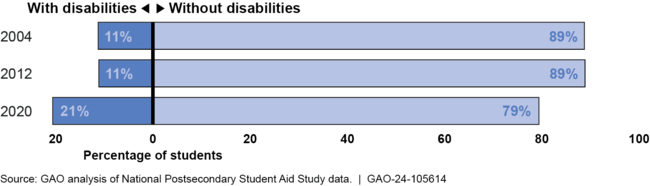
    The percentage of college students with disabilities has increased since 2004 according to GAO's analysis of Department of Education data (see figure). The increase is largely driven by more students reporting mental health conditions or attention deficit disorder. Students with disabilities graduated from college at lower rates than those without disabilities. Further, those with disabilities who did graduate were less likely to be employed full-time than peers without disabilities.

    Estimated Percentage of College Students by Disability Status, 2004–2020


    Note: “College students” includes undergraduates from postsecondary institutions of all types. Estimates are within a 1 percent margin of error.

    Students with disabilities face several challenges while transitioning to and attending college, according to college disability services staff and students GAO spoke with. For example, some students are unaware of or unprepared for the self-advocacy necessary to request accommodations without help from their parents, who can play a pivotal role in obtaining academic supports in high school. In addition, some students experience reluctance from faculty to provide accommodations. To help mitigate these challenges, college staff reported holding orientation sessions for students on how to request accommodations and training faculty on how to make their courses accessible, among other steps.

    Education has also taken steps to help address challenges faced by college students with disabilities. Education provides a range of supports including guidance, technical assistance, grants, and other resources. Education's priorities and federal standards highlight the need for prompt communication of guidance and other information affecting college students with disabilities. However, college staff GAO spoke with identified information gaps. For example:

  • Education has issued guidance materials on the importance of self-advocacy for students with disabilities in college, but this information may not reach students transitioning from high school. By encouraging state and local educational agencies to disseminate resources about the need for self-advocacy to assist students who wish to attend college, Education could help ensure that college students with disabilities are prepared to obtain needed accommodations.
  • Education does not provide notifications to college staff of newly issued guidance and other information about accommodations for students with disabilities, despite notifications on other topics. As a result, college staff report difficulties staying current on information that could help them support students with disabilities
  • .
  • ...
  • GAO is making two recommendations to Education to (1) encourage state and local educational agencies to disseminate resources about the importance of self-advocacy to obtain accommodations in college, and (2) enable college staff to receive notifications of newly issued guidance and other information about accommodations for postsecondary students with disabilities. Education generally agreed with GAO's recommendations.

Saturday, June 29, 2024

Disabilities and the End of Chevron Deference

Uncertainty and complexity are major themes of The Politics of Autism.

ASAN:

The Autistic Self Advocacy Network (ASAN) condemns the United States Supreme Court ruling on two combined cases, Loper Bright Enterprises v. Raimondo and Relentless v. Department of Commerce. The decision overturns a decades-old legal principle known as the Chevron Doctrine, which gives federal agencies the authority to reasonably interpret ambiguous laws when they create federal regulations. These regulations are made legally binding through a rulemaking process that is shaped by the public servants within federal agencies, the input of subject area experts across fields, and anyone who chooses to share their opinion. Instead, federal courts will now have the final say in circumstances where knowledge of highly specialized, complex, and technical issues is required. This ruling will weaken the regulatory authority of all federal agencies, including the Departments of Labor (DOL), Education (ED), Health and Human Services (HHS), the Social Security Administration (SSA), the Environmental Protection Agency (EPA), and the Food and Drug Administration (FDA).

...

This decision invites challenges to the forty years of legal precedents relying on Chevron. While these cases and the existing Code of Federal Regulations are not automatically overturned by Loper and Relentless, many will be challenged in the months and years to come. Future regulations are also under threat. Agencies may be less ambitious in fulfilling their mandates, protecting the public, and using taxpayers’ resources well in the face of increased risk that courts will undo their work. The endangered regulations include the Home and Community Based Services (HCBS) Settings Rule, the final rule implementing Section 504 of the Rehabilitation Act, the final rule implementing Title IX of the Education Amendments, and the final rule regarding section 1557 of the Affordable Care Act (ACA).


Thursday, June 27, 2024

Special Education After COVID

  In The Politics of Autism, I write about special education and the Individuals with Disabilities Education Act. II also discuss the day-to-day challenges facing autistic people and their families. Those challenges get far more intense during disasters.  And coronavirus proved to be the biggest disaster of all. 

Sara Randazzo  and  Matt Barnum at WSJ:

More American children than ever are qualifying for special education, but schools are struggling to find enough teachers to meet their needs.

A record 7.5 million students accessed special-education services in U.S. schools as of 2022-2023, including children with autism, speech impairments and attention-deficit hyperactivity disorder. That is 15.2% of the public-school student population, up from less than 13% a decade earlier, the most recent federal data shows.

Several factors are driving the increase. Pandemic disruptions left kids with lingering learning and behavioral challenges. Parents have become more assertive about asking for services, as the stigma around special education has lessened. Autism diagnoses have also risen in recent decades, and the state of Texas has seen a boom in special education after changing an approach that had limited access.

...

Since students returned to school, special-education teachers say they are seeing more mental-health issues and extreme behaviors, including students hitting staff, making lewd remarks and throwing furniture. Having the right support, like an aide to help a student calm down when they get stressed, can alleviate the behaviors.
“Traditionally there have been a lot of kids who were able to skate by and maintain at a level where they didn’t get flagged,” said Katy Chaffin, a special-education teacher in San Diego. “When you take years of school closure, for those kids, they’ve fallen so much farther behind.”

...

The 1970s-era federal law that created the special education system authorizes federal funding for up to 40% of the costs to provide the services, but the federal contribution has always fallen far short of that. Adjusted for inflation, regular federal funding for the law has fallen since 2010, according to figures compiled by the U.S. Department of Education.

A separate legal avenue for children with disabilities is a 504 plan, which guarantees school accommodations like extra time on tests. The share of students receiving a 504 has risen from 1% in school year 2009-2010 to 3.3% in 2020-2021, according to an analysis of federal data by Perry Zirkel, an education law researcher.

Thursday, May 2, 2024

New Rule on Health Discrimination

In The Politics of Autism, I discuss the day-to-day challenges facing autistic people and their families. 
People with autism and other disabilities have faced discrimination in organ transplants.  During the pandemic, they faced discrimination in the availability of ventilators.  And along with other people with disabilities, they reportedly encounter discrimination in health care more generally.

From HHS:

Today, the U.S. Department of Health and Human Services (HHS), through its Office for Civil Rights (OCR), finalized a rule that prohibits discrimination on the basis of disability. This rule, titled Discrimination on the Basis of Disability in Health and Human Service Programs or Activities, advances equity and bolsters protections for people with disabilities under Section 504 of the Rehabilitation Act (Section 504). This important Final Rule is HHS’s latest action in furtherance of Executive Order 14091, entitled Further Advancing Racial Equity and Support for Underserved Communities Through the Federal Government.

...
Section 504 prohibits discrimination on the basis of disability in programs and activities that receive funding from HHS. Since the law was enacted, major legislative and judicial developments have shifted the legal landscape of disability discrimination under Section 504.

HHS has updated the regulations to clarify obligations in several critical areas. Specifically, the rule:
  • Ensures that medical treatment decisions are not based on negative biases or stereotypes about individuals with disabilities, judgments that an individual with a disability will be a burden on others, or dehumanizing beliefs that the life of an individual with a disability has less value than the life of a person without a disability.
  • Prohibits the use of any measure, assessment, or tool that discounts the value of a life extension on the basis of disability to deny, limit, or otherwise condition access to an aid, benefit or service.
  • Defines what accessibility means for websites and mobile applications and sets forth a specific technical standard to ensure that health care and human service activities delivered through these platforms are readily accessible to and usable by individuals with disabilities.
  • Adopts the U.S. Access Board’s standards for accessible medical diagnostic equipment, like exam tables and mammography machines.
  • Details requirements to ensure nondiscrimination in the services provided by HHS-funded child welfare agencies, including, but not limited to, reasonable efforts to prevent foster care placement, parent-child visitation, reunification services, child placement, parenting skills programs, and in- and out-of-home services.
  • Clarifies obligations to provide services in the most integrated setting, like receiving services in one's own home, appropriate to the needs of individuals with disabilities.
Additionally, the Final Rule updates existing requirements to make them consistent with the American with Disabilities Act (ADA), as many HHS recipients are also covered by the ADA this consistency will improve and simplify compliance.

This rule takes effect 60 days after publication. The current rule remains in effect until that time. If you believe that you or another party has been discriminated against on the basis of race, color, national origin, sex, age, or disability, visit the OCR complaint portal to file a complaint online at: https://www.hhs.gov/ocr/complaints/index.html

The final rule may be viewed or downloaded at: https://www.federalregister.gov/public-inspection/2024-09237/nondiscrimination-on-the-basis-of-disability-in-programs-or-activities-receiving-federal-financial

A fact sheet on the rule is available here: https://www.hhs.gov/civil-rights/for-individuals/disability/section-504-rehabilitation-act-of-1973/part-84-final-rule-fact-sheet/index.html

Thursday, February 1, 2024

Autistic School Board Member's Lawsuit

In The Politics of Autism, I write:  "Support from the general public will be an important political asset for autistic people. Another will be their sheer numbers, since a larger population of identified autistic adults will mean more autistic voters and activists."  Previous posts have discussed autistic officeholders and political candidates in California,  New York, Georgia, Texas, and Wisconsin.

Claire Fahy at NYT:
When Sarah Hernandez joined the Enfield, Conn., Board of Education in 2017, she had a goal: making sure schools met the needs of students with disabilities. Among the first openly autistic candidates to be elected to public office in the country, she saw her win as a sign that her small town was open to her perspective.

But if voters were, her colleagues on the school board were not: They consistently denied her the accommodations she needed to do her job, according to a discrimination lawsuit she filed against the school board and the town of Enfield, which is 20 miles north of Hartford. The accommodations she asked for — both because of her autism and because she is hard of hearing — included asking board members to communicate by text or email instead of by phone and to face her while speaking to her.

The court battle over the lawsuit, which accused the board and the town of violating the Americans with Disabilities Act and the Rehabilitation Act of 1973, lasted more than four years. Last month, a jury sided with Ms. Hernandez and awarded her damages.

The amount? $10.

The nominal damages were a result of a 2022 Supreme Court decision, according to Stewart J. Schwab, a professor of employment and labor law at Cornell University. In the case, Cummings v. Premier Rehab Keller, the court ruled that people suing under the Rehabilitation Act, which prohibits organizations that receive federal funds from discriminating against people with disabilities, could not be awarded damages for emotional distress.

...

Witnesses testified in court that Ms. Hernandez looked like she could participate in her board duties without accommodations, according to Ms. Hernandez’s lawyer, Anthony May.

Misperceptions like these are why autism is considered an “invisible disability,” according to Simon Baron-Cohen, the director of the Autism Research Center at Cambridge University.

Autistic people may be “having a lot of stress under the surface, or confusion or overwhelm, but to the outside, to other people, they seem like they’re just the same as everybody else,” Mr. Baron-Cohen said. “So there’s a change in attitude that’s needed.”