Search This Blog

Showing posts with label Canada. Show all posts

Sunday, January 4, 2026

US Exports Misinformation to Canada

In The Politics of Autism, I analyze the myth that vaccines cause autism. This bogus idea can hurt people by allowing diseases to spread   Examples include measlesCOVID, flu, and polio.  A top antivaxxer is HHS Secretary RFK JrHe is part of the "Disinformation Dozen." He helped cause a deadly 2019 measles outbreak in Samoa.

Olivia Bowden at The Guardian:

Canadian officials and public health experts are warning that US health and science institutions can no longer be depended upon for accurate information, particularly when it comes to vaccinations, amid fears that misinformation from the Trump administration could further erode Canadians’ confidence in healthcare.

“I can’t imagine a world in which this misinformation doesn’t creep into Canadians’ consciousness and leads to doubt,” said Dawn Bowdish, an immunologist and professor at McMaster University in Ontario.

Those fears have emerged as the US health secretary, Robert F Kennedy Jr, has forwarded an anti-vaccine agenda. In December, a panel appointed by Kennedy voted to remove a longstanding recommendation by the US Centers for Disease Control and Prevention (CDC) that all newborns be vaccinated against hepatitis B.
The CDC also updated its website in November at the instruction of Kennedy to claim that “studies have not ruled out the possibility that infant vaccines cause autism”, which top public health experts have decried as false.

The agency’s move toward misinformation and away from public health leadership makes it more difficult to combat distrust in vaccinations in Canada, says Bowdish.

...

A December poll on vaccination hesitancy by research firm Leger Healthcare found that while most Canadians (74%) have confidence in vaccines, hesitancy has increased primarily due to fears around safety driven by social media and government mistrust.

The survey also found that 17% of those who expressed a lack of confidence in vaccines say they get their information from US government websites.


Tuesday, November 4, 2025

The US and Canada Will Likely Lose Measles Elimination Status

In The Politics of Autism, I analyze the myth that vaccines cause autism. This bogus idea can hurt people by allowing diseases to spread   Examples include measlesCOVID, flu, and polio.  A top antivaxxer is HHS Secretary RFK JrHe is part of the "Disinformation Dozen." He helped cause a deadly 2019 measles outbreak in Samoa.

Stephanie Pappas at Scientific American:

If current trends continue, North America could soon become a hotspot for permanent measles transmission. Canada could lose its measles-free designation this week, and the U.S. may not be far behind.

A key measles and rubella committee of the Pan American Health Organization (PAHO) will meet this week to discuss whether North American countries have lost their measles elimination status, meaning the measles virus has become endemic in those nations. A country is considered to have endemic measles if there has been uninterrupted transmission from a single outbreak of the virus that has lasted 12 months or longer.

Canada has likely already passed that milestone; the country has seen a single outbreak of more than 5,100 measles cases since October 2024, according to its health data. The U.S. is also on shaky ground. A 762-case outbreak in West Texas that started in late January 2025 was declared over on August 18. But health officials are investigating ongoing outbreaks in South Carolina and Utah. If the investigation can link those outbreaks to the original cases in Texas, and if health authorities can’t bring them under control before January 2026, the U.S. may lose its measles elimination status as well.
“I expect we will lose our elimination status,” says David Higgins, a professor of pediatrics at the University of Colorado School of Medicine. “We are marching right toward that.”


Sunday, October 26, 2025

TikTok: A Vector for Dangerous Misinformation

 In The Politics of Autism, I examine the role of social media in the development of the issue

Dexter McMillan at CBC Marketplace:
Marketplace journalists analyzed 100 videos discussing cancer treatments and another 100 for autism therapies. We found that at least 80 per cent of the remedies in the videos — totalling more than 75 million views — weren’t supported by scientific evidence.
...
Marketplace searched TikTok for cancer videos using the search terms "cancer cure" and "cancer treatment," and for autism videos using the terms "autism cure," "autism treatment" and "autism." Starting with the most viewed, we chose 100 each that featured a treatment or cure.
...
Marketplace journalists also found treatments our experts identified as dangerous among the 100 videos on autism.

One video with 760,000 views claimed that chelation therapy — typically used to treat heavy metal poisoning — can improve communication and behaviour in children with autism.

The medical procedure involves using an IV to administer chemicals that bind heavy metals in the body and eliminate them. The video claimed that removing these heavy metals improves autism symptoms.

In addition to this claim being unsupported by science, the treatment can be dangerous, said Dr. Melanie Penner, a pediatrician and autism researcher in Toronto.

...

Stem cell therapies for autism were featured in at least 14 videos reviewed by Marketplace, racking up 3.2 million views altogether. It involves infusing stem cells into the body using an IV.
...
Penner said the research doesn't support that. Meanwhile, these treatments can have serious complications.

Saturday, December 16, 2023

Using VR to Raise Autism Awareness

In The Politics of Autism, I write about the everyday struggles facing autistic people and their families, including prejudice.

Ioulia Koniou, Elise Douard & Marc J. Lanovaz, "Brief Report: Virtual Reality to Raise Awareness About Autism," Journal of Autism and Developmental Disorders.  Abstract

Purpose

The purpose of the study was to develop and test a virtual reality application designed to put the participants “in the shoes” of an autistic person during a routine task.

Method

The study involved a randomized controlled trial that included 103 participants recruited from a technical college. Each participant responded to three questionnaires to measure attitudes, knowledge, and openness toward autism. Prior to responding to these questionnaires, the participants in the experimental group also completed an 8-min virtual reality simulation designed by the research team in collaboration with autistic individuals.

Results

The participants who completed the virtual reality simulation reported better attitudes, more knowledge, and higher openness toward autism than the participants in the control group.

Conclusion

The results of the study suggest that virtual reality simulations are promising tools to raise awareness about autism.

... 
The results of our study indicate that the VR simulation positively influenced the attitudes, knowledge, and openness of the participants toward autism. These results are consistent with those of prior studies that have used VR to raise awareness about other neurodivergences (Formosa et al., 2018; Tassinari et al., 2022; Yuen & Mak, 2021). A strength of our study is that autistic individuals were involved in the design of the tasks and content included in the virtual reality application. This inclusion may have improved the social validity of the autistic simulation that our participants experienced. One mechanism that may explain the observed changes is that being placed in the shoes of the autistic person may allow the user to develop more empathy toward people with different needs (Lara & Rueda, 2021). That is, prior research had shown that VR perspective-taking experiences may promote prosocial behavior toward people that we consider different (Herrera et al., 2018). Moreover, the informational video embedded within the VR application may have improved knowledge by providing more details and nuance about the condition, which in turn influenced attitudes and openness toward autism in a positive way (Kuzminski et al., 2019; Nevill & White, 2011; Park et al., 2010).

One challenge of using VR to raise awareness is that access to head-mounted devices remains limited in the general population. For this reason, the VR application targets large organizations that train staff to work with autistic individuals or who service this population. For example, universities could use the application to train future professionals (e.g., occupational therapists, behavior analysts), health centers and hospitals could adopt the simulation to raise awareness among their personnel who have contact with autistic individuals (e.g., administrative assistants, nurses), and employers who integrate autistic individuals could raise awareness among managers and co-workers. Albeit promising, VR simulations may not be suitable for everyone. Some parts of the population (e.g., older adults) may experience challenges in moving around in the VR environment, especially if they have never used a joystick in the past.

...

Future research should adopt a longitudinal design to track whether these positive outcomes persist. Our virtual reality application simulated a single example of how an autistic person may experience a specific event, going to the dentist. Given the heterogeneity of autistic individuals, future simulations should present a broader range of experiences to prevent the development of stereotypical perceptions. Furthermore, researchers should examine more concrete manifestations of stigmatization (e.g., real-life observations) and the ability of VR to reduce them. Opportunities for social contact and behavioral observations can capture a more natural response and realistic desire for social distance or avoidance, as opposed to self-report scales. Overall, we propose that future research in this area continue to include more individuals to create a sample representative of the population observed over a longer period of time.

Thursday, December 7, 2023

Canadian Antivaxxers

 In The Politics of Autism, I analyze the discredited notion that vaccines cause autism. This bogus idea can hurt people by allowing diseases to spread  And among those diseases could be COVID-19.

Antivaxxers are sometimes violent, often abusive, and always wrong.

Out of sight of most mainstream media, the anti-vaccine crowd, once considered a fringe element in Canadian society, has become major player in opposing vaccine mandates and government intervention, in spreading misinformation and conspiracy theories and raising money for conservative politicians.

They have also tapped into the despair of many Canadians impacted by sky-high mortgage rates, rising food prices and a general feeling that politicians don’t really care about their welfare.

In short, the anti-vax movement has evolved into a potent political force.

They’ve done it by becoming good at spreading their voices on Facebook, TikTok, Instagram and other social media sites, convincing more and more parents against immunizing their children.
And their impact is obvious — COVID-19 vaccine rates are falling and there’s a small, but growing hesitancy to get children vaccinated against diseases such as smallpox, polio and measles. In Ontario, the latest figures indicate that so far this year only 13 per cent of the 1.8 million eligible residents and barely 40 per cent of seniors have received the updated COVID-19 vaccine.

 ...

I’ve given up on the notion that facts will change an anti-vaxxer’s mind.

Instead, governments, health agencies and professional groups must take the lead in an all-out battle against anti-vaxxer propaganda and misinformation with renewed, strong public health messaging.

It was Peter Hotez, dean of the National School of Tropical Medicine at Baylor College of Medicine in Texas, who warned about “the bad guys,” cautioning that they “are winning, in part because health agencies either underestimate or deny the reach of anti-science forces and are ill-equipped to counter it.”
It’s a warning Canadians as well as American must take to heart because if we don’t take it seriously then the anti-vax movement will recruit more people, its base will expand and public confidence in vaccines will erode more than it has already.

Thursday, August 10, 2023

Autism, Self-Harm, and Co-Occurring Psychiatric Diagnoses

In The Politics of Autism, I write about the many challenges facing people on the spectrum.  Among many other things, they are at high risk for suicide. (In July, the United States transitioned from 10-digit National Suicide Prevention Lifeline to 988 – an easy-to-remember three-digit number for 24/7 crisis care. "

Meng-Chuan Lai et al., "Self-Harm Events and Suicide Deaths Among Autistic Individuals in Ontario, Canada," JAMA Netw Open. 2023;6(8):e2327415. doi:10.1001/jamanetworkopen.2023.27415

Key Points

Question What are the sex-stratified rates of self-harm events and suicide death among autistic individuals vs nonautistic individuals and the associated sociodemographic and clinical risk factors?

Findings In this cohort study including 379 630 individuals regarding self-harm findings and 334 690 individuals regarding suicide death findings in Ontario, Canada, autistic females had an 83% increased risk and autistic males had a 47% increased risk of self-harm compared with nonautistic individuals, when accounting for neighborhood income and rurality, intellectual disabilities, and psychiatric diagnoses. The crude hazard ratio showed that autistic females had a 98% increased risk and autistic males had a 34% increased risk of suicide death, but these increases were associated with psychiatric diagnoses.

Meaning This study suggests that psychiatric diagnoses were significantly associated with risks of self-harm and especially suicide among autistic females and males.

Sunday, January 1, 2023

Justin Trudeau on Antivaxxers

 In The Politics of Autism, I analyze the discredited notion that vaccines cause autism. This bogus idea can hurt people by allowing diseases to spread  And among those diseases could be COVID-19.


Rachel Aiello at CTV:
So the tinfoil hats comment, you don't regret?

"When someone believes that your government is trying to inject a vaccine in you to control your mind and track you, and there's a microchip in it, that's almost the definition of a government conspiracy theory that you wear a tinfoil hat to protect your brain from brainwaves. It's a frame that when people fall into conspiracy theories, we need to call them out on that," was Prime Minister Justin Trudeau's response.

This was one of the highlights from Chief News Anchor and Senior Editor of CTV National News Omar Sachedina's year-end interview with Trudeau, which aired Saturday evening.

Sachedina was referring to the prime minister stating amid the "Freedom Convoy" protests that if those in "tinfoil hats" choose to reject science, they have to live with the consequences of their choice.

Asked if Trudeau felt he did everything he could to lower the temperature at the time, the prime minister revealed that he was unrepentant for his comments towards anti-vaxxers.

"I don't, and I won't apologize for calling out people who were harming their fellow Canadians," he said.
...
He pointed to examples of families sitting around the bedside of a loved one who was dying from COVID-19 "saying: 'oh my God, I wish you'd just taken the vaccine, I wish you hadn't listened to all those YouTube channels.'"

"Like this is real. There were real tragedies and there were people trying to gin that up and to expand the divisions, and the fear, and sense of conspiracy that were out there," Trudeau said.

Sunday, December 5, 2021

Magic Dirt: The Latest Quack Cure

Autism parents are highly vulnerable to pitches for quack "cures."

In The Politics of Autism, I write:

The conventional wisdom is that any kind of treatment is likely to be less effective as the child gets older, so parents of autistic children usually believe that they are working against the clock. They will not be satisfied with the ambiguities surrounding ABA, nor will they want to wait for some future research finding that might slightly increase its effectiveness. They want results now. Because there are no scientifically-validated drugs for the core symptoms of autism, they look outside the boundaries of mainstream medicine and FDA approval. Studies have found that anywhere from 28 to 54 percent of autistic children receive “complementary and alternative medicine” (CAM), and these numbers probably understate CAM usage.

 Brandy Zadrozny at NBC:

Black Oxygen Organics, or “BOO” for short, is difficult to classify. It was marketed as fulvic acid, a compound derived from decayed plants, that was dug up from an Ontario peat bog. The website of the Canadian company that sold it billed it as “the end product and smallest particle of the decomposition of ancient, organic matter.”Put more simply, the product is dirt — four-and-a-half ounces of it, sealed in a sleek black plastic baggie and sold for $110 plus shipping. Visitors to the Black Oxygen Organics website, recently taken offline, were greeted with a pair of white hands cradling cups of dirt like an offering. “A gift from the Ground,” it reads. “Drink it. Wear it. Bathe in it.”
...
Testimonials like these make up the majority of posts in dozens of Facebook groups, set up and overseen by BOO sellers, with hundreds of thousands of collective members, where BOO is heralded as a miracle drug. Teams of sellers in these private Facebook groups claim that, beyond cosmetic applications, BOO can cure everything from autism to cancer to Alzheimer’s disease. Conveniently in these times, BOO proponents say it also protects against and treats Covid-19, and can be used to “detox” the newly vaccinated, according to posts viewed by NBC News.
...

Ceara Manchester, a stay-at-home mother in Pompano Beach, Florida, helps run one of the largest anti-BOO Facebook groups, “Boo is Woo.” Manchester, 34, has spent the last four years monitoring predatory MLMs — or “cults,” in her view — and posting to multiple social media accounts and groups dedicated to “exposing” Black Oxygen Organics.

“The health claims, I had never seen them that bad,” Manchester said. “Just the sheer amount. Every single post was like, ‘cancer, Covid, diabetes, autism.’”

“I don’t feel like people are stupid,” Manchester said of the people who purchased and even sold BOO. “I think that they’re desperate or vulnerable, or they’ve been preyed upon, and you get somebody to say, ‘Hey, I’ve got this product that cures everything.’ You know when you’re desperate like that you might listen.”

Tuesday, September 14, 2021

Antivax Movement Starts to Infect Canada


In The Politics of Autism, I analyze the discredited notion that vaccines cause autism. This bogus idea can hurt people by allowing diseases to spread  And among those diseases could be COVID-19.

Antivaxxers are sometimes violent, often abusive, and always wrong.  

 Dr. Peter Hotez at Global News:

Well, it has finally happened. News this week of widespread and disruptive anti-vaccine protests at Canadian medical centres means that America’s destructive, self-defeating and totally nonsensical anti-vaccine movement has begun crossing the border.


As a pediatrician, vaccine-scientist and parent of an adult daughter with autism and intellectual disabilities, I have had a front-row seat to America’s anti-vaccine movement for the last two decades. I’m also a lead target, and sometimes known as the ‘OG Villain’ for writing the book, Vaccines Did Not Cause Rachel’s Autism a few years back.
...
Today, the anti-vaccine movement has three major drivers. One of them is anti-science aggression from the far-right, as highlighted above. However, there are also at least a dozen non-governmental groups identified by the Centre for Countering Digital Hate as responsible for approximately two-thirds of the anti-vaccine disinformation in America.

The third is Russian propaganda, which promotes anti-vaccine disinformation as a means to destabilize the U.S. and other democratic countries, possibly including Canada.


Thursday, March 4, 2021

"Violent Traits Have No Connection to Autism"

There is no evidence linking autism to planned violence, but in recent years, mass shootings by young men have led commentators in the mainstream media and on the Internet to suggest such a connection. After the 2007 Virginia Tech massacre, for instance, news reports said that the shooter was on the spectrum. The speculation made little sense to anyone who understood autism. Whereas autistic people have language delays and deficits, the killer had learned English as a second language — and learned it well enough to major in the subject in college. Later on, it turned out that he had an entirely different problem, a social anxiety disorder. Adam Lanza, who committed the Sandy Hook massacre in 2012, may have had an Asperger’s diagnosis, but his father emphasized that his behavior stemmed from the psychiatric illnesses that he also had. Nevertheless, the media speculated about Lanza’s place on the spectrum, which worried autism parents. One mother of an autistic child wrote: “This is the first time I'm truly afraid for him. Afraid of what may happen to my son with autism at the hands of a stranger; a stranger who has chosen to buy into the media-fueled misinformation that individuals diagnosed with an Autism Spectrum Disorder are dangerous and capable of horrendous acts of terror and violence.”

Catherine Porter at NYT:

The man who used his rental van as a weapon on a busy Toronto sidewalk in 2018, killing 10 people and badly injuring 16 in the city’s worst mass killing, was found guilty of murder and attempted murder by an Ontario judge on Wednesday.

Rejecting the novel argument that his autism spectrum disorder rendered him not criminally responsible, Justice Anne Molloy of the Ontario Superior Court ruled that the defendant, Alek Minassian, understood clearly what he was doing, despite the conclusion of some experts that he was incapable of feeling empathy because of his neurodevelopmental disorder.

  From the Ontario Autism Coalition:

The Ontario Autism Coalition is relieved that Alek Minassian has been found guilty for his crimes, and hopes that families impacted by the 2018 van attack will find at least a small sense of comfort from the verdict. We hope that this decision can now lift the dark cloud that has hung over this trial, with a firm rejection of the use of autism as a defence in this case.
Violent traits have no connection to autism; in fact, people on the autism spectrum are far more likely to be victims as opposed to perpetrators of violence. The court’s decision makes it clear this was never a case of autism causing mass murder, but rather a case where someone who committed mass murder happened to have autism. An autism diagnosis does not predispose one to commit acts of violence.
Individuals with autism are our neighbours, coworkers, and friends. Today’s verdict offers hope that our community can move forward despite the arguments of one defense attorney that autism is a valid defense for one of the most violent, abhorrent acts carried out against so many innocent people.
Angela Brandt, President of the Ontario Autism Coalition (OAC) mentions “there is nothing inherently violent about autism. Mentally healthy people, autistic or not, do not commit acts of violence. I hope Alek Minassian gets the help he requires”.
Nothing about the actions of Minassian are representative of those with autism and the verdict today emphasizes the distance between Minassian’s heinous acts and the autism community as a whole. Alek Minassian was an individual with autism who committed a crime. Other individuals with autism should not be measured by Minassian’s actions.

Monday, August 3, 2020

Autism and Juvenile Justice

In The Politics of Autism, I discuss the neurodiversity movement.    I also note that we ought to have more comparative studies of autism politics and policy.

I read this book in manuscript.  It is a terrific and much-needed contribution to the field.

A release from Washington State:
Amid ongoing discussions of criminal justice reform, a Washington State University professor argues in a new book that now is the time to focus on better serving children and teens on the autism spectrum who become entwined in the juvenile justice system.
Youth on the spectrum need greater access to mental health support staff who can provide counseling and act as advocates, writes Laurie Drapela, an associate professor of criminal justice at WSU Vancouver, and author of “Law and Neurodiversity – Youth with autism and the juvenile justice systems in Canada and the United States.
Drapela and co-authors Dana Lee Baker from California State University and Whiney Littlefield, a juvenile probation counselor in Washington’s Cowlitz County, think more training is necessary for police and corrections officers to help them better recognize the signs of autism. Significant effort also must be put into transitioning from a punitive response to the behaviors of children and teens with autism to identifying sources of community support for youth that often struggle with communication and social interaction.
By taking these steps, the juvenile justice system could improve at its stated goal: Reducing the likelihood of a child or teen taking part in criminal behavior as an adult.
“There is a real opportunity to start broadening how individuals involved in the juvenile justice system work with people on the autism spectrum who come to the attention of law enforcement,” Drapela said.
Baker, a former WSU faculty member, said she and Drapela saw the topic as understudied when approached by their publisher in 2016. A prior observation of a juvenile court procedure originally sparked her interest in researching how these systems fail youth on the autism spectrum.
“While observing a juvenile court hearing, I saw a child who clearly had autism bowing to the judge and people in the courtroom were laughing,” Baker recalled. “I was so struck by that moment. We can and should do better.”
One of their goals with the new book is to bridge the divide between researchers and juvenile justice practitioners. Demonstrating that punitive-centric systems fail children and teens with autism is central to that effort, Drapela said. It’s also vital that police officers and court officials better recognize signs that a child or teen they come into contact with is autistic and requires mental health support.
Children and teens of color on the autism spectrum face additional hurdles because popular frames of reference for autism, such as Dustin Hoffman’s character in “Rain Man,” are largely portrayed by white actors. It’s possible that police or corrections officers may miss cues that a youth of color is autistic because of this, among other factors, Drapela said.
One in 54 children in the United States is diagnosed with autism spectrum disorder, according to CDC data from 2016. Boys are four times more likely than girls to be diagnosed with autism. In Canada, the most recent prevalence rate is one in 66, per the country’s National Autism Spectrum Disorder Surveillance System.
Drapela and her coauthors focused on the history of juvenile justice systems in the two countries, finding that Canada does a better job of implementing social programs for youth with autism and connecting community stakeholders and social service agencies.
“One thing that really differentiates the United States is its very pointed interest on being harsh and using punitive measures,” Drapela said. “It pervades our culture.”
In tandem with reducing the use of punitive measures, Drapela argues the United States needs to reinvest in social support efforts.
“So much of what police engage with now are people with mental health issues, addiction problems, people who are poor or homeless, who would be better served by specialized social service workers,” Drapela said. “There are people who need jail cells, but in expanding the scope of the criminal justice system and shrinking the scope of our social assistance system, we’ve done a disservice to vulnerable populations.”
Additional resources in schools for students on the spectrum is also critical, as is additional training for school resource officers, Baker said.
“Behaviors exhibited by students on the spectrum may not be as different as behaviors in the environment at-large, yet they can be observed as criminal because of the lens being used,” she said.

Saturday, May 23, 2020

Law and Neurodiversity

In The Politics of Autism, I discuss the neurodiversity movement.    I also note that we ought to have more comparative studies of autism politics and policy.

I read this book in manuscript.  It is a terrific and much-needed contribution to the field.

From the University of British Columbia Press:
Law and Neurodiversity: Youth with Autism and the Juvenile Justice Systems in Canada and the United States
By Dana Lee Baker, Laurie A. Drapela, and Whitney Littlefield


As social perceptions of diversity become more nuanced, awareness of the prevalence of autism has grown. But how do we accommodate natural human neurodiversity within the juvenile justice system? And what are the consequences for young people?
Law and Neurodiversity offers invaluable guidance on how autism research can inform and improve juvenile justice policies in Canada and the United States. Both countries rely on decentralized systems of governance to craft and implement law and policy, but their treatment of detained youth with autism differs substantively. This perceptive book examines the history of institutionalization, the evolution of disability rights, and advances in juvenile justice that explicitly incorporate considerations of neurological difference into court practice. In Canada, the diversion of delinquent autistic youth away from formal processing has fostered community-based strategies for them under state authority in its place. US policies rely more heavily on formal responses, often employing detention in juvenile custody facilities. These differing approaches profoundly affect how crucial services such as education are delivered to youth on the autism spectrum.
Building on a rigorous exploration of how assessment tools, rehabilitation programs, and community re-entry plans differ between the two countries, Law and Neurodiversity offers a much-needed comparative analysis of autism and juvenile justice policies on both sides of the forty-ninth parallel.

Scholars and students of socio-legal studies, criminology, and disability studies will find this book essential reading, as will policy analysts and policymakers in juvenile justice and frontline workers working with autistic youth in the justice system.

Saturday, January 18, 2020

Testing Balovaptan

In The Politics of Autism, I discuss treatments, including medication.

At City News in Toronto, Faiza Amin reports:
Drug manufacturer Hoffmann-La Roche has commissioned an international research study for Balovaptan, a drug that could potentially help people on the spectrum manage everyday social and communication challenges better.
“It’s regulating hormones in our brain that have to do with how we perceive the social world, whether we understand social cues, how we relate to other people, and how we develop close bonds and relationships,” said Dr. Evdokia Anagnostou, the study’s lead researcher at Toronto’s Holland-Bloorview Kids Rehabilitation Hospital.
...
The Autism community remains divided on the drug, as one disability rights group in Ontario has raised concerns around whether or not the pill is ethical.
Autistics 4 Autistics Ontario (A4A) is a self-advocacy group for adults with autism, calling for reform to autism funding and services at the federal and provincial levels. Anne Borden, a member of the province’s A4A executive board, tells CityNews the organization opposes the drug and the research, saying it could prey upon people’s hopes and dreams.
“Who is this benefiting?” Borden asks. “This kind of research represents a very old way of approaching autism, looking at autistic people like they’re a problem to be solved or sort of a broken version of normal, rather than taking a position of acceptance.”
Borden said developing a pill for this purpose speaks to the dignity of people with autism, and can negatively affect how they are treated and perceived. She called this a “profit-generating” pill that may put “people from a vulnerable population” at risk, adding that there are ethical questions rooted in its very existence.
“There’s a deep psychological impact when all the people in your life are constantly trying to fix you for who you are and, in this case, gives you a pill to make you act differently,” Borden said.
“It’s not looking at communication as a two-way street. Whereas other ideas like inclusion, accessibility, communication, dialogue, and research into the access needs of autistic people will do that.”

Wednesday, October 16, 2019

International Data on Autism Research


From the Interagency Autism Coordinating Committee (IACC):
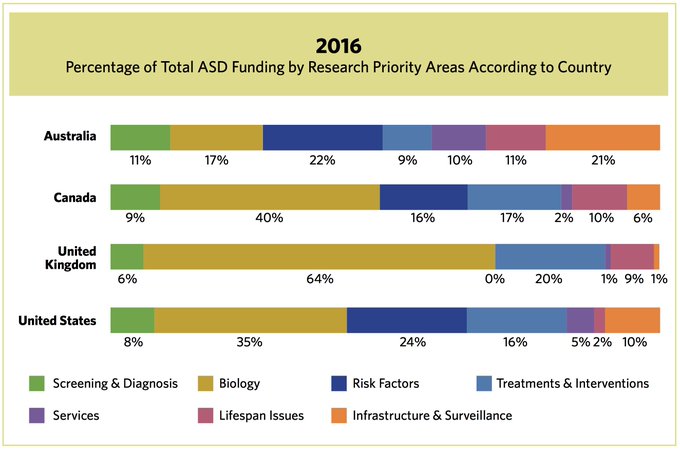
Over the past nine years in the United States (U.S.), the Office of Autism Research Coordination (OARC) at the National Institutes of Health (NIH) has published an annual report describing and analyzing the autism spectrum disorder (ASD) research portfolio across multiple government and non-government funders in the U.S. The report provides comprehensive information about autism research funding to the Interagency Autism Coordinating Committee (IACC), a U.S. federal advisory body, to help in its efforts to monitor ASD research efforts and trends. For the first time, a similar approach has been used to analyze ASD research across four countries – the United States, the United Kingdom, Canada, and Australia – to better understand the global ASD research funding landscape.
From the 
  • Screening and Diagnosis: Each of the four countries has similar proportions in funding in screening and diagnosis, with nearly a tenth of each country’s funding going towards this research area.
  • Biology of ASD: For the U.K., U.S., and Canada, biology was the greatest area of investment. For Australia, biology received a significant investment, although it was not its most well-funded research area.
  • Risk Factors: Research into identifying risk factors was the largest funded area in Australia, the second largest funded area in the U.S. and the third largest funded area in Canada. The U.K. did not fund research for risk factors in 2016.
  • Treatments and Interventions: Across all four countries, treatments and interventions saw considerable portions of funding.
  • Services: Services research had varying degrees of investment. Australia had the largest proportion of investment in services research among the four countries. For the U.K. and Canada, it was the least funded area of research.
  • Lifespan Issues: Research on lifespan issues received a similar proportion of funding in Australia, Canada, and the U.K., whereas it was the least funded area of research in the U.S.
  • Infrastructure and Surveillance: There were also differences in infrastructure and surveillance investment among the four countries. It was the second largest funded area in Australia and had a significant portion of funding in the U.S., however it was a small portion of funding for Canada and the U.K. in 2016.

Image

Sunday, October 14, 2018

Autism in a Canadian Municipal Election

In The Politics of Autism, I discuss the need for more research on autism in countries other than the United States.

Surrey First is a political organization in Surrey, British Columbia, Canada. In the campaign for the October 20 election, it is putting emphasis on autism.  A release:
Surrey First mayoral candidate Tom Gill wants to expand his city’s efforts to make sure Surrey’s 1,600 children with Autism Spectrum Disorder (ASD) feel at home in Surrey’s parks, pools, rinks and community centres. This summer, Surrey introduced “Sensory Friendly Spaces” at public events and has provided training to 100 of its recreational centre staff.

“I want Surrey to lead the country in inclusivity, particularly for our children,” said Gill. “Here in Surrey we’ve made a terrific start, but I want to take it further faster. Our Surrey First team wants to see another 500 of our parks, rec and library staff trained by June of next year, offer training to the more than 3,500 soccer, baseball, hockey and football coaches in our city, and pilot a Snoezelen sensory room in our new Clayton Community Centre which is under construction and set to open in summer 2020.”

Developed in Holland nearly 40 years ago, the Snoezelen (“explore and relax”) sensory rooms use sound, light, colour and texture to provide a multi-sensory experience for children with autism. Gill said he wants the pilot room to be a template for other Snoezelen rooms.

Gill said he wants to work with organizations such as the Canucks Autism Network and Pacific Autism Family Network to become a “champion for inclusion” that ensures children with autism and their families feel welcome and included.

Wednesday, April 25, 2018

Violence and Autism

In The Politics of Autism, I write:
There is no evidence linking autism to planned violence, but in recent years, mass shootings by young men have led commentators in the mainstream media and on the Internet to suggest such a connection. After the 2007 Virginia Tech massacre, for instance, news reports said that the shooter was on the spectrum. The speculation made little sense to anyone who understood autism. Whereas autistic people have language delays and deficits, the killer had learned English as a second language — and learned it well enough to major in the subject in college. Later on, it turned out that he had an entirely different problem, a social anxiety disorder. Adam Lanza, who committed the Sandy Hook massacre in 2012, may have had an Asperger’s diagnosis, but his father emphasized that his behavior stemmed from the psychiatric illnesses that he also had. Nevertheless, the media speculated about Lanza’s place on the spectrum, which worried autism parents. One mother of an autistic child wrote: “This is the first time I'm truly afraid for him. Afraid of what may happen to my son with autism at the hands of a stranger; a stranger who has chosen to buy into the media-fueled misinformation that individuals diagnosed with an Autism Spectrum Disorder are dangerous and capable of horrendous acts of terror and violence.”
Reports the man connected to Monday’s van rampage on Yonge St. may suffer from Asperger syndrome, have shaken advocates in Ontario’s autism community.
Asperger syndrome has been associated with autism spectrum disorder, a complex neuro-biological disorder that affects the ability to verbalize thoughts, manage anxiety, cope with changes to routine and participate in unstructured social situations. Symptoms also include repetitive behaviours and fixations.
But violent behaviour is not typically associated with the disorder, said Margaret Spoelstra executive director of Autism Ontario.
“Autism and mental health (problems) are not synonymous. Autism is a neuro-biological disorder. But it is not about violence,” she said Tuesday. “Autism is not the reason someone gets behind the wheel of a van and plows through a crowd of people.”
Alek Minassian, 25, of Richmond Hill, is alleged to have been behind the wheel of a white rental van that struck pedestrians at Yonge St. and Finch Ave. He is facing charges in the deaths of 10 people, and attempted murder charges for 13 others who were injured.

In 2009, the Richmond Hill Liberal quoted Minassian’s mother Sona in a story about the loss of Helpmate, a local social service organization that helped her son, who she said has Asperger syndrome. The story did not name the son.

Friday, March 30, 2018

Prevalence in Canada

 In The Politics of Autism, I discuss prevalence and the need for comparative analysis.

Autism spectrum disorder (ASD) has a significant and life-long impact on people living with the condition and their families. Families of children with ASD face unique challenges and the Government of Canada is committed to supporting them through investments in research and policy.

Today, the Public Health Agency of Canada, together with the provinces and territories, released the first national ASD prevalence estimates among children aged 5-17 years. The report, Autism Spectrum Disorders Among Children and Youth in Canada 2018: A report of the National Autism Spectrum Disorder Surveillance System, was developed in close cooperation with the provinces, territories and ASD stakeholder groups.

The report estimates that 1 in 66 Canadian children and youth have an ASD diagnosis, which is in line with findings in similar studies conducted in the United States. The data released today establish a baseline that will help researchers determine if ASD prevalence rates change over time. The data will also help inform the development of policies and services to support Canadians with ASD and their families.
...
Quick Facts
Key findings of the National Autism Spectrum Disorder Surveillance System Report include:
  • Among children and youth aged 5-17 years, 1 in 66 has received an ASD diagnosis.
  • Boys have received an ASD diagnosis four times more frequently than girls.
  • More than half (56%) of children and youth with ASD were diagnosed by age six, and more than 90% received a diagnosis by age 12.
  • Canadian prevalence estimates found in the report are similar to the most recent prevalence estimates from the United States, which have identified that 1 in 68 children have an ASD diagnosis and that boys are 4.5 times more likely to have an ASD diagnosis than girls.
Budget 2018 proposes to fund two new initiatives to support people living with ASD and their families:
  • A national resource exchange network to help connect people with ASD and their families to information, resources, employment opportunities, and local programming;
  • Funding for community-based projects that will help to reduce stigma and to integrate and strengthen health, social and educational programs.
Associated Links