Search This Blog

Showing posts with label District of Columbia. Show all posts

Friday, December 5, 2014

Charter Schools in DC and NY

Arianna Prothero reports at Education Week:
Fielding phone calls from parents asking about enrollment is part of everyday business for schools, but for some charter schools, the person on the other end of the line may only be posing as a parent.
Modeled after “mystery” or “secret shopper” services used in retail, authorizers in the District of Columbia and Massachusetts are using a similar tactic to make sure the charter schools they oversee are not turning away students with more specialized needs, such as children with disabilities or who are still learning English.
This issue has long dogged the charter sector which nationally, some studies show, enrolls a lower percentage of students with disabilities compared to regular public schools. The discrepancy, some charter critics say, comes from the publicly funded but independently run schools turning away such students in order to improve test scores.
“We started this because there was huge a perception among the public that charters counseled out students with disabilities,” said Naomi R. DeVeaux, the deputy director for the District of Columbia’s public charter school board. “We wanted to know if this was true.”
...
Multiple studies show that charter schools serve a smaller share of students with disabilities than regular public schools. Several reasons are floated to explain why: charter schools counsel students out; public schools over-identify students with disabilities; or for whatever reason, parents choose not to enroll their students in charters.
One of the early major reports documenting the discrepancy in special education enrollment numbers between charters and district schools nationwide was a 2012 U.S. Government Accountability Office report. Pulling data from the 2009-10 school year, the report found that, nationally, eight percent of students enrolled in charter schools had a disability compared to 11 percent in regular public schools.
Eliza Shapiro writes at Capital New York about the head of New York City Chancellor Carmen Fariña, who is visiting charter schools.
The New York Center for Autism Charter School provides specialized instruction for children with autism. And the Voice Charter School, which Fariña visited this fall, offers daily instruction in choral singing.
“I visit all schools with the same thoughts in mind: how is the school community serving the students of that particular community,” Fariña said. “Are they serving English language learners and students with special needs?”
Fariña is facing a wave of criticism from charter school advocates after she claimed some charters under-enroll English language learners and special education students, and that some charters cherry-pick high-performing students to boost test scores.
Groups like Families for Excellent Schools and the New York City Charter School Center have called upon Fariña to provide evidence backing up her claims or to retract them. F.E.S., which declined to comment for this article, will hold a rally at City Hall today demanding an apology from Fariña.
The de Blasio administration has had a troubled relationship with the city’s powerful charter school sector. De Blasio criticized charters during his mayoral campaign, singling out Success Academy C.E.O. Eva Moskowitz, whose schools Fariña has notably not visited. Spokespeople for Success did not respond to a request for comment.
De Blasio suffered a significant political blow in a losing battle against large charter networks during the spring, as the schools battled the mayor over space. During the feud, de Blasio allied himself with a coalition of independent charters, which defended the mayor’s stance on charters.

Thursday, September 25, 2014

Due Process

The Government Accountability Office has a new report, "Special Education: Improved Performance Measures Could Enhance Oversight of Dispute Resolution." The executive summary:
From 2004 through 2012, the number of due process hearings—a formal dispute resolution method and a key indicator of serious disputes between parents and school districts under the Individuals with Disabilities Education Act (IDEA)— substantially decreased nationwide as a result of steep declines in New York, Puerto Rico, and the District of Columbia. Officials in these locations largely attributed these declines to greater use of mediation and resolution meetings—methods that IDEA requires states to implement. Despite the declines, officials in these locations said that higher rates of hearings persisted because of disputes over private school placements or special education services. GAO did not find noteworthy trends in the use of other IDEA dispute resolution methods, including state complaints, mediation, and resolution meetings. States and territories reported on GAO’s survey that they used mediation, resolution meetings, and other methods they voluntarily implemented to facilitate early resolution of disputes and to avoid potentially adversarial due process hearings.
States, territories, and other stakeholders generally reported on GAO’s survey or in interviews that alternative methods are important to resolving disputes earlier. Some stakeholders cited the potential of these methods to improve communication and trust between parents and educators. Some state officials said that a lack of public awareness about the methods they have voluntarily implemented was a challenge to expanding their use, but they were addressing this with various kinds of outreach, such as disseminating information through parent organizations.
The Department of Education (Education) uses several measures to assess states’ performance on dispute resolution but lacks complete information on timeliness and comparable data on parental involvement. Education requires all states to report the number of due process hearing decisions that were made within 45 days or were extended; however, it does not direct states to report the total amount of time that extensions add to due process hearing decisions. Similarly, Education collects data from states on parental involvement—a key to dispute prevention—but does not require consistent collection and reporting, so the data are not comparable nationwide. Leading performance measurement practices state that successful performance measures should be clearly stated and provide unambiguous information. Without more transparent timeliness data and comparable parental involvement data, Education cannot effectively target its oversight of states’ dispute resolution activities.
A previous post noted that the Bloomberg administration beefed up its special-education legal team to defeat parents seeking private placements for their kids.  Perhaps the decline in New York reflects hardball legal tactics that discourage parents from going to due process.


Friday, June 27, 2014

Results-Driven Accountability in Special Education

A June 24 release from the US Department of Education describes a change in how it oversees the effectiveness of states’ special education programs.
Until now, the Department’s primary focus was to determine whether states were meeting procedural requirements such as timelines for evaluations, due process hearings and transitioning children into preschool services. While these compliance indicators remain important to children and families, under the new framework known as Results-Driven Accountability (RDA), the Department will also include educational results and outcomes for students with disabilities in making each state’s annual determination under the Individuals with Disabilities Education Act (IDEA).
...
The Department has worked extensively with states to ensure meaningful access to special education and related services for students with disabilities and has noted significant improvements in compliance over the last several years. However, educational outcomes in reading and math, as well as graduation rates, for students with disabilities continue to lag. With this year’s IDEA determinations, the Department used multiple outcome measures that include students with disabilities’ participation in state assessments, proficiency gaps between students with disabilities and all students, as well as performance in reading and math on the National Assessment of Educational Progress (NAEP) to produce a more comprehensive and thorough picture of the performance of children with disabilities in each state.
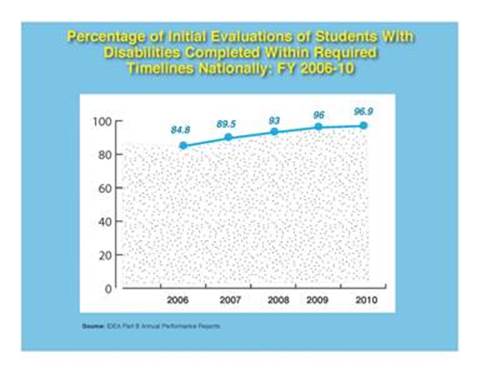
Graphic: Percentage of Initial Evaluations of Students With Disabilities Completed Within Required Timelines Nationally: FY 2006-10 [JPG, 20KB]
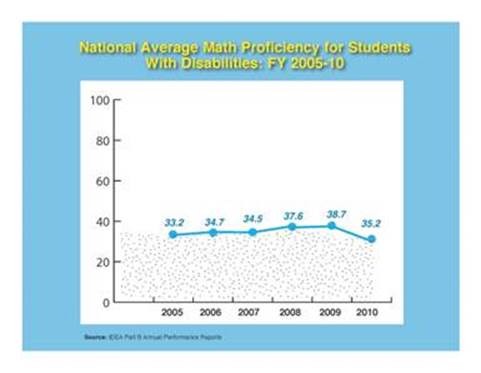
Graphic: National Average Math Proficiency for Students With Disabilities: FY 2005-10 [JPG, 16KB]
This change in accountability represents a significant and long-overdue raising of the bar for special education. Last year, when the Department considered only compliance data in making annual determinations, 41 states and territories met requirements. This year, however, when the Department includes data on how students are actually performing, only 18 states and territories meet requirements.
IDEA requires the Department to make annual decisions for states in four categories: meet requirements, need assistance, need intervention, or need substantial intervention. Under Results-Driven Accountability, the Department has made the following determinations for this year based on 2012-13 data.
Meets RequirementsFlorida, Georgia, Indiana, Kansas, Massachusetts, Minnesota, Missouri, Nebraska, New Hampshire, New Jersey, Pennsylvania, Vermont, Virginia, Wisconsin, Wyoming, Federated States of Micronesia, Marshall Islands, Palau
Needs AssistanceAlabama, Alaska, Arizona, Arkansas, Colorado, Connecticut, Hawaii, Idaho, Illinois, Iowa, Kentucky, Louisiana, Maine, Maryland, Michigan, Mississippi, Montana, Nevada, New Mexico, New York, North Carolina, North Dakota, Ohio, Oklahoma, Oregon, Rhode Island, South Carolina, South Dakota, Tennessee, Utah, Washington, West Virginia, American Samoa, Commonwealth of Northern Marianas, Guam, Puerto Rico
Needs Intervention California, Delaware, District of Columbia, Texas, Bureau of Indian Education, Virgin Islands
More on California here.  EdSource reports:
California was cited for federal intervention based on factors that included the proficiency gap between children with disabilities and all children on statewide assessments and the poor performance of children with disabilities on the National Assessment of Educational Progress test, the Education Department said in a letter to State Superintendent of Public Instruction Tom Torlakson.
In a statement, the California Department of Education said, “Like other states, we are concerned that the categorization is more the result of the particular methodology used than of the actual performance of the state’s school districts.” The department added that it will be working with the U.S. Department of Education to resolve issues.
The Education Department also said the California Health and Human Services Agency’s Department of Developmental Services will receive four years of federal intervention to improve the early identification of infants and toddlers with disabilities and enhance programs to assist young children in meeting developmental goals.
...
Through the Statewide Special Education Task Force, California is already undergoing a review of how to transform special education in the state, including possible changes in credentialing requirements for general education and special education teachers.

Tuesday, December 10, 2013

DC and Private Schools

At The Huffington Post, Joy Resmovits reports on Greg Masucci and Maya Wechsler, who are trying to get their son Max a decent education from the District of Columbia.
After cycling Max through four public schools in his short life, Greg and Maya have come to the conclusion that the District of Columbia Public Schools system doesn't have the capacity to educate their son. Federal law states that public school systems must foot the bill for private schooling for students like Max if the public schools can't give him a "free and appropriate public education."

How you define "appropriate," though, is where it gets blurry.

Last November, Max's family filed for private school funding. In January, a DCPS hearing officer denied their claim on the grounds that Max's lack of progress is not legal reason enough to grant him free tuition.

Washington, D.C., like other school districts throughout the country, is currently trying to reduce the number of special education students on the rolls of costly private schools. D.C. Mayor Vincent Gray has called for reducing his city's private placements by half. A document obtained by The Huffington Post shows that the district is offering incentives to public and charter school administrators who keep special education students under their roofs. But in a positive sign for special education students in D.C., the most recent results on the National Assessment of Educational Progress found that students with disabilities increased their scores by nine points in fourth grade reading and eighth grade reading and math, and by three points in fourth grade reading.

The district declined to discuss Max's case, citing privacy and pending litigation. It asserts the switch from private to public schools assuages a civil rights concern, because students with disabilities can stay in regular public schools where they can be included and not segregated. "Federal law requires that local education agencies evaluate every child at least once a year to determine whether or not they are in the least restrictive environment possible," Dr. Nathaniel Beers, a pediatrician who oversees special education for DCPS, told HuffPost. "Is there a kid in a self-contained classroom who doesn't need to be? Is this a kid who is in a more restrictive setting, like one of our self-contained school buildings?"

But many special needs advocates suspect it's an attempt to save money. For years, a court injunction compelled D.C. to place more special education students with even low or moderate disabilities in private placement. Consequently, private school tuition ate significantly into the city's school budget.

Sunday, July 4, 2010

Special Ed in DC

Here is a follow-up to a May 30 post about a special-ed controversy in Washington, DC. The Washington Post reports:

The administration of D.C. Mayor Adrian M. Fenty, seeking to whittle the annual $280 million cost of sending special education students to private schools, said Thursday that it will study several options to return as many as possible to the city's public schools.

The options, which officials said they will present to parents in meetings over the next few weeks, include forming public-private partnerships to build new facilities, co-locating "schools within schools" in joint ventures with private operators, expanding special education services in neighborhood schools by establishing separate classes for students who need full-time services, modernizing the city's special education schools and retraining staff, and offering scholarship-type grants so parents can buy special education services on the open market.

Fenty announced the initiative 90 minutes after his rival in the Democratic mayoral primary, D.C. Council Chairman Vincent C. Gray, unveiled his schools platform. Fenty's plan was designed in part to address recent criticism from special education parents who have expressed alarm at District attempts to "reintegrate" private school students without what they describe as adequate advance notice or careful consideration of their needs.

Sunday, May 30, 2010

Special Ed in NY and DC

The Washington Post reports:

The District's top special education official apologized to a roomful of anxious parents Wednesday night for mishandling an attempt to remove their children from private schools where they had been placed at public expense because the city was unable to meet their needs.

Richard Nyankori, deputy chancellor for special education, acknowledged serious problems with the initiative known as the "reintegration plan," which he undertook because he says the city now has the capacity to serve more students with disabilities in public and public charter schools or through some other form of support.

But many parents were angered and alarmed by what they described as the ad hoc, uncommunicative execution of the plan, saying they were informed without any previous consultation that their children would be moved at the end of the current school year. They said placement specialists hired by the District had notified them of the impending moves, in some cases just weeks after their individual education plans -- the documents specifying the special support their children would receive -- were reviewed.

NY1 reports:

There are a lot of shocking statistics coming out of School Chancellor Joel Klein’s mouth recently – including news of a $750 million deficit and 4,400 teacher layoffs. But one other startling fact almost got lost this week.

“For this school year, the current one, our schools enrolled 14,000 more students than had been projected and about half of them require special education services,” Klein said.

...

Officials still don't know for sure why there are so many more special education students. Is it better diagnosis? Less of a stigma? Or is special ed being promoted by school officials who see it as a source of federal aid?

“We really don't want to speculate,” said Laura Rodriguez of the Department of Education. “Part of what we do is analyze our data, get better at it, and have more consistent numbers, but we do understand that there is a rise in the numbers.”

But advocates say DOE should at least know more about these children, since fewer than 25 percent of special education students graduated last year.