Search This Blog

Showing posts with label Ukraine. Show all posts

Thursday, April 14, 2022

Ukrainians with Disabilities

 In The Politics of Autism, I discuss international perspectives.  In Ukrainechildren with autism and other disabilities are suffering.

The continued military attacks against Ukraine are putting the lives of an estimated 2.7 million people with disabilities at risk. The Committee on the Rights of Persons with Disabilities today deplored the Russian Federation’s aggression despite repeated calls for a ceasefire and cessation of hostilities. The Committee issued the following statement:
“The Committee is deeply disturbed that the fate of people with disabilities in Ukraine is largely unknown. There are ongoing reports that many people with disabilities, including children, are trapped or abandoned in their homes, residential care institutions and orphanages, with no access to life-sustaining medications, oxygen supplies, food, water, sanitation, support for daily living and other basic facilities.

People with disabilities have limited or no access to emergency information, shelters and safe havens, and many have been separated from their support networks, leaving them unable to respond to the situation and navigate their surroundings.

The continued military attacks leave people with disabilities extremely vulnerable and at grave risk of harm. Women with disabilities are at heightened risk of rape and sexual violence that has been widely reported. Few people with disabilities are reported to be internally displaced or to have reached Ukraine’s borders, indicating that many of them have not been able to flee to safety.

The United Nations Convention on the Rights of Persons with Disabilities requires States to ensure the inclusion of people with disabilities when meeting their obligations under international law, including international humanitarian and human rights law. Ratified by both the Russian Federation and Ukraine, the Convention requires States to take all necessary measures to ensure the protection and safety of people with disabilities in situations of risk, including armed conflict and humanitarian emergencies.

States parties to the Convention also have obligations for cooperation between and among States, and in partnership with representative organisations of people with disabilities and other civil society organizations, to provide humanitarian assistance that is inclusive and accessible.

The Committee urges all States, UN agencies, civil society and other stakeholders involved in humanitarian action to recognise and respond to the pleas and requirements of people with disabilities caught up in the hostilities. Their specific requirements, including according to gender and age, should be identified and included in all responses to the crisis. Ensuring access to humanitarian corridors, inclusion in evacuation and crisis response plans and the provision of accessible emergency information and communications are measures which should be implemented.

Measures need to be taken to ensure that all people with disabilities are accounted for, protected and provided with immediate access to humanitarian aid, taking into account their individual support requirements. Refugees and internally displaced people with disabilities, and people with disabilities in refugee-like situations need to be provided with support tailored to their individual requirements at border crossings, reception and accommodation facilities and to be provided with relocation assistance. Children with disabilities should be provided with individualised support to ensure they are not separated from their families and are protected from institutionalisation and other harmful practices, such as trafficking.

Above all, the Committee calls upon the Russian Federation to immediately end the hostilities and observe and respect the principles of international human rights and humanitarian law.

The Committee will continue to monitor the situation of people with disabilities in the conflict, in close cooperation with organisations of people with disabilities and human rights organisations.”

Tuesday, April 5, 2022

Russia's War Hurts Autistic People


Remarks by Ambassador Linda Thomas-Greenfield at a UN Security Council Briefing on the Humanitarian Impact of Russia’s War Against Ukraine

Madam President, last night, I returned from a trip to Moldova and Romania. I saw with my own eyes the refugee crisis caused by Russia’s unconscionable war. I spoke to refugees who indicated to me their desires to return to their home. And we’ve all seen the images on TV of the bombed-out buildings. But what we have not seen is that behind those destroyed buildings are destroyed lives and destroyed families. I met with women and children who had fled Ukraine, who stuffed their lives into backpacks and left the only home they had ever known. And these were sobering conversations.

One young woman I spoke to came with her six-year-old brother, who has autism and is struggling with cancer. Their single mother helped them escape to save their lives, but Russia’s war has interrupted the care her brother desperately needs.

Saturday, March 26, 2022

Russia Spread Vaccine Disinformation in Ukraine

 In The Politics of Autism, I look at the discredited notion that vaccines cause autism.  Russian trolls have spread the myth via social media.  They are also spreading other vaccine disinformation Antivaxxers are doing Putin's work for him

 Melissa Healy and Emily Baumgaertner at LAT:

Long before Russia launched its military assault on Ukraine, its citizens had been targeted for years by another Russian campaign — one designed to undermine confidence in Western vaccines and the governments offering them to their citizens.

The anti-vaccine messages were actively encouraged by President Vladimir Putin’s government, broadcast by Russian state television, and amplified on social media by Russian computer bots. The offensive was part of a larger effort to sow division within fledgling democracies and heighten suspicion of the West across Eastern Europe and the former Soviet republics.

In Ukraine, the seeds of vaccine skepticism fell on particularly fertile ground. Just 35% of residents are fully vaccinated against COVID-19, and only 1% more are partially vaccinated — among the lowest such rates in Europe, according to data from Oxford University. Childhood immunizations for diseases like measles and polio are among the continent’s lowest as well.

That gives public health officials reason for worry as more than 3.6 million Ukrainian refugees have poured into other countries and millions more are displaced within Ukraine, often hunkered down in crowded, frigid places without clean water or electricity.


Thursday, March 24, 2022

Autism in Ukraine

 In The Politics of Autism, I discuss international perspectives.  In Ukraine, children with autism and other disabilities are suffering.


Your contribution will help UNICEF continue to reach the children of Ukraine and their families with lifesaving assistance. Please donate.

Friday, March 18, 2022

Ukraine, Russia, and Antivaxxers

 In The Politics of Autism, I look at the discredited notion that vaccines cause autism.  Russian trolls have spread the myth via social media.  They are also spreading other vaccine disinformation Antivaxxers are doing Putin's work for him

At Politico, Laura Kayali and Mark Scott report that "Western anti-vaccine groups and conspiracy theorists have shifted quickly from parroting falsehoods about the global pandemic to peddling misinformation about the war, often from Moscow's viewpoint."  They continue:

The information war is playing out in real time across the European Union and the United States as well-organized and large online communities that had previously pushed back against COVID-19 restrictions are now framing Russia’s invasion as being between good-guy Moscow and Kyiv and its Western allies — now cast as New World Order oppressors — according to misinformation experts and fact-checking groups.

"The conspiracy sphere is an empty shell of sorts that aggregates as news unfolds," said Pauline Talagrand, who’s overseeing Agence France-Presse’s fact-checking work worldwide. "Whether it's vaccines or masks, there is always something that will trigger people who can be easily manipulated and are distrustful of traditional information."

“The problem with these recurring crises is that they contribute to the enlargement of these spheres and lead to the entrenchment of their narratives,” she added. 

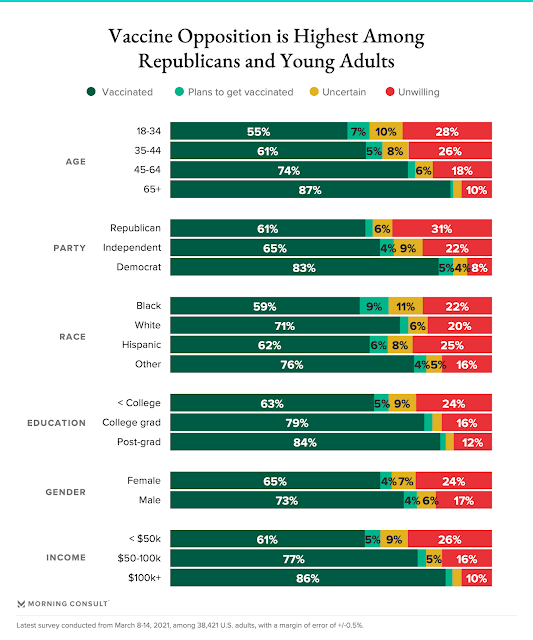
In the US, Republican pols are in the forefront.

From Morning Consult:


Wednesday, March 9, 2022

Antivaxxers Amenable to Russian Propaganda


Kiera Butler at Mother Jones:
Since the beginning of the pandemic, we’ve seen how conspiracy theories can overlap and collide. I’ve documented how anti-vaccine groups embraced QAnon disinformation about liberal elites conspiring to unseat Trump, and how white nationalists find willing audiences for their racist ideology in anti-mask groups. Over the last week, a new disinformation hybrid has appeared, as online anti-vaccine groups have become a hotbed of pro-Russia conspiracy theories about the conflict in Ukraine—and some of the most prominent anti-vaccine activists are actively promoting geopolitical falsehoods.

Imran Ahmed, executive director of the online extremism tracking group Center for Countering Digital Hate, has been following the convergence of the conspiracy theories, and he’s noticed they share familiar themes: alleged secret government alliances, anti-Semitic accusations, and allusions to nefarious scientists. “There are particular individuals within the anti-vaccine world who are amenable to pro-Russian propaganda,” he says, “and that would include some of the people who’ve cohered around QAnon and Trump.”

One example of this is how an old Trump-era storyline—the theory that SARS-CoV-2 was deliberately engineered in a lab and released—seems to have been reconstituted in a new form: Anti-vaccine influencers claim that the United States owns a network of secret biolabs in Ukraine where dangerous infectious disease research takes place. For them, it’s just obvious that Biden is sending aid to Ukraine in order to protect those assets. This rumor has been proven to be manifestly false—but that hasn’t stopped it from circulating and gaining momentum.

Saturday, February 26, 2022

Russian Disinformation Targets Antivaxxers


In The Politics of Autism, I look at the discredited notion that vaccines cause autism.  Russian trolls have spread the myth via social media.  They are also spreading other vaccine disinformation Antivaxxers are doing Putin's work for him.

Brian Contreras and Wendy Lee at LAT:
Over the last few days, researchers have warned that President Vladimir Putin’s regime is pushing, and will continue to push, false narratives aimed at justifying its aggression.

At least some of those narratives are finding purchase among an American public divided by previous waves of disinformation, said Graham Brookie, senior director of the Atlantic Council’s Digital Forensic Research Lab. “What we see … is not an insignificant amount of organic audience engagement from U.S. citizens that are predisposed to have their previously held beliefs reinforced by Russian disinformation.”

For instance, he said, anti-vaccine groups that are already skeptical of the U.S. government are now primed to disbelieve the official U.S. government narrative around Ukraine.

Russian “influence operations” relying on disinformation “exist at a steady state,” and have for years, added Brookie, but the ramp-up to war in Ukraine has brought “a massive surge.”

Jennifer Granston, head of insights at the social media analytics firm Zignal Labs, said the conspiracy theory that the Ukraine conflict is a government-manufactured distraction from supposed harms of COVID-19 vaccines is one of the disinformation narratives her company has monitored in recent days, along with the claim, embraced by a Russian state media outlet, that the invasion is a mere “peacekeeping mission.”