Search This Blog

Showing posts with label France. Show all posts

Sunday, August 18, 2024

Autism in France

  In The Politics of Autism, I discuss international perspectives.

In the past, France was a laggard in autism services, in part as a result of the malign influence of psychoanalysis.

There are signs of progress.

 The Connexion:

Earlier this year the French government launched an autism awareness campaign on TV and in cinemas to help people “better understand” the condition.

It featured celebrities who have been directly affected by autism, whether as the parents of autistic children, such as comedian Élie Semoun, actor Francis Perrin and screenwriter Minh Tran Huy, those who have siblings with it, or those who have been diagnosed themselves.

"There are 700,000 autistic people in France," said Fadila Khattabi, Secretary of State in charge of People with Disabilities and who introduced the campaign in April.

"We want to help society better understand how these people evolve, and how their exclusion is unjustified. Disabled people are fellow citizens in their own right... and not apart."

The short clips focused especially on the communication difficulties of autistic people and their sensory hypersensitivity.

Read more: 'Being neurodivergent is challenging in Paris'


Saturday, June 24, 2023

French Autistic Adults

  In The Politics of Autism, I discuss international perspectives.

Raven Bureau and Céline Clément have an article at Autism titled “`Survival classes for a neurotypical world': What French autistic adults want and need after receiving an autism diagnosis." Lay abstract:

Adults receiving an autism diagnosis might not react the same depending on their countries or cultures. We also know that autistic people are rarely asked what they think would be best for them following this diagnosis. In this study, we asked 12 French autistic adults about their experiences of receiving an autism diagnosis as well as what they thought might be useful afterwards. Overall, we found that some experiences were similar to experiences related by English or American participants, but some were specific to the French culture, suggesting that such research should expand into new territories and cultures, especially non-European ones. Our participants also had quite a few ideas as to what would be useful for people in the same situation. Some of the suggestions can be put into action by peers and professionals alike, while others are wishes relating to how our participants would like society to behave toward them and people like them, for example. This article allows for a better comprehension of how cultural differences can impact the experience of receiving an autism diagnosis as an adult and provides some insight into what these adults want and desire following such a diagnosis.

From the article:

 Some experiences related by our participants reflected the way autism is understood and conceptualized in France which, while the presence of stigma is similar to what autistic people can experience in other countries (Cage et al., 2019), seems to have a particular flavor due to psychoanalysis and its wide-reaching influence (Bishop & Swendsen, 2021; Briggs, 2020). As this approach is stillvery present in the public discourse, it seems unavoidable that it influences the social representations of autism inFrance. Research on the subject is scarce, and more research on representations of autism in France is needed. Indeed, these representations can have an impact on the mental health of adults receiving an autism diagnosis, as identified by our participants and supported by research using the minority-stress model and how it applies to autism (Botha & Frost, 2020).

Saturday, October 3, 2020

Prevention and Screening of Individuals with Severe Intellectual Developmental and Autism Spectrum Disorders

In The Politics of Autism, I discuss the day-to-day challenges facing autistic people and their families. Those challenges get far more intense during disasters.  And coronavirus is proving to be the biggest disaster of all. Providing education and social services is proving to be very difficult

A. Baghdadli, M. C. Picot, S. Miot & K. Munir have a letter at The Journal of Autism and Developmental Disorders: A Call to Action to Implement Effective COVID-19 Prevention and Screening of Individuals with Severe Intellectual Developmental and Autism Spectrum Disorders

The COVID-19 pandemic has led to an unprecedented global challenge in the care of individuals with ASD and IDD. [Intellectual Developmental Disorder] At a time when new waves of the pandemic are predicted, maintaining safety from increased transmission risk of COVID-19 in residential and specialized inpatient settings is of paramount importance. In lieu of dearth of international recommendations for protection of individuals with ASD and IDD requiring strong assistance in daily living, we draw attention to the following perspectives:

Infection Prevention and Control

  • Care needs to be provided in the safest way possible without discrimination on the basis of disability;
  • In view of asymptomatic COVID-19 forms, there is a need to strictly maintain social distancing measures, wear masks or cloth face coverings, and to compartmentalize COVID-19 free and COVID-19 safe areas, as well as to systematically plan to conduct RT-PCR testing before any admissions and transfers;
  • Since ASD and IDD are complex neurodevelopmental conditions, there is a need for infection prevention and control approaches adapted to the cognitive, behavioral, and physical care needs of individuals and in implementing all barrier measures;
  • The standard approaches to delivery of care need to be adjusted to incorporate telehealth and videoconferencing services in order to facilitate rapid access to primary care, and specialist providers, including those in mental and behavioral health, to access platforms with expertise in ASD and IDD, to address pressing COVID-19, as well as non-COVID-19 related conditions, and to make referrals as appropriate;
  • For continuity and minimal disruption of care, direct service and ancillary personnel need to be monitored daily for any COVID-19 related symptoms and contact and advised to stay home according to occupational health policies;
  • Since professional practice needs to be daily guided, it is important to continuously share the global experiences, and new evidence-based knowledge and scientific breakthroughs.

Screening

  • It is essential to promote a well-coordinated and continuous screening strategy among residents and caregivers, with contact exposure risk assessment, as well shared decision-making involving families, guardians, and referral partners involved in care pathways;
  • For rapid, highly responsive screening, the facilities need to be self-sufficient in performing nasopharyngeal COVID-19 testing with continuous availability of appropriately trained staff and provision of requisite transportable screening test kits;
  • Since individuals with ASD and IDD have severe adaptive difficulties, screening needs to be offered on-site with benefit of personalized care and insight into their needs and any anticipated risks.

Tuesday, December 4, 2018

Antivax Sentiment Spreads Worldwide. And So Does Measles.


Angela Giuffrida reports at The Guardian:
Italy’s health minister has sacked the entire board of the Higher HealthCouncil, the country’s most important committee of technical-scientific experts who advise the government on health policy.
In a move on Monday night that shocked Italian scientists, Giulia Grillo, from the Five Star Movementa vaccine-sceptic party that has supported unproven cures for cancer – said it was “time to give space to the new”.
“We are the #governmentofchange and, as I have already done with the appointments of the various organs and committees of the ministry, I have chosen to open the door to other deserving personalities,” she wrote on Facebook.
The decision will mean the replacement of 30 board members, including the president, Roberta Siliquini, the head of the school of hygiene and preventive medicine at the University of Turin who was nominated in December 2017 by the former health minister Beatrice Lorenzin.
Zachary Young at Politico Europe reports that social media have helped antivax sentiment spread broadly, affecting France.
And if online activity in the U.S. is any indication, some of the vaccine skepticism in Europe could be driven by Russian bots.
In the online war for public opinion on vaccines, the French government is being overwhelmed. According to an October report from the European Commission, only 69.9 percent of French people agree that “vaccines are safe,” placing the country of Louis Pasteur — the 19th century biologist who discovered the principles of vaccination — 26th in the EU28 totem pole, ahead of only Bulgaria and Latvia. When it comes to the seasonal flu vaccine, France ranks last, with 51.8 percent of respondents feeling secure.
Part of the reason that France has fallen so low in EU rankings has to do with anti-vaccination ideas spreading virally on social media, according to health officials and observers of online activity. According to an April report by Printemps Prevention, a preventative health nonprofit, 18 of the 25 most-viewed YouTube vaccines videos in France take a skeptical position. On search engines, the report shows, anti-vaccine queries have increased by 130 percent over five years.
...


Eleven EU member countries currently fall below the relevant threshold for measles, which requires 93-95 percent vaccination rates, and outbreaks have surged on the Continent since 2017. Whereas the once-rampageous disease was “eliminated” from the Americas in 2016, Europe has this year registered some 41,000 measles cases causing 40 deaths, according to the World Health Organization.
Among 27 European countries measured by the OECD, France has the lowest rate of childhood vaccination for the disease.
Marie Werbregue, from central France, became mobilized in the debate after her daughter became autistic, which she attributes to vaccination. Now, she is president of the association “Info Vaccins France” and co-moderates a 10,319-member Facebook group on the subject.

From the World Health Organization:
Reported measles cases spiked in 2017, as multiple countries experienced severe and protracted outbreaks of the disease. This is according to a new report published today by leading health organizations.

Because of gaps in vaccination coverage, measles outbreaks occurred in all regions, while there were an estimated 110 000 deaths related to the disease.

Using updated disease modelling data, the report provides the most comprehensive estimates of measles trends over the last 17 years. It shows that since 2000, over 21 million lives have been saved through measles immunizations. However, reported cases increased by more than 30 percent worldwide from 2016.

The Americas, the Eastern Mediterranean Region, and Europe experienced the greatest upsurges in cases in 2017, with the Western Pacific the only World Health Organization (WHO) region where measles incidence fell.

“The resurgence of measles is of serious concern, with extended outbreaks occurring across regions, and particularly in countries that had achieved, or were close to achieving measles elimination,” said Dr Soumya Swaminathan, Deputy Director General for Programmes at WHO. “Without urgent efforts to increase vaccination coverage and identify populations with unacceptable levels of under-, or unimmunized children, we risk losing decades of progress in protecting children and communities against this devastating, but entirely preventable disease.”

Saturday, November 10, 2018

Signs of Hope in France

In The Politics of Autism, I describe the need for comparative perspectives on the issue.  France, where psychoanalysis long dominated -- and severely hampered -- autism treatment, is worth a special look.  There are some signs of hope there.

At The Journal of Autism and Developmental Disorders,  Carol Sankey, Cyrielle Derguy Céline Clément, Jennifer Ilg, and Émilie Cappe have an article titled "Supporting Parents of a Child with Autism Spectrum Disorder: The French Awakening."  The abstract:
After being wrongfully blamed for their child’s disturbances, French parents of a child with autism spectrum disorder (ASD) are now perceived as essential partners of care professionals. This shift in perspective has encouraged the development of parent training programs in the field of autism. In this paper, we present three programs currently implemented in France for parents of a child with ASD. We investigated their social validity, from the parents’ perspective. All three programs showed good social validity: attendance rate was good and parents were satisfied. In France, like elsewhere, more parents should be given the opportunity to participate in such programs to help them deal with the specific challenges of raising a child with ASD.

Thursday, September 13, 2018

Autism, Education, and the European Union

In The Politics of Autism, I discuss the need for more study of the issue in other countries.

At PLOS One, Monika Roleska and colleagues have an article titled: "Autism and the  Right to Education in the EU: Policy Mapping and Scoping Review of the United Kingdom, France, Poland and Spain."  The abstract:
Introduction
Autistic people may have different educational needs that need to be met to allow them to develop their full potential. Education and disability policies remain within the competence of EU Member States, with current educational standards and provisions for autistic people implemented locally. This scoping review aims to map EU and national special education policies with the goal of scoping the level of fulfilment of the right to education of autistic people.
Methods
Four EU countries (United Kingdom, France, Poland and Spain) were included in this scoping review study. Governmental policies in the field of education, special education needs and disability law were included. Path dependency framework was used for data analysis; a net of inter-dependencies between international, EU and national policies was created.
Results and discussion
Each country created policies where the right to free education without discrimination is provided. Poland does not have an autism specific strategy, whereas the United Kingdom, France and Spain have policies specifically designed for autistic individuals. Within the United Kingdom, all countries created different autism plans, nevertheless all aim to reach the same goal—inclusive education for autistic children that leads to the development of their full potential.
Conclusion
Policy-making across Europe in the field of education has been changing through the years in favour of autistic people. Today their rights are noticed and considered, but there is still room for improvement. Results showed that approaches and policies vastly differ between countries, more Member States should be analysed in a similar manner to gain a broader and clearer view with a special focus on disability rights in Central and Eastern Europe
From the article:
This study provided vital information on the right to education of autistic people in the UK, France, Poland and Spain. The scope of this study only included four countries, therefore the results cannot be generalized and clear conclusion on the average level of the fulfilment of the right to education cannot be drawn. More countries should be analysed to get a better picture of the situation across the EU. Additionally, since this is the first in a series of studies that map SEN policy in the EU, the findings have not been able to be triangulated to ensure reliability. Furthermore, the initial pool of identified studies has not been examined by other authors, meaning the reliability of the screening process cannot be guaranteed. More research should also be conducted to establish whether strategies that are in place have an effect on autistic children, such as improved learning, skills and higher rates of participation in education. To the best of our knowledge, there are no previous studies that have examined whether education of autistic people in EU countries is directed to development of their talents, creativity and provides them with skills they need to successfully progress into employment. To this day, the research in the field of education and autism policies in the EU as well as globally is scarce and remains an important gap in autism research. It is for this reason that this study aimed to review existing information as well as attract interest to conduct more research in this field in the future.

Wednesday, August 22, 2018

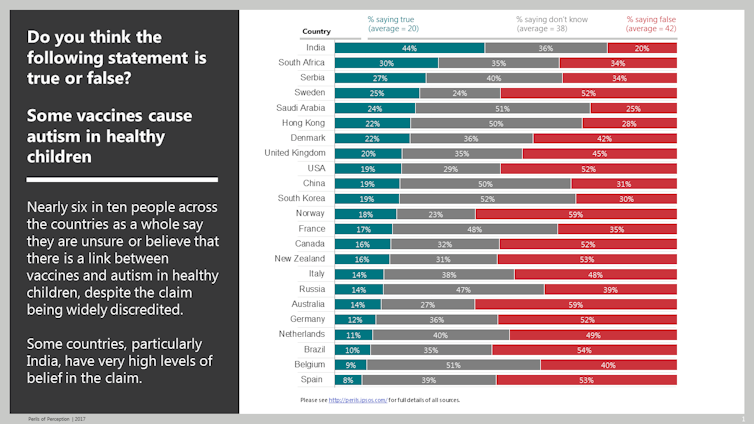
International Opinion on Vaccines and Autism

In The Politics of Autism, I look at the discredited notion that vaccines cause autism..


Bobby Duffy at The Conversation:
Have these unfounded fears stuck with the public around the world? Our first ever multi-country study, in 38 nations, on vaccine misperceptions suggests they have. Around one in every five people believe that “some vaccines cause autism in healthy children”, and 38% are unsure whether it is true or not.
The proportions positively believing it is true ranged from an incredible 44% in India, down to 8% in Spain.
But there are majorities in many countries who think it’s true or are unsure: in France it’s 65%, in Britain it’s 55%, in Italy it’s 52%. And even in countries where it’s not quite a majority who think it’s true or are unsure, it’s often only just below: in Sweden it’s 49% and in the US and Germany it’s 48%.

Tuesday, April 17, 2018

Autism in France

 In The Politics of Autism, I describe the need for comparative perspectives on the issue

Richard Bates at The Conversation:
France has a problem with autism. The country’s highest administrative court estimates that there are 700,000 autistic people in France. However, only 75,000 are diagnosed. Autistic children have historically been diagnosed later in France than in neighbouring countries. They have often been excluded from mainstream education and lacked access to support services and extracurricular activities.

Many French autists are confined to day hospitals and live-in institutions, isolated from the community and frequently unable to communicate through speech – whereas in the US, for example, public schools are required by law to fully include autistic children in mainstream classroom education. For years, families in northeast France have taken autistic children to Belgium, to access its superior services.
The French government recognises these shortcomings. It was forced to do so in 2004 by a combination of domestic campaign groups and international pressure: the Council of Europe judged France’s autism provisions to be in breach of the European Social Charter. This judgement has been repeated in several subsequent cases. In 2016, the UN Committee on the Rights of the Child also worried that French autists “continue to be subjected to widespread violations of their rights” to education and support.

The response has been a series of “Plans Autisme”, so-called “Marshall Plans” directing investment towards improving outcomes. The latest such plan – the fourth – was launchedin early April by the French president, Emmanuel Macron, and will run until 2022. It seeks to recruit thousands of teaching assistants to enable autistic children to attend mainstream schools, as well as facilitating more diagnoses. Yet its very existence demonstrates that the results of the previous three plans were disappointing.

Saturday, April 7, 2018

France to Make Amends for Treatment of Autistic People

In The Politics of Autism, I describe the need for comparative perspectives on the issue.
The French government has launched a €340m (£297m) strategy in an effort to make amends for the country’s scandalous state treatment of children and adults with autism, which has been denounced by the United Nations as a “widespread violation” of citizens’ rights.
President Emmanuel Macron, who made the need to improve the education and rights of people with autism a part of his election campaign, said he wanted everyone “to be included in school and everyday life”.
The strategy was launched by the prime minister, Édouard Philippe, on Friday afternoon and intends, in the words of one government adviser, to “at last” give children with a neurodevelopmental disorder access to mainstream education in France – a legal right that they have consistently been denied.
There will also be a drive to improve support for autistic adults, only 0.5% of whom are in regular employment, and who are routinely admitted to psychiatric hospitals. The government acknowledged that an adult with autism in France is three times more likely to be in long-term psychiatric care than the rest of the population. Rights groups decry the treatment as inadequate and inappropriate.

Monday, January 22, 2018

Autism, France, and Psychoanalysis

In The Politics of Autism, I describe the need for comparative perspectives on the issue. In The Independent, Marta Zaraska writes:
France lags about four decades behind countries such as the United States and the United Kingdom when it comes to diagnosing and treating autism, says Danièle Langloys, president of the advocacy group Autisme France. ... One 2015 study pegs the prevalence of autism in France at 0.36 per cent, well below the 1 per cent reported in the UK and roughly 2.5 per cent reported in the US. Among children who are diagnosed with autism, only about one in five attends a mainstream school.
The French government has been taking small remedial steps but huge problems remain. Psychoanalysis dominates psychological treatment in France, but it does not work for autism.
Psychoanalysis is a “dictatorship of thought” in France that, over the past 40 years, has become part of the national culture, Langloys says. In the 1950s, there were only about 150 psychoanalysts in France, compared with thousands in the US. By the early 21st century, though, the number in France had soared to about 10,000 – with a sharp increase during the late 1960s connected to a rise in anti-establishment politics.

...

In a 2012 survey of 1,000 French adults, 22 per cent claimed that some kinds of parent-child interactions can cause autism, and another 23 per cent said the condition can result from stressful life events. These disproven ideas are also common among psychoanalysts in France. “There are still groups that resist scientific information on autism and who continue saying that with a developmental and behavioural approach, you are doing ‘dressage’ of children,” or training them like horses, Rogé says. “They say [psychoanalysis] is a very humanist, flexible model, but I think it resembles more a sect, a religion, because it is based on faith and not on scientific facts.”
 In 2011, a large, systematic meta-analysis of early interventions for autism found no evidence supporting a psychoanalytic approach for the condition. Yet if French parents oppose it, they can face dire consequences, including the forced removal of their children to institutions or foster homes. Langloys says social workers can label a family as troublesome just for seeking out a second opinion. “Social workers know nothing but psychoanalysis, so for them the mother is always too fused or too cold,” she says. To them, she says, “it’s normal to take away her children.” Her association has counted several hundred cases of children being separated from their parents in the past 15 years. In 2014, Autisme France began offering its members access to legal aid services to help families facing court proceedings to remove their children

Sunday, January 6, 2013

France, Autism, and Psychoanalysis

Previous posts have discussed the dismal state of autism treatment in France.  A film titled "The Wall,"by Sophie Robert, explained the ongoing grip of discredited psychoanalytic theories in that country.  Kristina Chew writes:
Robert’s film has been part of an ongoing effort to change the understanding and treatment of autism in France. After the organization Autism Europe lodged a complaint against France in 2002 for failing to educate autistic children, the European Committee of Social Rights said that “France has failed to achieve sufficient progress” in educating autistic children and had made autistics an “excluded group.”
Seeking to help their children, more parents in France have been taking action, lobbying politicians like Daniel Fasquelle, a member of France’s parliament who says in the BBC that it is an “an out-and-out disgrace” that France’s medical community should continue to swear by psychoanalysis as the treatment for autism. David Heurtevent’s Support the Wall project continues the fight for the rights of autistics in France to education and services.
It is perhaps not surprising that the use of psychoanalysis to treat autism should be making its last stand in France, where Freudianism has long been applied not only to the treatment of mental illness but also to the study of literature, philosophy and radical politics. In a new year, it is more than time for the French medical community to acknowledge that it is decades behind the rest of the world in understanding what autism is and in treating and educating autistic individuals in ways that will actually help them achieve all they can.

Saturday, May 19, 2012

France and Autism

In Unstrange Minds, Roy Grinker writes about the way in which psychoanalysis has warped France's approach to autism. Maria Cheng writes at AP:
Last month, a report by France's top health authority concluded there was no agreement among scientists about whether psychotherapy works for autism, and it was not included in the list of recommended treatments.
That provoked an outcry from psychiatrists. Groups including Freudian societies, the World Association of Psychoanalysis and France's Child Institute started a petition calling on the French government to recognize their clinical approach, focused on psychotherapy.
"The situation in France is sort of like the U.S. in the 1950s," said Dr. Fred Volkmar, a U.S. expert who directs the Child Study Center at Yale University. "The French have a very idiosyncratic view of autism and, for some reason, they are not convinced by the evidence."
...

In Spain, for example, autism treatment guidelines published in 2006 lumped psychotherapy together with alternative therapies like chelation, which involves the injection of chemicals into the body to remove heavy metals. Spanish officials ruled there was no evidence such alternative treatments work.
Joaquin Fuentes, a psychiatrist and scientific adviser for a Spanish autism group, said that where he works in the Basque region, autistic children go to regular schools and none are sent to psychiatric hospitals. "To be exposed to psychoanalytic treatment is a painful and unethical way of treating children with autism," he said.

Tuesday, February 21, 2012

"Refrigerator Mother" Theory in Ireland and France

The discredited "refrigerator mother" theory still lives in some parts of the world. Victoria White writes at The Irish Examiner:
IT’S nearly two weeks since psychologist Tony Humphreys sparked outraged by saying children on the autism spectrum were shutting down because of an "absence of expressed love" from their parents.
My first reaction was inarticulate rage. Yes, I have a child in the autism spectrum. Yes, I love him to bits. Yes, I show it.

However, as the rage dies, I realise that Humphreys’ blunder is a symptom of a much wider malaise: Traditional psychology is defending its territory.

For over a century, at least since Freud, the whole of Western society has become accustomed to seeing mental dysfunction as part of a story. Much like a detective novel, the story has at its core a terrible secret. You extract the secret and you have cured the patient.
... 
I was told: "Here we believe that every issue comes from inside the family." [emphasis added]
Remember that you were paying for all this: Two years of probing in the wrong place when an autism diagnosis should take a maximum of six months. 
Earlier this month, The Irish Examiner reported:
CLINICAL PSYCHOLOGIST Dr Tony Humphreys has reiterated controversial comments he made in an article published in the Irish Examiner last week linking parenting with the development of autism.
In the article, Humphreys suggested that a link lay between autism and parents not expressing love and affection to their young children. The article has been criticised by the Psychological Society of Ireland and Irish Autism Action, and it has since been removed from the Examiner site.
Speaking to RTÉ’s Claire Byrne on the Marian Finucane Show today, Humphreys said that children communicate all the time. If we respond to how children communicate and pick up what they’re trying to express, then they feel secure and continue to communicate, he said.
However, if we don’t, then children “wisely” shut down and stop communicating.
A few days after that, the Examiner reported:
 Health Minister James Reilly has described recent comments made by clinical psychologist Dr Tony Humphreys about autism as "utterly outrageous".

Dr Humphreys has been severely criticised for his article in the Irish Examiner which gave the impression parents were to blame for their child’s condition.

Speaking to TV3 yesterday, Dr Reilly, who has a 25-year-old autistic son, said the hurt caused by Dr Humphreys was "astonishing".

"Well, it was utterly outrageous. The hurt that he has caused people is absolutely astonishing. I heard him on the radio the other day and I thought he compounded it by saying ‘I thought this was a good news story that parents wouldn’t have to worry or feel guilty about passing on their bad genes to their children’.

"What? Another utter insult to parents and, you know, I’ll say this to parents, let no one set a limit on your child’s horizon. Experts will come and experts will go, but you know your child and you know what your child needs and you know the help they need and keep fighting. We’ll support them," Dr Reilly said
Meanwhile, Paul O'Donoghue writes in The Irish Times on the situation in France:
ON JANUARY 26th last, a court in the French town of Lille ordered that a documentary film be censored and removed from the internet.
The film, entitled The Wall, by Sophie Robert, critically examined the current dominant understanding and treatment of autism in France, which is founded on outdated and redundant theories of psychoanalysis.
Robert interviewed 27 psychoanalysts, three of whom later sued her, claiming they were misrepresented in the film. I have watched the documentary and so far as I can judge, the views of all of those interviewed are consistent with the psychoanalytic model that sees autism as being caused by a distorted relationship between the affected child and the mother. There is no objective evidence to support this viewpoint.
...
Ideologies can give rise to dire consequences and this is evident in the experiences of many French children with autism. In contrast to most other Western countries, it is claimed that up to 80 per cent of them do not attend school. In 2004 the Council of Europe condemned France for failing to provide appropriate education for children with autism.

Friday, December 9, 2011

Autism and Psychoanalysis in France

In A History of Autism, Adam Feinstein offers one explanation for the persistence of psychoanalytic theories of autism in France. During the Second World War, pro-Vichy psychiatrists believed in the genetic theory whereas pro-Resistance professionals took the psychoanalytic approach.

Whatever the case, psychoanalysis still has a grip on autism treatment in France, as Geri Dawson writes at Autism Speaks:

You may have seen recent headlines generated by the controversial French film, The Wall, which highlights the persistence of inappropriate autism treatments in France. There, families with a child who has autism are often offered outdated psychoanalytical therapies based on the widely debunked Freudian idea that autism results from being raised by an emotionally cold mother (the so-called “refrigerator mom” theory of autism).

The persistence of such ineffective treatments and outdated attitudes reminds us of the need to continually educate the public and the world medical community of the effectiveness of modern therapies for autism—including behavioral interventions such as Applied Behavioral Analysis. For more information, please see the “How Is Autism Treated?” page of the Autism Speaks website and Autism Speaks’ 100 Day Kit, created specifically for newly diagnosed families to make the best possible use of the 100 days following their child’s diagnosis of autism.