Search This Blog

Showing posts with label intellectual disability. Show all posts

Monday, December 15, 2025

Trump and the R-Word

 In The Politics of Autism, I write about the everyday struggles facing autistic people and their families -- including casual prejudice against disabled people.  

Trump has a long history of using the r-word, and Lordy, there are tapes.

Phillip M. Bailey at USA Today:

...Trump's return has heralded a reversal of what MAGA activists and other conservatives said was a hyper-sensitive "cancel culture."

Over the last year or so that has given the R-word a resurgence, appearing unapologetically in places like Joe Rogan's podcastElon Musk's social media posts and Trump's statements.

"The word ‘r-----ed’ is back and it’s one of the great culture victories," Rogan, who endorsed Trump last year, said in an April episode of his popular podcast, which has more than 20 million subscribers on YouTube.

Media Matters said its researchers found there was an uptick in the use of the words "r----d" or "r-----ed" on Fox News from being used a total of eight times in 2024 to a total of 23 times so far in 2025.

The most frequent offender, the watchdog group said, was the program "Gutfeld!" hosted by Greg Gutfeld, a conservative political commentator and comedian whose program debuted in April 2021 and averages about 3.3 million viewers, according to Late Nighter.

Gutfeld's late night show, which has a more humorous tone than other Fox News shows, mentioned the words the most across the network, according to Media Matters, increasing from three times in 2024 to 17 in 2025, so far. The next closest show was "The Five" with three mentions.
A release from Montclair State:

A joint study from Montclair State University faculty in the Joetta Di Bella and Fred C. Sautter III Center for Strategic Communication in the College of Communication and Media and the Department of Justice Studies shows a dramatic increase in content containing the slur “retard” on X after Donald Trump’s Thanksgiving Day Truth Social post used the word.

Highlights from the study include:

• A 225.7% increase in posts containing the r-word on X.

• About 1.12 million posts using the r-word identified in the week after Donald Trump’s Thanksgiving message used the term.

• The most viewed, liked and shared content in the period studied enthusiastically endorsed the r-word.

• Results are consistent with the period after other prominent accounts used the word, but with greater overall volume reflecting the reach of a U.S. president.

“The normalization of speech that marginalizes has become a prominent part of social media,” said Daniela Peterka-Benton, Ph.D., a professor of Justice Studies at Montclair State University and editor of the book Human Trafficking and Disabilities, which focuses on the vulnerabilities of the disabled community. “The dangers of the online space for those who have been marginalized appear to be increasing rapidly,” she added.

“Influential voices online have a responsibility to do better, and many seem to be shirking that responsibility in cases like this one,” said Bond Benton, Ph.D., professor of Communication at Montclair State University.

The full study, which can be found here, was conducted by Benton from the Joetta Di Bella and Fred C. Sautter III Center for Strategic Communication and Peterka-Benton from the Department of Justice Studies.

At The Guardian, Ramon Antonio Vargas and Rachel Leingang report that Trump's use of the slur helped cost him a significant political victory:

An Indiana Republican lawmaker whose child has Down syndrome has promised to oppose efforts to redraw the state’s congressional map to favor his party after Donald Trump aimed a slur for people with intellectual disabilities at a political opponent.

Michael Bohacek, a member of Indiana’s state senate, wrote on Friday on Facebook that he has been “an unapologetic advocate for people with intellectual disabilities” since one of his daughters was born with Down. Referring to how the president used an ableist slur to insult Tim Walz, the Democratic Minnesota governor, a day earlier, Bohacek’s post added: “His choices of words have consequences.”

“I will be voting NO on redistricting, perhaps he can use the next 10 months to convince voters that his policies and behavior deserve a congressional majority,” he added.

Saturday, April 12, 2025

A Bonkers Week with RFK Jr.

On Thursday, RFK Jr. pledged to find the cause of autism by September. Christina Jewett at NYT:
Dr. Philip Landrigan, a pediatrician and expert on environmental toxins, pointed to the current mass layoffs and cutbacks for research at Mr. Kennedy’s Department of Health and Human Services as one reason for doubting such quick progress.

“Given that a great deal of research on autism and other pediatric diseases in hospitals and medical schools is currently coming to a halt because of federal funding cuts from H.H.S.,” he said, “it is very difficult for me to imagine what profound scientific breakthrough could be achieved between now and September.”

...

“We are launching requests to scientists from all over the country and all over the world,” Mr. Kennedy said in an interview on Fox News. “Everything is on the table: our food system, our water, our air, different ways of parenting, all the kind of changes that may have triggered this epidemic.”

In the interview, Mr. Kennedy also said an important part of the effort would be to compare autism rates in vaccinated and unvaccinated children. It’s an angle that many scientists dismiss, saying that parents who vaccinate their children are also more likely to get a diagnosis, given higher rates of interaction with health providers.

Alejandra O'Connell-Domenech at The Hill:

“We find that unrealistic and misleading,” President and CEO of The Autism Society of America Christopher Banks told The Hill.

Banks and The Autism Society of America’s Chief Marketing Officer Kristyn Roth agreed that there is a “significant need” for more investment and credentialed research to better understand autism spectrum disorder.
...
The speed at which Kennedy is promising to find the cause of the disability is harmful to those struggling during an autism diagnosis as well, Roth added.

‘It’s giving people a lot of false hope,” she said. “True, rigorous, peer-reviewed science takes time to find quality answers.”  

Alexander Tin at CBS:

A top federal health official ousted by the Trump administration denounced Health and Human Services Secretary Robert F. Kennedy Jr.'s claim that he would be able to determine the cause of autism by September, warning against offering "false hope" to families.

"There are people, probably, who are hearing me now who know that I cared for leukemia patients for a significant number of years. Giving people false hope is something you should never do," said Dr. Peter Marks, in an interview Friday with "Face the Nation with Margaret Brennan."

 Adam Cancryn, Lauren Gardner and David Lim at Politico:

HHS Secretary Robert F. Kennedy Jr.’s visit to the FDA Friday was supposed to introduce him as a trusted leader to agency employees. It did anything but.

Over the course of 40 minutes, Kennedy, in largely off-the-cuff remarks, asserted that the “Deep State” is real, referenced past CIA experiments on human mind control and accused the employees he was speaking to of becoming a “sock puppet” of the industries they regulate.

“Because of my family’s commitment to these issues, I spent 200 hours at Wassaic Home for the Retarded when I was in high school,” Kennedy said, in a reference to the Wassaic State School for the Mentally Retarded in Wassaic, New York. “So I was seeing people with intellectual disabilities all the time. I never saw anybody with autism.”

The remark jolted several FDA employees in the audience, who misheard the reference and thought he was making a derogatory remark about people with intellectual disabilities, according to two employees granted anonymity for fear of retaliation.

By the end of the event, billed as a welcome from the new commissioner, Marty Makary, several FDA staffers had walked out of the rooms where the speech was being broadcast at the agency’s headquarters in White Oak, Maryland, according to two employees granted anonymity for fear of retaliation.

Aria Bendix at NBC:

In an interview Wednesday with CBS News, Kennedy said the Trump administration was focused on finding ways to treat people who choose not to get vaccinated. However, there are no approved treatments for measles, which kills almost 3 out of every 1,000 people diagnosed.

Many medical experts have taken issue with his approach to the current measles outbreak, which has included emphasizing unproven treatments and framing vaccination as a personal choice (which some doctors view as a nod to his anti-vaccine supporters).

Kennedy also suggested that measles cases are inevitable in the United States because of ebbing immunity from vaccines — a notion doctors say is false.

 Devi Shastri at AP:

U.S. measles cases topped 700 as of Friday, capping a week in which Indiana joined five others states with active outbreaks, Texas grew by another 60 cases and a third measles-related death was made public.

Health Secretary Robert F. Kennedy Jr. claimed in a televised Cabinet meeting Thursday that measles cases were plateauing nationally, but the virus continues to spread mostly in people who are unvaccinated and the U.S. Centers for Disease Control and Prevention redeployed a team to West Texas.


Sunday, October 13, 2024

Trump Despises People with Disabilities

 In The Politics of Autism, I discuss the issue's role in campaign politics.   In the 2016 campaign, a number of posts discussed Trump's bad record on disability issues more generally.   As his words and actions have shown, he despises Americans with disabilities  He told his nephew Fred that severely disabled people -- such as Fred's son -- should "just die."

Jonathan Swan, Maggie Haberman, and Shane Goldmacher at NYT:

Donald J. Trump took his seat at the dining table in his triplex penthouse apartment atop Trump Tower on the last Sunday in September, alongside some of the most sought-after and wealthiest figures in the Republican Party.

...

He disparaged Vice President Kamala Harris as “retarded.” He complained about the number of Jews still backing Ms. Harris, saying they needed their heads examined for not supporting him despite everything he had done for the state of Israel.

He has also used the r-word before, and Lordy, there are tapes.

In welcoming the US Olympic team to the White House , Trump said:

So today, on behalf of the United States, I want to thank every Olympian and Paralympian. And what as just incredible. And what happened with the Paralympics was so incredible and so inspiring to me. And I watched — it’s a little tough to watch too much, but I watched as much as I could.

Trump thinks it's "tough to watch" disabled people play sports.  This comment is the latest sign of his aversion to people with disabilities.

On November 26, 2015, Jose A. DelReal at The Washington Post:

On stage Tuesday, Trump berated Times investigative reporter Serge Kovaleski for his recent recollection of an article he had written a few days after the [9/11] attacks. Trump appeared to mock Kovaleski's physical condition; the reporter has arthrogryposis, which visibly limits flexibility in his arms.

“Now, the poor guy — you've got to see this guy, ‘Ah, I don't know what I said! I don't remember!' " Trump said as he jerked his arms in front of his body.

On August 3, 2015, Celeste Katz wrote at The New York Daily News:

"While disabled veterans should be given every opportunity to earn a living, is it fair to do so to the detriment of the city as a whole or its tax paying citizens and businesses?" Trump wrote in a 1991 letter to John Dearie, then-chairman of the state Assembly's Committee on Cities.
"Do we allow Fifth Ave., one of the world's finest and most luxurious shopping districts, to be turned into an outdoor flea market, clogging and seriously downgrading the area?" Trump demanded.
New York's original peddling exceptions for veterans date back to 1894 — created to give those disabled during the Civil War a chance to support themselves.
In 2004, when the regulations had come up for renewal, Trump piped up again.

John Hendrickson at The Atlantic:

Former president Donald Trump, perhaps threatened by President Joe Biden’s well-received State of the Union address, mocked his opponent’s lifelong stutter at a rally in Georgia yesterday. “Wasn’t it—didn’t it bring us together?” Trump asked sarcastically. He kept the bit going, slipping into a Biden caricature. “‘I’m gonna bring the country tuh-tuh-tuh-together,’” Trump said, straining and narrowing his mouth for comedic effect.

Trump has made a new habit of this. “‘He’s a threat to d-d-democracy,’” Trump said in his vaudeville Biden character at a January rally in Iowa. That jibe was also a response to a big Biden speech—one tied to the anniversary of the January 6 insurrection. (Guess who the he was in that sentence.)
...

Stuttering is one of many disabilities to have entered Trump’s crosshairs. In 2015, he infamously made fun of a New York Times reporter’s disabled upper-body movements. Three years later, as president, when planning a White House event for military veterans, he asked his staff not to include amputees wounded in combat, saying, “Nobody wants to see that.” Stuttering is a neurological disorder that affects roughly 3 million Americans. Biden has stuttered since childhood. He has worked to manage his disfluent speech for decades, but, contrary to the story he tells about his life, he has never fully “beat” it.

Tuesday, July 16, 2024

State of the States on IDD

The Politics of Autism includes an extensive discussion of insurance and  Medicaid services for adults with intellectual and developmental disabilities

Kansas University Center on Developmental Disabilities, and director, State of the States in Intellectual and Developmental Disabilities project
In FY2021, 87% of the total public funding for IDD services was distributed through Medicaid-related services.
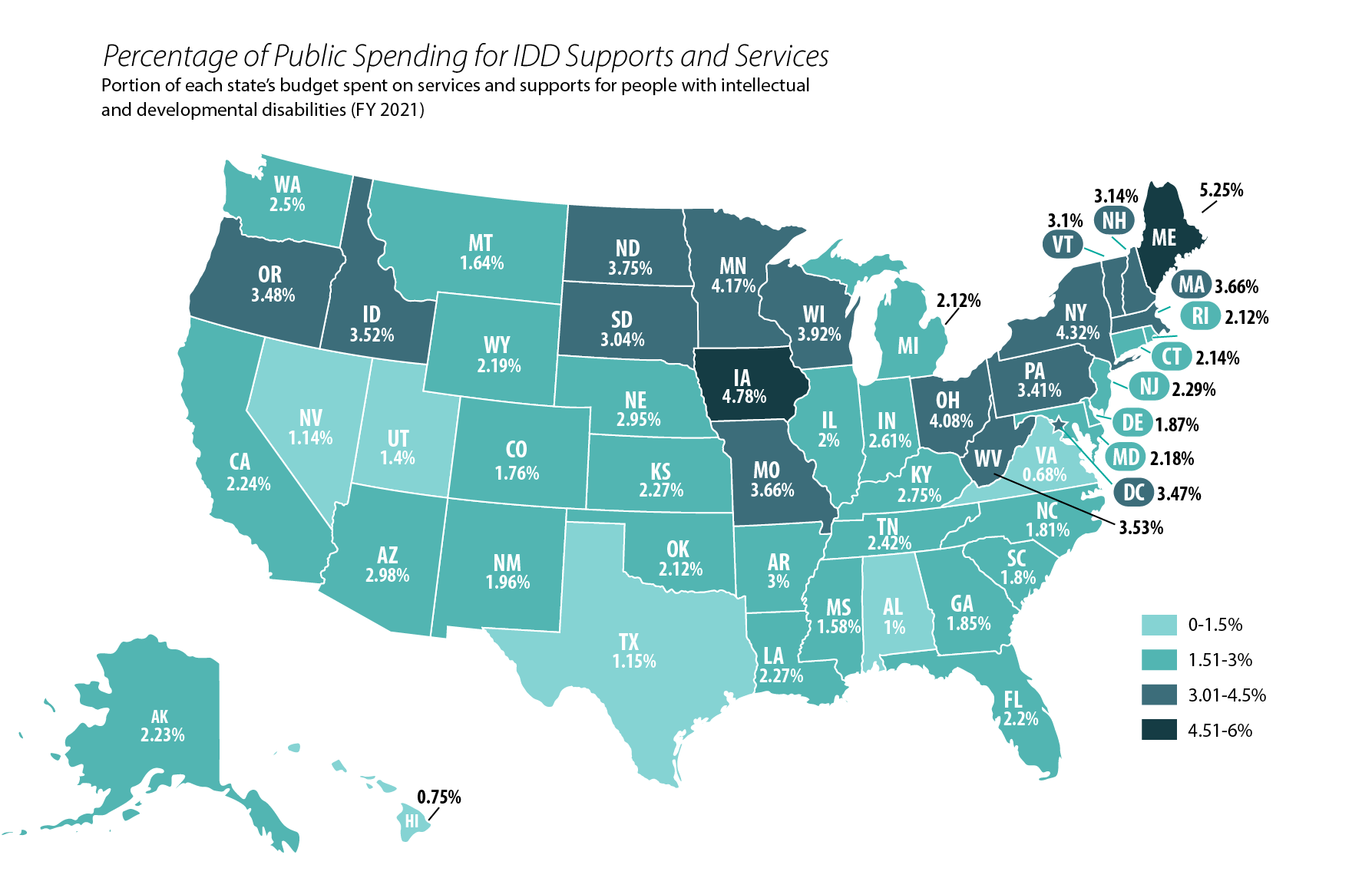
As a percentage of each state’s budget, supports for intellectual and developmental disability services make up between less than 1% and up to 6% of any state’s budget, or an average of 2.57%. This is illustrated in the map below.

This map of the United States shows the percentage of public spending in each state for IDD supports and services, ranging from .75% in Hawaii to 5.25% in Maine.


After Olmstead, funding shifted away from congregate settings:


Thursday, May 30, 2024

Best Practices for Health Care

 In The Politics of Autism, I discuss the day-to-day challenges facing autistic people and their familiesHealth problems are prominent among them. 

Kinga Borondy at Gannett:

A bill pending before the Massachusetts Legislature would establish best-practices standards around treatment of patients on the autism spectrum or those with intellectual and developmental disabilities.

“Terrible things can happen to people with autism or those who are intellectually developmentally delayed while they are in medical settings,” said Maura Sullivan, executive director of The Arc of Massachusetts. “They have been restrained, kept in isolation, suffered medical trauma.”

The legislation, sponsored by Rep. Sean Garballey, D-Medford, and Sen. Jason Lewis, D-Winchester, would offer training to all patient-facing staff, from doctors and nurses to custodians and security officers, on recognizing and adjusting to the challenges presented when treating and interacting with intellectually divergent patients.

The Arc already offers the training to young medical professionals through its Operation House Call program, which was launched in 1991 and uses a network of volunteer families. The program has been integrated into the Tufts School of Medicine and the Simmons School of Health Science, and has expanded to Yale School of Nursing, UMass Chan Medical School and Harvard Medical School.

The bill would set standards for treatment in Massachusetts as well as establish a mandatory training program for all practitioners, with continuing education credits for completing the course.

Tuesday, October 24, 2023

Medicaid, Autism, and Intellectual Disability

The Politics of Autism includes an extensive discussion of insurance and Medicaid services.


Lay Abstract
What is known? In most states, Medicaid waivers provide individuals with an intellectual disability diagnosis generous healthcare coverage throughout adulthood. By comparison, fewer Medicaid programs are available for autistic individuals, and they are more likely to experience disruptions, or gaps, in Medicaid coverage and subsequently not re-enroll.
What this paper adds? One in five autistic individuals with Medicaid coverage between ages 8 and 25 accrued a new intellectual disability diagnosis. The probability of a new intellectual disability diagnosis was higher among those who had previous disruptions in Medicaid coverage.
Implications for research and policy. Expanding Medicaid to cover autistic people of all ages could decrease the need for intellectual disability diagnosis accrual. Input from autistic individuals and their families regarding their health insurance access and healthcare experiences is critically important to understanding next steps for research.

One possibility is that they did not need ID services earlier, or simply fell through the cracks.

The second explanation is that individuals in our sample were diagnosed with ID as a mechanism for retaining or regaining Medicaid coverage not afforded to individuals with ASD alone. Prior research by Shea and colleagues (2022) supports this hypothesis; they observed autistic Medicaid enrollees with ID had half the probability of Medicaid disenrollment compared to those with ASD alone. Given individuals with ID have frequent interactions with the healthcare system (Shea et al., 2018), we expect our eligibility criteria of least 1 + claim in a 12-month period to be appropriate for identifying ID; sensitivity analyses supported robustness of these findings. Because of their established advocacy history people with ID are often more likely to be Medicaid-eligible than autistic people (Rizzolo et al., 2013). While the addition of an ID diagnosis among autistic people may help maintain Medicaid enrollment, it also could lead to autistic individuals not receiving autism-specific or appropriate healthcare if access is limited to ID-specific services (Shea et al., 2021). Although outpatient behavioral health services are the typical intervention modality recommended for both ASD and ID (Lloyd & Kennedy, 2014), the cognitive deficits observed in ID differ from the social and communication challenges observed in ASD (American Psychiatric Association, 2013).

Saturday, August 26, 2023

GAO on HCBS


From the Government Accountability Office:
Intellectual or developmental disabilities, such as Down syndrome, are conditions that are present from childhood that may result in difficulties with learning, problem solving, and using everyday life skills. Medicaid home-and community-based services (HCBS) programs provide a range of services that can help individuals with these disabilities with daily activities, such as eating and bathing.

Reviewing Medicaid data for six selected states, GAO found that over 45 percent of beneficiaries with intellectual or developmental disabilities enrolled in HCBS programs had an additional health condition in 2019. Health conditions included behavioral health conditions, such as anxiety disorders, and chronic physical conditions, such as high blood pressure. Among beneficiaries enrolled in comprehensive HCBS programs, which cover round-the-clock care, the prevalence of behavioral health conditions was higher than in the overall Medicaid population.

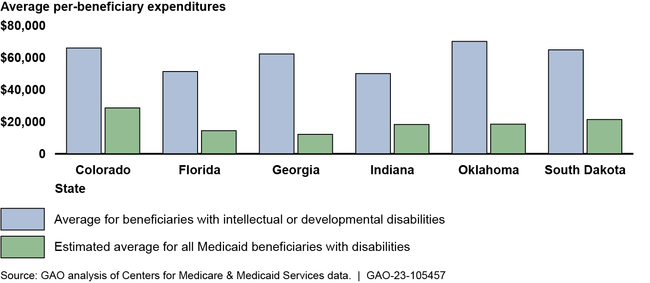
GAO's analysis found that average per-beneficiary Medicaid expenditures in 2019 for beneficiaries with intellectual or developmental disabilities in selected states ranged from about $51,000 to $70,000. This is two to five times higher than the average expenditure for all Medicaid beneficiaries with disabilities.

 GAO's analysis also found for 2019:


HCBS expenditures lower than institutional costs: Average HCBS program expenditures were generally lower than states' estimated costs for serving beneficiaries with intellectual or developmental disabilities in institutional settings.

Expenditures higher for beneficiaries with additional health conditions: Expenditures were generally higher for beneficiaries with intellectual or developmental disabilities who had additional health conditions. For example, in comprehensive HCBS programs, expenditures were 13 to 40 percent higher for beneficiaries with a behavioral health condition than for those without.


Why GAO Did This Study

Medicaid is the nation's primary payer of long-term services and supports, including HCBS programs, for individuals with intellectual or developmental disabilities. Medicaid spending for these services was estimated at $23 billion in fiscal year 2018, the most recent year of nationwide estimates available. States are permitted to limit enrollment in certain HCBS programs and establish waiting lists. Research has shown people with intellectual or developmental disabilities comprised the majority of individuals on waiting lists for HCBS programs as of 2021, with wait times averaging over 5 years.

GAO was asked to provide information about the characteristics and health care expenditures among Medicaid beneficiaries with intellectual or developmental disabilities with long-term care needs. For selected states, this report describes (1) health and demographic characteristics, and (2) health care expenditures for adults with intellectual or developmental disabilities enrolled in Medicaid HCBS programs in 2019.

GAO analyzed Medicaid data for 2019, the most recent finalized year of data that preceded the COVID-19 pandemic, for six states. States were selected based on, among other things, having at least one HCBS program covering nonelderly adults with intellectual or developmental disabilities in 2019, and having data in the federal Medicaid data system of sufficient detail and quality to conduct analysis.

Average Per-Beneficiary Medicaid Expenditures, 2019

HLFig_5-v3_105457


Wednesday, June 28, 2023

Autism and Euthanasia in the Netherlands

 In The Politics of Autism, I write about the dangers of eugenics and euthanasia

Irene Tuffrey-Wijne and colleagues have an article at BJPsych Open:Euthanasia and physician-assisted suicide in people with intellectual disabilities and/or autism spectrum disorders: investigation of 39 Dutch case reports (2012–2021)

Abstract

Background

Euthanasia review committees (Regionale Toetsingscommissies Euthanasie, RTE) scrutinise all Dutch cases of euthanasia and physician-assisted suicide (EAS) to review whether six legal ‘due care’ criteria are met, including ‘unbearable suffering without prospect of improvement’. There are significant complexities and ethical dilemmas if EAS requests are made by people with intellectual disabilities or autism spectrum disorders (ASD).

Aims

To describe the characteristics and circumstances of people with intellectual disabilities and/or ASD who were granted their EAS request; investigate the main causes of suffering that led to the EAS request; and examine physicians’ response to the request.

Method

The online RTE database of 927 EAS case reports (2012–2021) was searched for patients with intellectual disabilities and/or ASD (n = 39). Inductive thematic content analysis was performed on these case reports, using the framework method.

Results

Factors directly associated with intellectual disability and/or ASD were the sole cause of suffering described in 21% of cases and a major contributing factor in a further 42% of cases. Reasons for the EAS request included social isolation and loneliness (77%), lack of resilience or coping strategies (56%), lack of flexibility (rigid thinking or difficulty adapting to change) (44%) and oversensitivity to stimuli (26%). In one-third of cases, physicians noted there was ‘no prospect of improvement’ as ASD and intellectual disability are not treatable.

Conclusions

Examination of societal support for suffering associated with lifelong disability, and debates around the acceptability of these factors as reasons for granting EAS, are of international importance.


Wednesday, May 31, 2023

Transition in Norway

  In The Politics of Autism, I discuss international perspectives.

From Eric Benninghoff:

For the past year I have traveled throughout Norway, exploring the transition to adulthood for a variety of often-marginalized groups, including people with intellectual disabilities or learning challenges. Along the way, I have met several organizations aiming to improve the situation for this population, including a largely government-funded but privately run group called Helt Med.

Helt Med has developed a work inclusion model across Norway to help employ individuals with intellectual disabilities in the mainstream workforce. More recently, they have also been trying to expand a smaller pilot program called Ung Jobb, which aims to create a smooth school-to-career pipeline for some of these students.

As of spring 2023, only about 40 high school students have gone through the Ung Jobb program, which is primarily in Agder County in southern Norway. But Agder government announced it will be tripling its current investment in the program starting in the 2023-2024 school year. This comes as Helt Med aims to expand the Ung Jobb project to other parts of the country.

This video report takes an in-depth look at Helt Med’s school-to-career program in Agder County, exploring its potential as one solution to better support students with intellectual disabilities in their transition from school to working life in Norway.


Thursday, May 18, 2023

Discrimination in Kidney Transplants

In The Politics of Autism, I discuss the civil rights of people with autism and other disabilities.   A number of posts have provided details on discrimination in organ transplantation.

Brittany N. Hand and colleagues have an article at JAMA Surgery titled "Comparing Kidney Transplant Rates and Outcomes Among Adults With and Without Intellectual and Developmental Disabilities."

Key Points

Question How do rates of kidney transplant and transplant outcomes differ for adults with vs adults without intellectual and developmental disabilities (IDD)? [see 2/16/23 post]

Findings In this cohort study, adults with IDD were 54% less likely to be evaluated for and 62% less likely to receive a kidney transplant than adults without IDD. However, among those who received a kidney transplant, postoperative outcomes were similar for adults with and without IDD.

Meaning These data suggest the IDD should not categorically disqualify adults from transplant and underscore the urgent need for antidiscrimination initiatives to promote the receipt of equitable care for this population.
Abstract

Importance Improving equity in organ transplant access for people with intellectual and developmental disabilities (IDD) is a topic of social discourse in mainstream media, state legislation, and national legislation. However, few studies have compared evaluation rates, transplant rates, and outcomes among adults with and without IDD.

Objective To compare rates of kidney transplant and transplant-specific outcomes between propensity–score matched groups of adults with end-stage kidney disease (ESKD [also referred to as end-stage renal disease (ESRD)]) with and without co-occurring IDD.

Design, Setting, and Participants This retrospective cohort study included all Medicare inpatient and outpatient standard analytical files from 2013 through 2020. A total of 1 413 655 adult Medicare beneficiaries with ESKD were identified. Propensity–score matching was used to balance cohorts based on age, sex, race, follow-up duration, and Charlson Comorbidity Index. The matched cohorts consisted of 21 384 adults with ESKD (10 692 of whom had IDD) and 1258 kidney transplant recipients (629 of whom had IDD). Data were analyzed between June 1, 2022, and August 1, 2022.

Exposure IDD.

Main Outcomes and Measures Evaluation for kidney transplant, receipt of kidney transplant, perioperative complications, readmission, mortality, graft rejection, and graft failure.

Results Of the 21 384 propensity–score matched adults with ESKD, the median (IQR) age was 55 (43-65) years, 39.2% were male, 27.4% were Black, 64.1% were White, and 8.5% identified as another race or ethnicity. After propensity score matching within the ESKD cohort, 633 patients with IDD (5.9%) received a kidney transplant compared with 1367 of adults without IDD (12.8%). Adults with IDD were 54% less likely than matched peers without IDD to be evaluated for transplant (odds ratio, 0.46; 95% CI, 0.43-0.50) and 62% less likely to receive a kidney transplant (odds ratio, 0.38; 95% CI, 0.34-0.42). Among matched cohorts of kidney transplant recipients, rates of perioperative complications, readmission, and graft failure were similar for adults with and without IDD.

Conclusions and Relevance Using the largest cohort of adult kidney transplant recipients with IDD to date, the study team found that rates of evaluation and transplant were lower despite yielding equivalent outcomes. These data support consideration of adults with IDD for kidney transplant and underscore the urgent need for antidiscrimination initiatives to promote the receipt of equitable care for this population.

Thursday, February 16, 2023

Transplant Discrimination


Sophie Putka at MedPage Today:
Despite similar kidney transplant outcomes, adults with intellectual and developmental disabilities (IDD) were less likely than the general population to be evaluated for transplant and less likely to receive one, a propensity-score matched analysis found.

In the cohort of more than 21,000 end-stage kidney disease (ESKD) patients on Medicare, multivariable analysis showed that patients with IDD were 54% less likely than those without IDD to be evaluated by a transplant surgeon (OR 0.46, 95% CI 0.43-0.50) and 62% less likely to receive a transplant (OR 0.38, 95% CI 0.34-0.42), according to researchers led by Brittany Hand, PhD, of The Ohio State University School of Health and Rehabilitation Sciences in Columbus.

Among the subset evaluated by a transplant surgeon, about a fourth of the patients included overall, those with IDD had 51% lower odds of receiving a transplant (OR 0.49, 95% CI 0.43-0.55), the group reported in JAMA Surgery.
...

Only some states have passed laws that explicitly prohibit discrimination against people with disabilities in transplantation, they noted, adding that there's a need for strong evidence to back new policies -- like a bill at the federal level that would prohibit healthcare providers from denying someone access to an organ transplant because of a disability.


"We echo the authors' assertion that there is an urgent need to address bias and curb discrimination against this vulnerable patient population," said Melissa Chen, MD, and Alexander Toledo, MD, both of the University of North Carolina at Chapel Hill, writing in an accompanying editorial.

Thursday, January 26, 2023

Prevalence and Inequality

Autism rates tripled among children in the New York and New Jersey metropolitan area from 2000 to 2016, according to a study published Thursday in the journal Pediatrics.

The authors, a team from Rutgers University, calculated the trend by analyzing Centers for Disease Control and Prevention estimates of the number of children who've been identified as having autism spectrum disorder by age 8.

Although there is no medical test for autism, the CDC has established a network of 17 sites across the country that estimate autism rates based on a combination of formal medical diagnoses and records from schools and health care providers.

Nationally, the rise in autism rates has been similar to the trend in New York and New Jersey, according to a 2021 CDC report. One in 54 children had been diagnosed with autism by age 8 in 2016, compared to 1 in 150 in 2000.

Advances in diagnostic capabilities and greater understanding and awareness of autism spectrum disorder seem to be largely driving the increase, the Rutgers researchers said. But there’s probably more to the story: Genetic factors, and perhaps some environmental ones, too, might also be contributing to the trend.

Precisely what those other factors are is still unknown, but researchers are at least clear on one fact: Autism has nothing to do with vaccines.

"We know for sure, for so many years now, that vaccines don’t cause autism," said Santhosh Girirajan, an associate professor at Pennsylvania State University who studies the genetic underpinnings of neurodevelopmental disorders and wasn't involved in the new study.
“One of the assumptions about ASD is that it occurs alongside intellectual disabilities,” said Josephine Shenouda, an adjunct professor at the Rutgers School of Public Health and lead author of the study published in the journal Pediatrics. “This claim was supported by older studies suggesting that up to 75 percent of children with autism also have intellectual disability.”

“What our paper shows is that this assumption is not true,” Shenouda said. “In fact, in this study, two-in-three children with autism had no intellectual disability whatsoever.”

Using biannual data from the New Jersey Autism Study, researchers identified 4,661 8-year-olds with ASD in four New Jersey counties (Essex, Hudson, Ocean and Union) during the study period. Of these, 1,505 (32.3 percent) had an intellectual disability; 2,764 (59.3 percent) did not.

Subsequent analysis found that rates of ASD co-occurring with intellectual disability increased two-fold between 2000 and 2016 – from 2.9 per 1,000 to 7.3 per 1,000. Rates of ASD with no intellectual disability jumped five-fold, from 3.8 per 1,000 to 18.9 per 1,000.

Shenouda said there may be explanations for the observed increases, though more research is needed to specify the precise causes.

“Better awareness of and testing for ASD does play a role,” said Walter Zahorodny, associate professor at the Rutgers New Jersey Medical School and senior author on the study. “But the fact that we saw a 500 percent increase in autism among kids without any intellectual disabilities – children we know are falling through the cracks – suggests that something else is also driving the surge.”

ASD prevalence has been shown to be associated with race and socioeconomic status. The Rutgers study identified that Black children with ASD and no intellectual disabilities were 30 percent less likely to be identified compared with white children, while kids living in affluent areas were 80 percent more likely to be identified with ASD and no intellectual disabilities compared with children in underserved areas.


Saturday, December 10, 2022

Emergency HCBS Payments


This study’s aim was to examine the impact of pandemic emergency Home- and Community-Based Services (HCBS) payments on the continuity and security of people with intellectual and developmental disabilities (IDD). Using a multilevel logistic regression, we analyzed secondary Personal Outcome Measures interviews from 738 people with IDD (March 2020 through April 2022), and state pandemic emergency HCBS payment data from 16 states. The odds of people with IDD experiencing continuity and security during the pandemic increased by 3% for every 1% states increased their payment rates, and by 398% when states offered retainer payments. Increased reimbursement rates and retainer payments can help providers maintain operations and promote the continuity and security of people with IDD.

Friday, October 21, 2022

Worsening Shortage of Direct Support Professionals

In The Politics of Autism, I discuss the day-to-day challenges facing autistic people and their families.  One is a shortage of caregivers and direct support professionals, which is likely to get worse.  

From ANCOR:
For the third consecutive year, ANCOR has measured the impact of the direct support workforce crisis on community providers and their ability to provide high-quality community-based services for people with intellectual and developmental disabilities (I/DD). Although our research indicates that this was a significant challenge long before the COVID-19 pandemic, data from the 2022 State of America’s Direct Support Workforce Crisis confirms that these problems have not only been amplified by the pandemic but are also at the root of service and program closures, service launch delays, struggles adhering to quality standards and more. The results of our 2022 survey reveal that this workforce emergency is now to the point of denying access to services and further threatening the quality of services for people with I/DD.

Over the course of a four-week period beginning in August 2022, ANCOR fielded a survey across its provider network that garnered 718 responses. In the broadest terms, what we found is that providers are unable to attract and retain DSPs at a rate that, if left unaddressed, has the potential to completely collapse the system of services as we know it.

Key findings from ANCOR’s 2022 State of America’s Direct Support Workforce Crisis survey include that:
  • 83% of providers are turning away new referrals, a 25.8% increase since the beginning of the pandemic.
  • 63% of providers are discontinuing programs and services, a staggering 85.3% increase since the beginning of the pandemic.
  • 92% of providers are struggling to achieve quality standards, a 33.3% increase since the beginning of the pandemic and a 13.6% increase in the last year alone.
  • 71% of case managers are struggling to find available providers, citing difficulty to connect families to long-term services and supports due to lack of available providers.

Monday, August 8, 2022

Improved College Access in Massachuetts

  In The Politics of Autism, I discuss the growing number of college students on the autism spectrum

A July 28 release from Massachusetts Advocates for Children:

Thank you for your advocacy, your voices were heard! After almost a decade of advocacy, Governor Baker signed the higher education bill which provides inclusive educational opportunities for individuals with Intellectual Disabilities and Autism at state colleges and universities. Young adults with disabilities can now be lifelong learners with their peers!

Many thanks to Gov. Baker, Senate Ways and Means Chair Rodrigues, House Ways and Means Chair Michlewitz, Senate President Spilka, Speaker Mariano, lead sponsors Representative Garballey and Senator Lovely, Joint Committee on Higher Education Co-Chairs Senator Gobi and Representative Rogers, and many other important lawmakers.

This law includes provisions that remove barriers precluding persons with Intellectual Disabilities (ID) and Autism from participating in state colleges and universities. Individuals with ID and autism who cannot pass MCAS [Massachusetts Comprehensive Assessment System] and who do not obtain a regular high school diploma can participate as non-matriculating students in courses with their nondisabled peers and participate in extracurricular activities and other aspects of campus life, with supports and services necessary to facilitate inclusion.

The law also ensures state colleges and universities establish guidelines governing selection of individuals with ID and Autism as well as course selection. Supports and services to facilitate inclusion can be provided by the local school district, the Massachusetts Rehabilitation Commission, Department of Developmental Services, or private funding. The law also codifies the MAICEI grant program and allows the special education IEP Team to consider higher education as an option for students with disabilities.


Download the entire document here

View the new law here

Tuesday, May 24, 2022

Suicidal Ideation

In The Politics of Autism, I write:

Many analyses of autism speak as if it were only a childhood ailment and assume that parents are the main stakeholders. But most children with autism grow up to be adults with autism, and they suffer uniquely high levels of social isolation. Almost 40 percent of youth with an autism spectrum disorder never get together with friends, and 50 percent of never receive phone calls from friends. These figures are higher than for peers with intellectual disability, emotional disturbance, or learning disability. When school ends, many adults with autism have grim prospects. Though evidence is sparse, it seems that most do not find full-time jobs. Compared with other people their age, they have higher rates of depression, anxiety, bipolar disorder, and suicide attempts.


Youth suicide is a major problem in the United States and globally, but little is known about suicide risk in autistic youth and youth with intellectual disability specifically. Using data from the National Emergency Department Sample, which is the largest database of emergency department visits in the United States, we found that emergency department visits with a suicidal ideation or intentional self-inflicted injury diagnosis were more common in autistic youth and youth with intellectual disability than in youth without these diagnoses (i.e. the comparison group). This was true when examining both suicidal ideation diagnoses and intentional self-inflicted injury diagnoses at emergency department visits. In addition, the number of emergency department visits with a suicidal ideation or intentional self-inflicted injury diagnosis increased more from 2006 to 2014 in autistic youth and youth with intellectual disability compared with the comparison group. We also found both similarities and differences when examining factors, such as age, sex, and co-occurring mental health conditions, related to emergency department visits with a suicidal ideation or intentional self-inflicted injury diagnosis across groups that may be helpful for understanding suicide risk. It is urgent that we improve our understanding, assessment, and treatment of suicidality and self-harm in these groups through more research and clinical efforts.