Search This Blog

Showing posts with label Oklahoma. Show all posts

Tuesday, June 13, 2023

Autism by the Numbers: Age of First Intervention

Uncertainty is a major theme of The Politics of Autism.  In the concluding section, I write:
A key question in autism policy evaluation is simple to pose, hard to answer: How do autistic people benefit? How much better off are they as a result of government action? While there are studies of the short-term impact of various therapies, there is surprisingly little research about the long term, which is really what autistic people and their families care about. As we saw in chapter 4, few studies have focused on the educational attainment of autistic youths. For instance, we do not know much about what happens to them in high school, apart from the kinds of classes that they take. One study searched the autism literature from 1950 through 2011 and found just 13 rigorous peer reviewed studies evaluating psychosocial interventions for autistic adults. The effects of were largely positive, though the main finding of the review is that there is a need for further development and evaluation of treatments for adults.

Autism by the Numbers, created by Autism Speaks in collaboration with the National Autism Data Center at Drexel University, has the potential to transform the way we understand and meet the needs of autistic individuals and their families. This central, authoritative hub of reliable data about people with autism will allow insight into the strengths and weaknesses of systems that exist to improve health, education, employment and advocacy. The Autism by the Numbers Annual Report and Dashboard can also be used to support the creation of precision public health programs specific to the diverse needs of the autistic community.


 Autism by the Numbers data also show variation between states in access to diagnosis and early  intervention. 
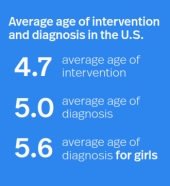
Infographic showing average age of intervention and diagnosis in the U.S.
  • Average age of first intervention ranges from 3.7 to 7.2 years of age across states.
  • Average age of diagnosis ranges from 3.6 years to 7.6 years across states.
  • Delaware and Kentucky have the youngest age of first intervention, at 3.7 years in each state.
  • Oklahoma (5.3 years), Mississippi (5.5 years), Ohio (5.6 years), North Dakota (6.0 years) and West Virginia (7.2 years) show an average age of intervention above the national average, indicating a possible need to improve screening processes or access to intervention services.

More in-depth research is needed to understand why some states are able to effectively screen for ASD and provide early intervention services, while others experience significant delays in care.
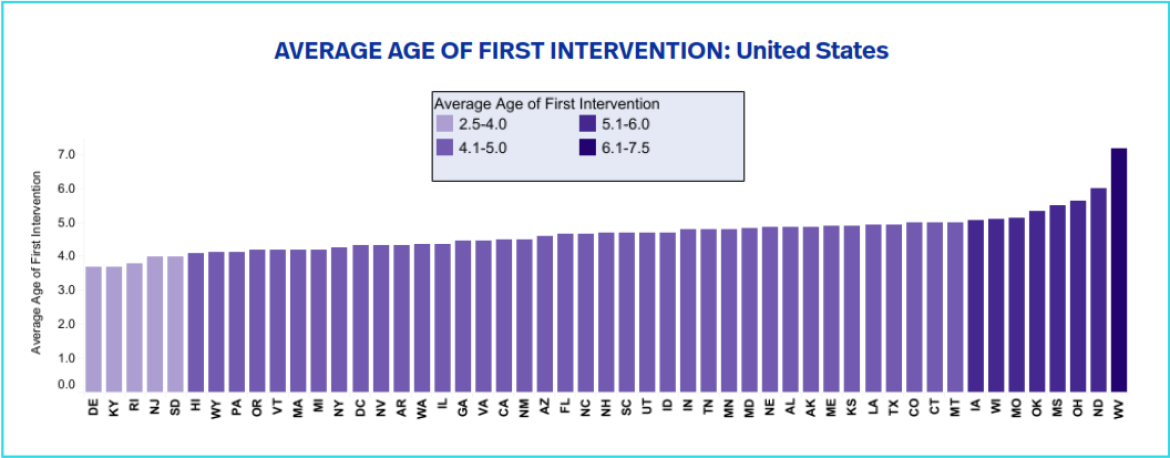
Bar graph showing average age of first intervention by state in the U.S.

Tuesday, March 28, 2023

Education Secretary on Corporal Punishment

In The Politics of Autism, I write about special education and the Individuals with Disabilities Education Act.

After an initial vote failed, the OK House voted to ban corporal punishment against some students with disabilities.

Letter from Secretary of Education Miguel A. Cardona to state and local officials:

Our nation's schools should make every effort to provide children and youth with safe and supportive environments that protect and enhance their physical, emotional, and mental well-being. Unfortunately, some schools continue to put the mental and physical well-being of students at risk by implementing the practice of corporal punishment,1 defined by the U.S. Department of Education (Department) as the practice of paddling, spanking, or otherwise imposing physical punishment on students.2 Therefore, if the use of corporal punishment is permitted or practiced in schools and educational settings within your state or district, I urge you to move swiftly toward condemning and eliminating it.
Laws in a majority of states and the District of Columbia ban the use of corporal punishment in public schools,3 and other states have prohibited the use of corporal punishment for students with disabilities.4 According to the Department's Civil Rights Data Collection (CRDC), the number of public school students subjected to corporal punishment declined between the 2013-14 to the 2017-18 school years.5 However, the use of corporal punishment in school is either expressly allowed or not expressly prohibited in 23 states.6 Furthermore, researchers have determined that the use of corporal punishment in schools is likely underreported.7
...
The CRDC data also reflects that students of color, boys, and students with disabilities are reported to be disproportionately subjected to corporal punishment.17 In the 2017-2018 school year, nearly 900 preschool students were subjected to corporal punishment.18 Boys represented about 81 percent of all students subjected to corporal punishment, but only account for about 50 percent of the total public school student population. As captured in this Office for Civil Rights infographic [PDF, 984KB], Black students were 2.3 times more likely than white students to receive corporal punishment.19 These disparities are particularly acute for Black students and students who represent more than one of these groups. In states that reported instances of corporal punishment, Black boys were twice as likely as white boys to be subjected to corporal punishment, and Black girls were 4 times as likely as white girls to be subjected to corporal punishment.20 In some states, other student subgroups, such as Native American students, are subject to corporal punishment at disparate rates.21

Thursday, March 16, 2023

Oklahoma Bill on Corporal Punishment

In The Politics of Autism, I write about special education and the Individuals with Disabilities Education Act.

María Luisa Paúl at WP:
Oklahoma state Rep. John Talley thought his bill to bar schools from spanking children with disabilities would find little to no opposition at the state’s legislature. After all, the Republican lawmaker said he had fielded calls with dozens of families and educational groups, drawn inspiration from his personal experience and received support from colleagues on both sides of the aisle.

Yet on Tuesday, what seemed like a rare bipartisan moment quickly came crashing down as other Republican lawmakers invoked the Bible to argue against Talley’s House Bill 1028, claiming in some instances that “God’s word is higher than all the so-called experts,” as Rep. Jim Olsen posited during the proposed legislation’s debate. The bill wound up with 45 votes in favor and 43 against — six short of the 51 it needed to pass.

“Several scriptures could be read here. Let me read just one, Proverbs 29: ‘The rod and reproof give wisdom, but a child left to himself bringeth his mother to shame,’” Olsen said. “So that would seem to endorse the use of corporal punishment.”

The problem with that assessment, Talley told The Washington Post, was that it conflated his bill with an overall ban on corporal punishment. House Bill 1028 would specifically prohibit schools from using that measure on “any student identified with a disability in accordance with the Individuals with Disabilities Education Act.” The current state law bars the punishment — which includes slapping, spanking or paddling — for children with “the most significant cognitive disabilities,” unless the student’s parents allow it through a waiver.

A minister himself, Talley also disagreed with Olsen’s religious interpretation.

“Why don’t we follow all the other Old Testament laws?” Talley said. “There’s about 4,000 of them, and one of them is to not allow wives to wear jewelry, or stone your child if they’re disobedient. Why don’t we do that? Because we pick and choose what we want to follow.”

Monday, November 12, 2018

Antivax Movement in New York and Oklahoma

In The Politics of Autism, I look at the discredited notion that vaccines cause autism.

Julia Belluz at Vox:
Anti-vaccine advocates have swayed parents in New York to refuse immunizations for their kids, sparking two of the largest measles outbreaks in the state’s recent history, according to local health officials.
As of Friday, 17 people in the neighborhoods of Williamsburg and Borough Park in New York City were confirmed with measles, along with 55 people in nearby Rockland County, for a total of 72 cases. Additional cases are currently under investigation, and the number is expected to rise.
What’s notable here is that all of the cases are occurring among unvaccinated or under-vaccinated Orthodox Jews, mainly children. When asked why people are opting out of vaccines, the city health department said anti-vaccine propagandists are distributing misinformation in the community.

The fearmongerers include the Brooklyn group called PEACH — or Parents Teaching and Advocating for Children’s Health — which spreads misinformation about vaccine safety, citing rabbis as authorities, through a hotline and magazines. Brooklyn Orthodox Rabbi William Handler has also been proclaiming the well-debunked link between the measles-mumps-rubella (MMR) vaccine and autism. Parents who “placate the gods of vaccination” are engaging in “child sacrifice,” he told Vox.
Last week, Republican Kevin Stitt won election as governor of Oklahoma.  In September, Sam Stein profiled him at The Daily Beast:
“I believe in choice,” Stitt said, “And we’ve got six children and we don’t vaccinate, we don’t do vaccinations on all of our children. So we definitely pick and choose which ones we’re gonna do. It’s gotta be up to the parents, we can never mandate that. I think there’s legislation right now that are trying to mandate that to go to public schools, it’s absolutely wrong. My wife was home schooled, I went to public schools, our kids go to Christian school, and that’s back to a parent’s choice.”

Stitt’s comments raise the specter that Oklahoma could water down immunization laws should he be elected the state’s governor this fall. They also place him within a growing fringe of politicians who have, in recent years, expressed skepticism over the prevalence of childhood vaccinations—a group that includes President Donald Trump himself.
“Kevin believes the topic of vaccinations is a serious decision that should be made by parents in consultation with their pediatricians,” said Donelle Harder, Stitt’s spokeswoman. She said that Stitt did not believe that vaccinations cause harmful medical side effects —an oft-argued and scientifically baseless claim from vaccine skeptics. The “root of his decision,” she said was the desire for parental choice
Such a position puts Stitt on the opposite side of public health advocates who have warned that immunizations must be a social contract in order to be medically effective. Anecdotal and scientific data has shown a direct correlation between vaccination hesitancy and the rise of diseases like measles.


Monday, November 5, 2018

"Vaccine Freedom PACs"

In The Politics of Autism, I look at the discredited notion that vaccines cause autism.

At Wired, Megan Molteni writes of Dr. Ervin Yen, a moderate Oklahoma legislator who who sponsored a bill to require vaccination of schoolchildren.  He lost his 2016 GOP primary to an antivaccine opponent.
In other hotbeds of anti-vaccine sentiment, centrist conservatives who’ve championed similar bills have also been conspicuously missing from this year’s midterm ballots. Replacing them are candidates backed by well-financed organizations made up of members who either entertain the fraudulent science linking vaccines to autism, who believe their kids have had adverse vaccine reactions, or think the government shouldn’t dictate what goes in their children’s bodies.
...
In the 18 states that currently permit parents to send their unvaccinated children to public schools on the grounds of philosophical objections, “Vaccine Freedom” PACs are increasingly flexing political muscle to keep it that way. By making a broader appeal to parental rights, some groups are now pushing agendas that would eliminate vaccine mandates of any kind. And as they shape this year’s election ballots to be more favorable to their cause, the nation creeps ever closer to an infectious disease outbreak as inevitable as it will be tragic.
...
On Tuesday, Americans will head to the polls to cast their votes in what may be the most consequential midterm elections in modern US history. While all eyes will be on the national races that could shift power in Washington, just as crucial are the state legislative elections taking place further down the ballot. States are the battlefields where the Trump administration’s war on science, regulations, the environment, and the rights of minorities are increasingly being fought. They are where decisions about vaccines as a cornerstone of 21st-century public health policy get made.
The good news is that laws work. When California got rid of personal belief exemptions in 2015, only 90.4 percent of kindergartners in public schools were fully immunized. In the 2017-18 school year, 95.1 percent of kindergartners had all their immunizations, according to the California Department of Health. The bad news is, California is one of only three states to have such strict requirements.
As vaccine freedom PACs move from the margins to mainstream, more and more kids are going to school unvaccinated. Data released in October from the Centers for Disease Control and Prevention showed that while national exemption rates remain low at 2.2 percent, this is the third year that exemptions have increased. At least where vaccinations are concerned, where California goes, the nation does not seem to be following.

Wednesday, October 24, 2018

Gubernatorial Candidates Abet the Antivax Movement

In The Politics of Autism, I look at the discredited notion that vaccines cause autism.

Republican gubernatorial candidates are abetting the anti-vax movement.

Max Reiss at NBC Connecticut:
In a grainy video recorded over the summer at a campaign event, Bob Stefanowski, the Republican candidate for governor, shared some of his thoughts on childhood immunization laws.
NBC Connecticut obtained the video of Stefanowski from a source working for Democratic campaigns in Connecticut. The video is two minutes long, and it is unknown what is said before or after the two-minute portion on immunization policy.
Stefanowski was asked by an audience member at the event, which appears to have been hosted by the Quiet Corner Tea Party, about the state mandating certain immunizations in order for students to attend public school.
The member of the audience, who is off camera and cannot be identified, asked, “Do you think the state should dictate [immunizations] or should local [Boards of Education] handle that?”
Stefanowski responded by saying, “I think it depends on the vaccination. We shouldn’t be dumping a lot of drugs into kids for no reason.”
Reiss also reports:
More than three dozen doctors, nurses, and other medical professionals are criticizing Republican gubernatorial nominee Bob Stefanowski after NBC Connecticut aired exclusive video of the candidate expressing skepticism of childhood vaccines and the state law requiring kids get immunized in order to attend school.

The group of health professionals includes pediatricians, registered nurses, and other specialists.
"As pediatricians, it is deeply concerning to us that a candidate for governor would spread flagrant disinformation about childhood vaccinations," The group wrote of Stefanowski’s comments.
They went on to describe Stefanowski’s position as, "downright dangerous," and "irresponsible."
Jay Michaelson at The Daily Beast:
In Oregon, Dr. Knute Buehler—yes, a physician—said that “parents should have the right to opt out” of vaccinations “for personal beliefs, for religious beliefs or even if they have strong alternative medical beliefs.”
Buehler described the opt-out system as beneficial. “I think that gives people option and choice and that’s the policy I would continue to pursue as Oregon’s governor,” he said.
And in Oklahoma, Kevin Stitt, the favorite in the governor’s race, said in February that “I believe in choice. And we’ve got six children and we don’t vaccinate, we don’t do vaccinations on all of our children. So we definitely pick and choose which ones we’re gonna do. It’s gotta be up to the parents, we can never mandate that. I think there’s legislation right now that are trying to mandate that to go to public schools, it’s absolutely wrong. My wife was home schooled, I went to public schools, our kids go to Christian school, and that’s back to a parent’s choice.”.”

Sunday, September 17, 2017

Special Education Teacher Shortage in Oklahoma


Public schools in 48 states and the District of Columbia report teacher shortages in math for the 2017-18 school year, according to the US Department of Education. Forty-six states report shortages in special education, 43 in science and 41 in foreign languages.
Jennifer Palmer reports at Oklahoma Watch:
Oklahoma schools started the school year with more than 500 teaching vacancies, but special education is the most difficult to fill, according to a recent survey of 300 districts by the Oklahoma State School Boards Association. Some districts report special education teacher vacancies year after year.
The shortage of special education teachers is a nationwide problem. It is likely compounded in Oklahoma by the state’s comparatively low teacher salaries, although state law requires that special education teachers receive a salary of 5 percent more than general education teachers. Forty-six states, including Oklahoma, reported shortages in special education for the 2017-2018 school year; math and science are also hard-to-staff areas.
...
High turnover is driving the special-education teacher shortage. Special education teachers tend to leave the classroom at higher rates than general education teachers, and they burn out quicker, research has shown. Coupled with the normal teaching demands is a grueling amount of paperwork and meetings required by federal law.
But the shortage is a pipeline issue, too. Federal data show students graduating with teaching credentials in areas like early childhood and elementary education far outnumber those credentialed to teach students with disabilities. The University of Oklahoma, for instance, graduated six special education teachers in 2015-2016, compared to 69 in elementary education. Keeping those graduates in Oklahoma is an even bigger issue: More than half of OU’s spring teaching graduates accepted jobs out of state this year.

Tuesday, April 4, 2017

Autism Advocacy in Oklahoma

The Politics of Autism includes an extensive discussion of insurance legislation in the states.

William W. Savage III writes at NONDOC:
When Tara Hood and a group of dedicated parents decided to advocate for the Oklahoma Legislature to pass a bill mandating health insurance coverage of autism treatment, she thought it would take a few years.
“We didn’t know what we were doing,” Hood said. “None of us thought it was going to pass in one year. We were pleasantly surprised.”
Hood and other autism advocates spoke of their 2016 legislative victory Monday during Autism Awareness Day at the Oklahoma State Capitol. They also discussed further efforts they said are needed to improve the lives of the thousands of Oklahoma children living on the autism spectrum.
...
[D]espite the mandate taking effect Nov. 1 for state-based insurance plans in Oklahoma, families with autistic children have plenty of room to fall through the cracks.
For instance, SoonerCare (Oklahoma’s Medicaid program) does not offer coverage for things like applied behavior analysis (ABA), said Judith Ursitti, director of state government affairs for the national advocacy organization Autism Speaks.
...
“There are still some gaps,” Ursitti said of Oklahoma’s law. “It’s a federal mandate (for Medicaid programs), but Oklahoma is not in compliance.”

Friday, May 6, 2016

Oklahoma Governor Signs Mandate

The Politics of Autism includes an extensive discussion of insurance legislation in the states.

Barbara Hoberock reports at The Tulsa World:
Coverage for children with autism will be required in insurance policies under a bill signed into law Wednesday by Gov. Mary Fallin.
House Bill 2962, by Rep. Jason Nelson, R-Oklahoma City, mandates that insurance policies issued in the state provide coverage for the screening, diagnosis and treatment of autism spectrum disorder for children younger than 9 or for up to six years for children diagnosed after age 3, with an annual maximum benefit of $25,000.

The Oklahoma autism community is thrilled — parents and providers alike,” said Tara Hood, a founder of Oklahomans for Autism Insurance Reform. “We have been waiting years and years for meaningful autism insurance reform to happen in Oklahoma, and we could not be more happy.

“When you get a child diagnosed with autism in Oklahoma, you only have few choices.”

The law goes into effect Nov. 1.

Wednesday, April 27, 2016

Final Passage of Oklahoma Insurance Mandate

The Politics of Autism includes an extensive discussion of insurance legislation in the states.

Legislation that requires health insurers to cover the treatment of children with autism has received final legislative approval in the Oklahoma House.
The House on Wednesday voted 65-26 for the bill and sent it to Gov. Mary Fallin for her signature.
The bill requires coverage for the screening, diagnosis and treatment of autism spectrum disorder in children younger than 9 years old. Under the measure, children would have access to applied behavior analysis for up to 25 hours a week, with a limit of $25,000 a year.
Autism spectrum disorder affects how a person processes sensory information and their ability to interact and relate to others. Oklahoma is one of only seven states in the nation that does not require insurers to cover autism.

House Bill 2962: http://bit.ly/1R7F9l

Wednesday, April 20, 2016

Endorsement of Oklahoma Mandate

The Politics of Autism includes an extensive discussion of insurance legislation in the states.

The Tulsa World editorial:
The Oklahoma Senate approved last week a measure to mandate coverage. The state House has previously approved a variation of the same legislation. So the measure must return to the House, but our sense is that House Bill 2962 is about to become law.
It’s about time. A similar proposal was considered in a highly emotional debate in 2008 and 2009, but was not approved. That choice has left thousands of insured Oklahoma families to face the extreme financial challenge of autism without any coverage.
Since then, we’ve learned more about the treatment of autism and the cost of that treatment.
While the disorder can be ruinously expensive for families, it’s impact on insurance rates is modest: about 50 cents per month per policyholder, based on other states’ experience.
...
We urge the House to accept Senate amendments to HB 2962 and quickly send this important reform to the desk of Gov. Mary Fallin.

Thursday, March 31, 2016

OK Autism Insurance Mandate Advances

The Politics of Autism includes an extensive discussion of insurance legislation in the states.

Barbara Hoberock reports at The Tulsa World:
A bill requiring insurance companies to cover the treatment of autistic children is headed to the Senate floor.
The Senate Appropriations Committee on Wednesday passed House Bill 2962, by Rep. Jason Nelson, R-Oklahoma City, and Sen. A.J. Griffin, R-Guthrie.

The vote was 36-3. Voting against the measure were Sens. Bill Brown, R-Broken Arrow, Nathan Dahm, R-Broken Arrow, and Anthony Sykes, R-Moore.

The measure requires coverage for the screening, diagnosis and treatment of autism spectrum disorder in individuals younger than 9 years old.

If the person is not diagnosed or treated until after the age of 3, coverage shall be provided for at least six years, provided that the child shows sufficient progress and improvement determined by the health-care provider, according to the measure.

“No insurer shall terminate coverage or refuse to deliver, execute, issue, amend, adjust or renew coverage to an individual solely because the individual is diagnosed with or has received treatment for an autism spectrum disorder,” according to the measure.

The bill would limit coverage for applied behavior analysis to 25 hours per week and no more than $25,000 a year.

Thursday, March 10, 2016

Mandate Passes Oklahoma House

The Politics of Autism includes an extensive discussion of insurance legislation in the states.

Randy Krehbiel reports at The Tulsa World:
Autism treatment would be included in all new health benefit plans in the state under legislation approved Wednesday by the Oklahoma House of Representatives.
A sometimes emotional discussion and debate ended with a 76-20 vote reflecting a marked change on the issue by the House’s Republican majority.

House Bill 2962, by Rep. Jason Nelson, R-Oklahoma City, would require insurers to cover autism for children up to 9 years old, or for six years after diagnosis if the diagnosis is made after age 3.
The amount of coverage limit could be no less than $25,000 per year.
The law also would apply to children covered by Sooner Care, the state’s Medicaid program. Legislative staff estimated the cost of that portion of the bill at $22 million to the state.
Tim Talley reports at AP:
“It’s been a long battle … to fight for those who can’t really fight for themselves up here,” said Rep. Mike Brown, a Democrat from Tahlequah who played a pivotal role in trying to pass autism coverage legislation in 2008.
Brown said research indicates that the early diagnosis of autism spectrum disorder can provide the basis for an appropriate educational and treatment program.
“There’s a window of opportunity that’s very narrow in these children’s lives,” Brown said. “It’s time to do the right thing.”

Saturday, February 27, 2016

Oklahoma: Autism Doesn't End with the School Day

The Politics of Autism includes an extensive discussion of insurance legislation in the states.

Opponents of insurance mandates say that schools should provide autism services. At Tulsa World, Carey Cadieux Ward writes:
But autism doesn’t end with the school day. What about children with autism who are unable to speak or communicate in any way? What about those who suffer from behaviors that cause them to hurt themselves or others, keeping them from even walking through the school doors in the first place?
...

The bad news is that health insurers in Oklahoma deny these treatments, saying that the schools should handle them. I wonder if the real assumption health plans are making is related to the cost of covering it. It’s a valid concern. Health insurance is expensive these days. But reasonable readers will recognize that other factors not originating in Oklahoma are causing that expense.

Actual claims data for autism coverage from multiple states show that the cost passed along to premiums payers is around 40-50 cents per month, less than the cost of a postage stamp. Meanwhile, the Harvard School of Public Health says it costs $3.2 million to care for individuals on the autism spectrum over their lifetime if they don’t get the treatment they need.

Some 43 states have passed autism insurance reform laws, including all states bordering Oklahoma. My assumption is that true fiscal conservatives who work hard and pay taxes in Oklahoma recognize the impact of those numbers.

Legislators from both parties recognize it too, and House Bill 2962 is the result. It’s a simple piece of legislation that requires health insurance to cover basic, evidence-based treatment for autism in Oklahoma.

Monday, February 22, 2016

Pushing for a Mandate in Oklahoma

The Politics of Autism includes an extensive discussion of insurance legislation in the states.

Bill Schammert reports at KOKH-TV:
For the first time in nearly a decade, legislators are looking at the issue of insurance coverage for autistic children. On Wednesday, dozens of families from across Oklahoma gathered at the state capitol to make their presence known.
"We have really good momentum and a lot of positive support," mother Tara Hood said.
Hood is referencing House Bill 2962. She's the mother of two autistic children. Statistics show one in every 64 children will be born with autism.
"You get the news and it's a punch in the gut," she said. "Then in Oklahoma, you find out none of the [suggested] therapies are covered, so it's a double kick in the gut."
Bill Hickman writes at The Oklahoman:
As the father of a child diagnosed with an autism spectrum disorder, an attorney who has represented children with special needs, and chairman of the board of the Good Shepherd School for Autism in Oklahoma City, I'm grateful that state Reps. Jason Nelson and Jason Dunnington, both of Oklahoma City, have introduced House Bill 2962. This represents a bipartisan effort to enact an insurance mandate for autism coverage this legislative session.
Oklahoma parents who have children diagnosed with autism deserve the same treatment in insurance law as parents whose children are diagnosed with a life-threatening illness. Be it autism or a life-threatening illness, treatment is critical to the child and cost-prohibitive for most parents without insurance.
If 43 states and the District of Columbia can require autism coverage in their states, so can Oklahoma. I call on all citizens and lawmakers to support this quest and make certain the 1 in 68 Oklahoma children who need and deserve autism treatment receive it.
This isn't just a legal issue. It's also a moral one, and one that Oklahoma must finally address.

Thursday, February 4, 2016

Insurance in Oklahoma

The Politics of Autism includes an extensive discussion of insurance legislation in the states.

Steve Shaw reports at KWTV in Oklahoma:
State lawmakers are considering a bill that would help thousands of families dealing with Autism.

House Bill 2962 was introduced in a House Insurance Committee earlier this week. Supporters say Oklahoma is one of only seven states that don’t make insurance companies cover autism treatments.

...
Dr. Scott Singleton is Clinical Director at Good Shepherd Catholic School in Oklahoma City. All of the students at the school either suffer from Autism or another neurological disability. He said passing this legislation is a no-brainer.
“It costs about $5,000 a month if you don’t get early intervention, if you get early intervention it drops that number down to about $3,000 a month,” Dr. Singleton.
News9.com - Oklahoma City, OK - News, Weather, Video and Sports |

Friday, January 29, 2016

Insurance Legislation in Oklahoma

The Politics of Autism includes an extensive discussion of insurance legislation in the states.

Oklahoma lawmakers are fighting to help children on the autism spectrum. Rep. Jason Nelson authored a bipartisan bill to mandate insurance companies cover treatment and diagnosis costs. Oklahoma is only one of seven states that do not require insurance companies to help with autism treatment and medication costs. Many families here in Oklahoma hope we won't be the last state to require it.
A.J. Griffin is sponsoring the legislation in the state senate.

Rep. Nelson said revisiting because our state has been here before. In 2008 a similar bill deemed "Nick's Law" was proposed, named after Nick Rhode. His family also fought hard for their son on the autism spectrum, but the bill was never even heard. The Rhode family ultimately left the state because caring for Nick cost too much. Rep. Nelson thinks the issues the legislature had with the bill then, have now been fixed.
"The bill is different than it was and I think the approach is different than it was then," he said.
In the last eight years, many other states have passed autism insurance laws. They found the requirement impacted insurance premiums by only 31-46 cents per member per month. That amount is far below the estimates lawmakers had in 2008.
Lacey Lett reports at KFOR-TV:
"We're not asking for any special treatment, just equal treatment that other states have already passed," said Tara Hood, an advocate.
Forty-three other states passed similar autism reform legislation.
Hood is hoping Oklahoma will be next on the list.
"If my daughter had a different diagnosis of ADHD, it would be covered. I'm not sure why autism is excluded," Hood said.
More from Autism Speaks 

Monday, June 8, 2015

Ending the Vaccine Exemption in Oklahoma

Jaclyn Cosgrove writes at The Oklahoman:
Sen. Ervin Yen, R-Oklahoma City, a cardiac anesthesiologist, plans to file legislation next year that would remove the religious and philosophical exemption options.

Yen wrote the legislation after a measles outbreak that started at Disneyland in California in December. As of Feb. 11, a total of 125 measles cases with rash had been confirmed in U.S. residents connected to the outbreak, according to the Centers for Disease Control and Prevention.
Yen said he anticipates some lawmakers will argue that the government should not tell people what to do, but in the realm of vaccines, it’s a matter of public safety.
“This is not telling people they have to vaccinate their kids — it’s telling them they need to vaccinate their kids if they go to public, private or parochial schools,” Yen said.

Yen said he was concerned that, in Oklahoma, the number of children whose parents are choosing to exempt their children has continued to rise.
Although it remains a small number, Oklahoma has seen an increased number of parents choosing the personal exemption.

In the 2004-05 school year, only .3 percent of kindergarteners were not vaccinated because of their parents’ personal beliefs, according to a voluntary survey that the state Health Department administers to schools across Oklahoma. However, in 2014-15 school year, that number rose to 1.1 percent

Tuesday, October 30, 2012

Autism in a Minnesota House Race, Continued

The Associated Press reports on a Minnesota congressional race.  As a previous post noted, the incumbent disclosed that he had moved his children, including his ASD son, to Massachusetts to be closer to their mother.
An autism advocate accused Republican Rep. Chip Cravaack on Monday of revealing his son's autism to get sympathy as he faces questions about his Minnesota ties in a tight congressional race.
Wayne Rohde of the Autism Advocacy Coalition of Minnesota said Cravaack has done little in Washington regarding autism issues. Rohde said Cravaack hasn't joined a bipartisan congressional autism caucus or been active in supporting a federal push for insurance coverage of autism treatments.
"I truly believe it was used to try to gain sympathy and deflect any questions about his residency issue," he said.
...
Rohde, who lives outside the 8th District in Woodbury, described himself as a Republican who isn't politically active. He contacted both campaigns Saturday and heard back from Nolan campaign manager Mike Misterek, who Rohde said asked if he would be willing to release his story to the media.
Misterek said he called Rohde to acknowledge his message.
"I don't think this is a political thing at all," Misterek said.
Campaign adviser Ben Golnik said Cravaack was being honest in disclosing how his son's autism affected the family's move, calling the contact between Nolan's campaign and Rohde "a disgusting new low."
As a previous post noted, Rohde moved from Oklahoma to Minnesota because the latter had a stronger insurance mandate. He was a co-founder of the Vaccine Safety Council of Minnesota.

Tuesday, April 12, 2011

ABA: The Good, the Bad, the Contentious

Today, autism in children has become more prevalent than childhood cancer, juvenile diabetes and pediatric AIDS combined, according to a national autism organization, and TRICARE now covers Applied Behavior Analysis therapy to treat eligible beneficiaries.

Autism Speaks, a national autism science and advocacy organization, defines autism as "a group of complex developmental brain disorders." Today, about one in every 110 children is diagnosed with autism.

April is Autism Awareness Month, a month that's been observed by the Autism Society since the 1970s, according to their website. Autism Awareness Month highlights the growing need for concern about autism and its potential treatments.

Many different types of treatment exist for an autistic individual. However, one of the more prominent techniques that has gained status recently is ABA therapy. According to the National Institute of Child Health and Human Development, ABA may help reduce problem behaviors associated with autism and teach vital new skills.

As part of the growing recognition of ABA therapy, TRICARE now covers this type of treatment for eligible beneficiaries. It's part of TRICARE's Autism Services Demonstration, an enhanced benefit under the ECHO program. ECHO - or Extended Care Health Option - is TRICARE's benefit for individuals with disabilities.
With autism legislation blocked three years in a row at the state Capital, Eric Littleton said he is interviewing for jobs out of state and will be leaving Oklahoma as soon as he can find work.

“The policies that are currently being promoted do not reflect the values or the faith that the people of Oklahoma embrace, and I continue to cry out to my brothers and sisters to speak out on this unbiblical status quo,” Littleton said.

A series of reforms were passed in 2009 geared to help children with autism. Sooner Success is a program that trains primary care physicians and pediatricians to be specialists in diagnosing autism from birth to age 3. Twenty Oklahoma doctors are specialized in diagnosing autism, he said.

Solomon Littleton was 5 years old in 2008 when he contracted the rare neurological disease Landau-Kleffner syndrome. Eric and Marci Littleton saw their son’s normal life deteriorate with a loss of motor skills. Soon Solomon could no longer feed himself, toilet or dress himself. His behavior became erratic as he would slam his body into walls at home.

House Bill 1248 by state Rep. Randy Grau, R-Edmond, was intended to include children with autism spectrum disorders in the state’s high risk insurance pool. The bill was killed in March by the Appropriations and Budget Committee. The high risk pool was created by the Legislature in 1995 to serve those who have been denied health insurance due to a serious health condition.

House Speaker Kris Steele, R-Shawnee, said he wants to delay consideration of Grau’s bill pending evaluation of a new Sooner Start program that is based on Senate Bill 135. SB 135 went into effect in January. It was authored by Steele and state Sen. Ron Justice.
Maura Lerner reports at The Minneapolis Star-Tribune:

Eric Larsson, a Minneapolis psychologist and leading advocate, says ABA is more than just a treatment -- it's a way to rescue children "from the ravages of autism." He tells parents that nearly half of children can recover if they start ABA soon enough. "They're coming to us because they want to cure their child," he said. "Just like you or I would do if we had cancer."

But other autism experts say the benefits of ABA treatment have been blown out of proportion. They say there is scarce evidence that it's really better than less costly alternatives.

"A lot of claims out there are inflated," said Barbara Luskin, a psychologist with the Autism Society of Minnesota. "Autism is a difference in the way your brain is. You're not going to cure it."

This year, for the third year in a row, the Minnesota Legislature is debating whether to require the state's health insurance plans to cover ABA treatment for autism, a speech and behavior disorder that is said to affect 1 in 110 children nationally.

More than 20 states have adopted such mandates since 2007, says Lorri Unumb of Autism Speaks, a national advocacy group. Ultimately, she hopes it will become the law of the land as part of national health reform.

"There is no controversy at all about whether ABA is the gold-standard treatment," says Unumb, a lawyer and senior policy adviser. "The only discussion is whether we can afford it."

But among medical experts, there is no consensus that ABA is necessarily the best, says Dr. James Moore, an autism specialist at Children's Hospitals and Clinics of Minnesota.

"If we all believed it, then we wouldn't recommend anything else," Moore said.

In Minnesota, health plans typically pay for certain types of autism treatment, such as speech and occupational therapy. But most draw the line at ABA, calling it costly and unproven.

"The concern is that you've got desperate parents," said Glenn Andis, a psychologist and senior vice president of Medica Health Plans, which opposes the mandate. "You've got a provider who says they've got all the answers, and they're going to cure their kids? Need I say more?"