Search This Blog

Showing posts with label housing. Show all posts

Wednesday, September 30, 2026

Lawmakers Seek to Affirm Olmstead

 In The Politics of Autism, I discuss court cases involving the civil rights of people with autism and other disabilities. 


In August, the Department of Justice quietly released a memo pertaining to the landmark 1999 disability civil rights case Olmstead v. L.C.  That precedent, the memo claimed without evidence, increases homelessness.

From the Disability Rights Education and Defense Fund:
This week, a bipartisan House resolution was introduced in Congress affirming the right of disabled people to live in their homes and communities, not segregated in institutions. The Defend Community Integration Coalition (DCIC) applauds this introduction.

We thank Bipartisan Disability Caucus Co-Chairs Representatives Debbie Dingell (D) and Brian Fitzpatrick (R) for leading and introducing H. Res. 1586, which affirms that the Olmstead decision reflects Congress’s intent that people with disabilities should live and receive services in their communities. The resolution is also cosponsored by Representatives Kean (R), Lawler (R), Wilson (R), Scanlon (D), and Simon (D), showing strong bipartisan support for community integration, and reflecting its bipartisan history.

More than 27 years ago, the Supreme Court held in Olmstead v. Lois Curtis that the unjustified isolation of people with disabilities is discrimination under the Americans with Disabilities Act. That ruling did not come out of nowhere.Res. 1586 lays out the record: in 1977 and 1978, federal regulations under Section 504 of the Rehabilitation Act provided that services for people with disabilities must be delivered in the most integrated setting appropriate. Congress ratified those rules when it amended Section 504 in 1978. In 1990, it wrote into the ADA a finding that isolation and segregation are a serious and pervasive form of discrimination and incorporated Section 504’s integration regulations into the ADA’s public services title. The Supreme Court affirmed in the Olmstead decision that unnecessary segregation of people with disabilities is a form of disability discrimination. The integration mandate is the law as written and enacted by Congress. It is a civil right that has been reaffirmed by courts for decades.

That clarity matters right now. The integration mandate is facing new and unprecedented attacks, so this affirmation of Congress’s directives could not be more timely. Disabled people belong in our communities. This resolution sends a clear message from both sides of the aisle that Congress meant what it said, and we urge every member to cosponsor it.

We urge every House member to cosponsor H. Res. 1586, and we call on the Senate to introduce a similar bipartisan resolution as soon as possible. We also call on federal and state leaders to back the Congressional commitment with increased investment in home and community-based services and the direct care workforce that makes community living possible. Let’s defend community integration today.
Learn more about the Olmstead decision
Learn more about the Defend Community Integration Coalition

Video description: Jessica Podesva and Steve Lieberman speak into a microphone with the U.S. Capitol dome in the background. Thumbnail: Visit ncil.org/community. Defend Community Integration Coalition Logo features logos of: National Council on Independent Living; American Association of People with Disabilities; Autistic Self Advocacy Network; Caring Across Generations; National Disability Rights Network; United Spinal Association; Access Living; National Association of Councils on Developmental Disabilities; Center for Public Representation; Bazelon Center for Mental Health Law; Disability Rights Education and Defense Fund.

Tuesday, September 15, 2026

Governors Push Back on DOJ's Efforts to Undercut Olmstead

 In The Politics of Autism, I discuss court cases involving the civil rights of people with autism and other disabilities. 


In August, the Department of Justice quietly released a memo pertaining to the landmark 1999 disability civil rights case Olmstead v. L.C.  That precedent, the memo claimed without evidence, increases homelessness.

Eighteen governors signed a letter asking the Justice Department to stop its efforts to undercut enforcement of the Olmstead decision.  

For nearly four decades, the Americans with Disabilities Act (ADA) has embodied a fundamental national commitment that disability should not be a basis for exclusion or diminished opportunity.  States have worked with local and federal government partners since 1990 to implement both the letter and spirit of this much-celebrated, bipartisan law.  On June 18, 2026, the Department of Justice’s Office of Legal Counsel issued a legal opinion that questions the longstanding legal framework surrounding the rights of Americans with disabilities to live with dignity, independence, and full community participation.  On July 20, 2026, the DOJ declared that it will not rely on its own longstanding Olmstead guidance, issued June 22, 2011. 

As Governors, we are deeply concerned by the federal government’s retreat from its longstanding role in protecting the right to community integration and that such actions signal changes to programs serving individuals with disabilities. For more than 25 years, the Supreme Court’s landmark decision in Olmstead v. L.C. has built on the commitment of the ADA and reinforced the principle that people with disabilities should have the opportunity to live, work, receive services, and participate in their communities rather than being unnecessarily segregated in institutional settings. This is a principle Americans are proud of and is a Northstar internationally for people with disabilities. 

This principle has changed lives and transformed this country. Red and blue states have spent decades investing in home and community based services, developing supportive housing, expanding access to education and employment opportunities, and redesigning and strengthening community based services.  These efforts reflect not only our progress under federal civil rights law, but our shared conviction that people with disabilities belong in their communities, whenever possible.  

Recent actions have already created significant uncertainty for states and for the workforce of dedicated individuals who support people with disabilities throughout the country.  More importantly, people with disabilities and their families are terrified about moving backwards - or worse - becoming institutionalized against their will - after decades of advocacy.  We simply cannot risk reversing the progress this country has made in ensuring Americans with disabilities have meaningful choices about where and how they live their lives.   

We strongly oppose any federal actions that would weaken protections against unnecessary segregation or diminish the right of people with disabilities to receive services in the most integrated settings appropriate to meet their needs, consistent with established Olmstead precedent.  Community integration is not an abstract legal concept. It means having a home, being able to work, attend school, shop, worship, build relationships, and participate in an ordinary civic life.  

This is not a partisan issue. The ADA was enacted with overwhelming bipartisan support and signed into law by President George H.W. Bush. The continued movement toward community-based services has progressed under Republican and Democratic administrations and in states led by Governors of both parties.  States may differ in how we administer these services but we stand united around the basic principle that Americans with disabilities are full members of our communities and should not be forced into segregation to receive the services and support they need.   

We stand ready to work with the Administration and Congress to strengthen community-based systems while preserving individual choice.  We must ensure that our nation continues moving toward greater independence, inclusion, and opportunity for all Americans with disabilities.  We urge you not to turn back the clock on generations of progress.  

  •  Governor Kathy Hochul State of New York 
  • Governor Ned Lamont State of Connecticut 
  • Governor JB Pritzker State of Illinois 
  • Governor Wes Moore State of Maryland 
  • Governor Gretchen Whitmer State of Michigan 
  • Governor Mikie Sherrill State of New Jersey 
  • Governor Katie Hobbs State of Arizona 
  • Governor Matt Meyer State of Delaware 
  • Governor Janet Mills State of Maine 
  • Governor Maura Healey State of Massachusetts 
  • Governor Tim Walz State of Minnesota 
  • Governor Michelle Lujan Grisham State of New Mexico 
  • Governor Josh Stein State of North Carolina 
  • Governor Josh Shapiro State of Pennsylvania 
  • Governor Bob Ferguson State of Washington 
  • Governor Tina Kotek State of Oregon 
  • Governor Dan McKee State of Rhode Island 
  • Governor Tony Evers State of Wisconsin 

Thursday, August 20, 2026

Assault on Integration

In The Politics of Autism, I discuss court cases involving the civil rights of people with autism and other disabilities. 


Last week, the Department of Justice quietly released a memo pertaining to the landmark 1999 disability civil rights case Olmstead v. L.C.  That precedent, the memo claimed without evidence, increases homelessness.

Jonaki Mehta at NPR:
[In 1999] the Supreme Court handed down the Olmstead decision. It reinforced the ADA's integration mandate, which says people with disabilities should get to learn, live and work in their communities rather than in institutions. The government made that promise after people with disabilities fought against segregation in institutions, which have a long history of abuse and neglect.
...

In practice, the integration mandate requires that states provide people with disabilities the services they need to thrive in their homes or communities — in other words, in the most integrated setting possible. For someone with intellectual or developmental disabilities, that could mean a personal care worker helping them to get dressed or eat, or a case manager helping them find a job or housing, among other services.

Now, a lawsuit brought by several Republican-led states, Texas v. Kennedy, is working its way through the courts. The plaintiffs argue that the federal government cannot require states to provide disability services in the community rather than in institutions. Then, in June, the Department of Justice (DOJ), which enforces the integration mandate, issued a legal opinion taking a similar position — essentially aligning itself with the plaintiffs in the case. "Congress has not imposed an integration mandate on states," the memo reads. It goes on to say the Olmstead decision "held only that a state cannot institutionalize such patients without justification. … What counts as adequate justification remains an open question." In July, the DOJ also clarified that it would no longer enforce Olmstead in the same way it had in the past.

Thursday, June 25, 2026

Stephen Miller Behind the Snake Pit Memo

In The Politics of Autism, I discuss court cases involving the civil rights of people with autism and other disabilities. 

Last week, the Department of Justice quietly released a memo pertaining to the landmark 1999 disability civil rights case Olmstead v. L.C.  That precedent, the  memo claimed without evidence, increases homelessness.

Ben Penn and Celine Castronuovo at Bloomberg Law:
White House adviser Stephen Miller was the driving force behind the Justice Department’s recent memo authorizing states to institutionalize people with disabilities rather than fund community-based care, said people briefed on the situation.

Miller, the president’s powerful deputy chief of staff, was frustrated that the department’s Civil Rights Division was still reaching settlements compelling states to transfer those experiencing mental illness out of institutions, added the individuals, who spoke anonymously out of fear of retaliation.

They said Miller felt DOJ’s agreements—including one reached with South Carolina in December—would increase homelessness and didn’t adhere to President Donald Trump’s July executive order pressuring cities and states to move homeless people into treatment centers.

The June 18 DOJ Office of Legal Counsel opinion concluded states may disregard decades of Supreme Court precedent and ensuing regulations mandating integration of individuals with disabilities into home or community settings.

Spokespeople for both the White House and DOJ denied Miller played a role in the memo.
...
There is no evidence cited in the opinion demonstrating the rise in homelessness was caused by the Supreme Court’s 1999 decision in Olmstead v. L.C. holding that the Americans with Disabilities Act prohibits unjustified segregation of individuals with disabilities. In a recent case study, Brandeis University researchers highlighted how states have used their Olmstead settlements to reduce housing costs for low-income people with disabilities.

Tuesday, July 16, 2024

State of the States on IDD

The Politics of Autism includes an extensive discussion of insurance and  Medicaid services for adults with intellectual and developmental disabilities. 

Kansas University Center on Developmental Disabilities, and director, State of the States in Intellectual and Developmental Disabilities project
In FY2021, 87% of the total public funding for IDD services was distributed through Medicaid-related services.
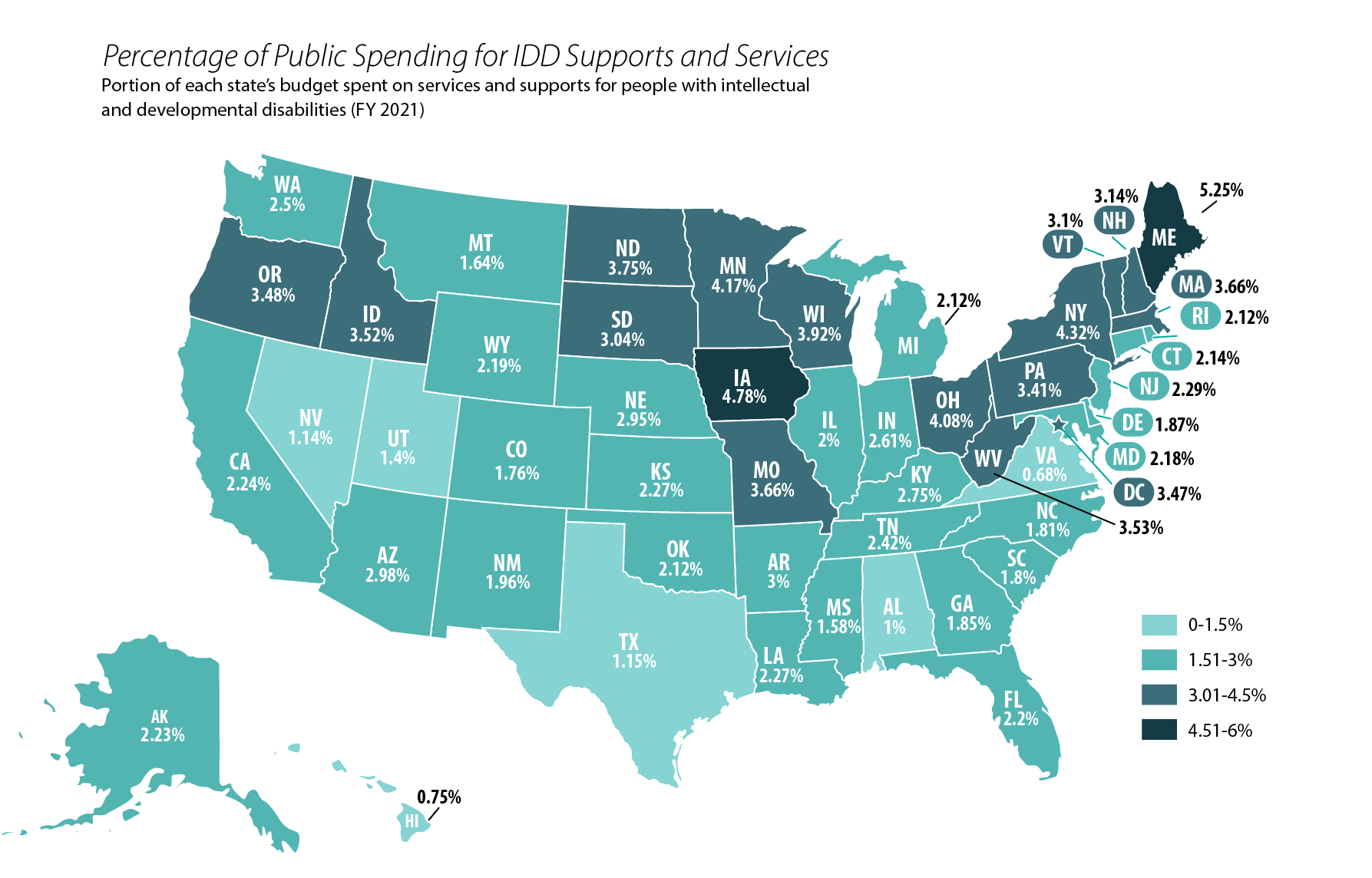
As a percentage of each state’s budget, supports for intellectual and developmental disability services make up between less than 1% and up to 6% of any state’s budget, or an average of 2.57%. This is illustrated in the map below.

This map of the United States shows the percentage of public spending in each state for IDD supports and services, ranging from .75% in Hawaii to 5.25% in Maine.


After Olmstead, funding shifted away from congregate settings:


Saturday, June 22, 2024

Olmstead at 25


In The Politics of Autism, I discuss court cases involving the civil rights of people with autism and other disabilities. 

At STAT, Timmy Broderick writes about the 25th anniversary of the Olmstead decision.
Prolonged, involuntary stays in institutions used to be the norm for people with disabilities, as books like “One Flew Over The Cuckoo’s Nest” have portrayed. But after two Georgia women with mental illness and developmental disabilities sued to leave a state hospital, the Supreme Court decreed in 1999 that siloing people with disabilities in hospitals was discriminatory and a violation of the Americans with Disabilities Act.

This landmark ruling, known as the Olmstead decision, augured a shift away from institutional care for long-term services and towards the most integrated setting possible — treating people with disabilities not as outcasts but as community members who can make choices and decide their own futures. The name refers to the main defendant, Tommy Olmstead, the commissioner of the Georgia Department of Human Resources at the time. Some experts refer to it as the Brown v. Board of Education for people with disabilities because of its dramatic expansion of civil rights in the face of forced segregation and a rejection of “separate but equal” institutions.

...

Twenty-five years after the Olmstead decision, home and community-based services (HCBS) is the norm rather than the exception for Medicaid recipients. National Medicaid spending on HCBS routinely exceeds spending on institutional services, and nearly 10 million people received some form of HCBS in 2019. Most states now have “Olmstead plans” that sketch out how to further grow community care, too.

But those gains are unevenly distributed, and disability advocates have had to sue several states to ensure their compliance.

Friday, June 21, 2024

States Warn About Shrub Oak


Jennifer Smith Richards and Jodi S. Cohen at Pro Publica
Two more states are now scrutinizing a New York boarding school for autistic students and have warned school districts about troubling conditions there.

In Connecticut, education officials visited Shrub Oak International School and alerted districts that a state watchdog group determined there were ongoing “serious safety concerns” at the unregulated for-profit private school. Separately, the state’s Department of Developmental Services, which serves residents with intellectual disabilities and autism, has decided to stop sending more students there, an agency spokesperson told ProPublica. That agency described the facility as looking “more akin to a penal institution than an educational campus.”

Washington education authorities, meanwhile, visited Shrub Oak this month and warned school districts to contact the state before considering enrolling students there. Officials are reviewing the state’s relationship with the school, officials told ProPublica.

The scrutiny of Shrub Oak comes as a ProPublica investigation published in May documented how parents and workers repeatedly asked New York authorities to investigate their concerns at the school to no avail.

Sunday, January 7, 2024

Housing in Massachusetts

 In The Politics of Autism, I write:

When disabled people reach their 22d birthday, they no longer qualify for services under IDEA. ... People in the disability community refer to this point in life as “the cliff.” Once autistic people go over the cliff, they have a hard time getting services such as job placement, vocational training, and assistive technology. IDEA entitles students to transition planning services during high school, but afterwards, they have to apply as adults and establish eligibility for state and federal help. One study found that 39 percent of young autistic adults received no service at all, and most of the rest got severely limited services.
From BNN:
My daughter’s discharge from a dayhab program threw into sharp relief the grim issue that many families like ours face – a system ill-equipped to serve the burgeoning number of autistic adults. It’s a wake-up call to the urgent need for housing solutions. The Massachusetts Department of Developmental Services (DDS) and its vendors, in their inability to provide necessary support, stand testament to this critical deficiency.

The failing of the state in predicting the surge in demand for housing, despite the availability of special education data, has snowballed into a crisis. Analysis by Autism Housing Pathways (AHP) augurs a considerable number of young adults requiring group home placements and supportive housing units annually. The state does have a supportive housing program that could potentially be scaled up to meet this demand, but the challenge lies in overcoming the lack of political will to channel sufficient funding into these housing and service programs.

Wednesday, October 11, 2023

Housing for Autistic People

In The Politics of Autism, I discuss the day-to-day challenges facing autistic people and their families. 

David Chiu at People:
A New Jersey town will be the future site for a one-of-a-kind residential housing complex for adults with autism.

The Red Bank zoning board recently approved a plan last month to construct and develop an apartment building for neurodiverse adults, the Two River Times reported, which would be the first one ever in the Garden State.

According to a press release, the THRIVE Red Bank project will consist of 32 one-bedroom apartments to encourage independent living for adults with autism. The building’s amenities will include a teaching kitchen, workout spaces and socialization areas.

Karen Fluharty, a mother of an adult son with autism, is one of the people who spearheaded THRIVE Red Bank through Parents With A Plan, a nonprofit organization she co-founded whose mission is "to develop a model community for adults with autism and other related developmental disorders."

Friday, March 31, 2023

Biden Proclaims World Autism Awareness Day

In The Politics of Autism, I discuss efforts to raise the issue's profile.

President Biden:

There is no one way to be autistic — each individual with autism experiences it differently — but together, autistic people make industries, communities, and our Nation stronger. Today, we celebrate the achievements of neurodiverse people everywhere and champion the equal rights and dignity of all those living on the autism spectrum.

Here in the United States, more than 5.4 million adults are autistic, and 1 in every 44 children has been diagnosed with autism. Yet this developmental disability is still misunderstood. Autistic people continue to face obstacles when seeking employment, health care, education, and housing, and the immense contributions of people with autism are often overlooked. We owe it to our fellow Americans to address the disparities they face and to support autistic people with tools that facilitate clearer communication, increased productivity, and greater independence.

That is why my Administration is funding cutting-edge research to enable earlier autism diagnoses and to develop more resources to help neurodiverse people of all ages thrive. Recognizing that Autism Spectrum Disorder is categorized as a disability, my American Rescue Plan provided $25 billion to States to make it easier for people with disabilities, including autism, to receive care at home. We also rolled out new tools and strategies for partner organizations to connect disabled Americans with stable housing while helping them pay rent, fight eviction, and prevent homelessness.

Last year, I was proud to reauthorize Kevin and Avonte’s Law, which expands training for first responders and others giving care to people with autism. And in my recent State of the Union Address, I called on the Congress to increase its support for community living for people with disabilities.

My Administration is also boosting employment opportunities for autistic and other historically marginalized Americans. I was proud to sign an Executive Order advancing diversity, equity, inclusion, and accessibility in the Federal workforce, which will help create new jobs for Americans with autism and make space for their voices in the policy-making process.

We are helping State and local governments, employers, and nonprofits tap Federal funds to hire more Americans with disabilities like autism through competitive integrated employment practices. We are cracking down on employers who discriminate on the basis of disability, and we are fighting to end the unfair use of sub-minimum wages. I continue to urge States that have not yet expanded Medicaid coverage under the Affordable Care Act to do the right thing and provide health insurance to those currently locked out of Medicaid support that would otherwise be available to them from the Federal Government. Medicaid expansion would help many Americans with disabilities, including those with autism.

To support students with autism, the Department of Education is ensuring that public schools uphold their obligation to provide free and appropriate public education in the least restrictive environment to all students. My Administration has also issued new guidance to help schools avoid the discriminatory use of discipline, which too often impacts autistic students, whose needs and behaviors are commonly misunderstood.

As we build a more inclusive, just, and equal Nation, we aim to lead by the power of our example. I reestablished the role of Special Advisor on International Disability Rights at the Department of State to prioritize disability rights in our policy discussions with foreign nations. The United States Agency for International Development is advancing disability inclusion as part of its democracy, climate, humanitarian, and peacebuilding activities. And as co-chair of the Global Action on Disability Network and a participant in the Global Disability Summit, the United States continues to promote the equal human rights of people with disabilities worldwide.

America is founded on the idea that all people are created equal and deserve to be treated equally throughout their lives. Today and always, let us strive to live up to this ideal. Let us embrace our diversity; empower each other to reach our full potential; and promote the basic decency, acceptance, and fairness we know is right.

NOW, THEREFORE, I, JOSEPH R. BIDEN JR., President of the United States of America, by virtue of the authority vested in me by the Constitution and the laws of the United States, do hereby proclaim April 2, 2023, as World Autism Awareness Day. I call upon all Americans to learn more about autism to improve early diagnosis, to learn more about the experiences of autistic people from autistic people, and to build more welcoming and inclusive communities to support people with autism.

IN WITNESS WHEREOF, I have hereunto set my hand this thirty-first day of March, in the year of our Lord two thousand twenty-three, and of the Independence of the United States of America the two hundred and forty-seventh.

Tuesday, December 13, 2022

HCBS Problems and the Pandemic

The Politics of Autism includes an extensive discussion of insurance and  Medicaid services for adults with intellectual and developmental disabilities. Home and Community-Based Services (HCBS) are particularly important.

 A November 16 release from the National Council on Disability:

Today the National Council on Disability releases a report examining weaknesses in the home- and community-based services (HCBS) ecosystem, taking stock of the preventable disproportionate death toll in congregate settings during the COVID-19 pandemic.

Strengthening the HCBS Ecosystem – Responding to Dangers of Congregate Settings during COVID-19 builds upon findings in NCD’s 2021 Progress Report: The Impacts of COVID-19 on People with Disabilities and 2012 report Deinstitutionalization: Unfinished Business. The report illustrates the interworking of the HCBS ecosystem, including the direct care workforce and an adequate accessible, affordable housing inventory, and how HCBS is safer, costs less, and is the preference of most individuals over institutional settings.

Currently, 820,000 people with disabilities remain on wait lists to transfer out of institutional settings. During the first year of the pandemic, 35,000 nursing home residents died of COVID-19, representing 42% of the total deaths in the U.S.

“For many people with disabilities during the pandemic, congregate settings had a devastating impact,” said NCD Chairman Andrés Gallegos. “In many instances, social distancing wasn’t achievable and the inability to transition out of such a setting became a death trap.”

NCD found that approximately 14 million Americans of all ages need HCBS, with 40% being adults under 65 years old, and people younger than 30 years old making up the fastest growing nursing home population.

“Severe shortages of direct care workers and available affordable, accessible housing are just two examples are longstanding fragilities in the HCBS ecosystem,” said the Chairman. “The neglect in addressing these matters led to the preventable deaths of scores of Americans with disabilities and will again if policymakers don’t act.”

The report offers NCD’s key recommendations to create a new paradigm – the Community Living Bias – with pointed recommendations for policymakers for Medicaid, the direct care workforce, housing policy, hospital discharge planning, COVID-19 flexibilities and waivers, and data collection.

From the report:

 Intersectional inequities are also present in an analysis of HCBS outcomes and successful interventions. A 2019 study focused on the potential of HCBS waivers to reduce disparities in unmet need among children of color with autism spectrum disorder.136 States with 1115 waivers from the Federal Government offered expanded eligibility for HCBS, which differed in the “generosity” (i.e., the amount of services offered, number of participants allowed and duration). The study found that waivers with the highest “generosity” were most effective in closing disparities between Black and White children with autism.137 The State of Washington also used 1115 waivers to expand access to HCBS services to “pre-Medicaid” individuals to divert institutionalization.138 These findings provide important implications that the presence of a waiver alone, without consideration of the inequitable baseline, may not address racial, ethnic, age, or other inequities.

  • 136 LaClair, Michelle, David S. Mandell, Andrew W. Dick, Khaled Iskandarani, Bradley D. Stein, and Douglas L. Leslie. “The effect of Medicaid waivers on ameliorating racial/ethnic disparities among children with autism.” Health services research 54, no. 4 (2019): 912-919. Strengthening the HCBS Ecosystem 85 
  • 137 Id.
  • 138 Anthony, Stephanie, Arielle Traub, Sarah Lewis, Cindy Mann, Michelle Herman Soper, and Stephen A. Somers. “Expanding Access to HCBS for “Pre-Medicaid” Individuals to Prevent or Delay Nursing Facility Utilization: A Strategy for Strengthening Long-Term Services and Supports.”


Monday, July 4, 2022

Disability Pride Month

In The Politics of Autism, I discuss the neurodiversity movement and changing attitudes toward disability in general.

From HUD:

 July marks the 2022 celebration of Disability Pride Month and the 32nd anniversary of the Americans with Disabilities Act, a comprehensive civil rights law for persons with disabilities. The U.S. Department of Housing and Urban Development (HUD) is using this opportunity to reaffirm our commitment to support the rights of individuals with disabilities to integration and community living as upheld in the landmark case, Olmstead v. L.C. HUD recognizes that quality, accessible, and affordable housing is vital to fulfilling the civil rights of individuals with disabilities, and that furthering the goals of Olmstead is a core part of our mission.

Friday, February 25, 2022

St. Joseph's University to Open ASD Residence Hall

In The Politics of Autism, I discuss the employment of adults with autism and other developmental disabilities. Many posts have discussed programs to provide them with training and experience.  
I also discuss the growing number of college students on the spectrum. 

Susan Snyder at The Philadelphia Inquirer:

St. Joseph’s, home to the Kinney Center for Autism Education and Support, plans to open its first residence hall specifically for students on the spectrum. With a capacity of up to 17 student residents and one student adviser, Saint Albert’s Hall off Lapsley Lane on the Lower Merion side of campus will undergo up to $250,000 in renovations this summer. A large three-story house, it used to be a women’s residence but most recently was used for COVID-19 housing.

“We came to the realization that the residence hall was a spot where a lot of our folks were struggling,” said Angus Murray, Kinney’s executive director. “Academically, they’re usually able to make the cut and succeed, but because of their social skills, they struggle in the residence halls. So we thought it might be helpful to have what we’re referring to as a longer runway as they transition from high school to college.”

St. Joseph’s will be among the first traditional college campuses in the country to offer such an option solely for its students. Landmark College in Vermont, for instance, is for students with learning disabilities and autism, and another group of residence halls in Vermont, Oregon, and Wisconsin, operated by Mansfield Hall, offer housing and services to students with autism from multiple college campuses.

Mercyhurst University in Erie offers apartment housing on campus with most of its students in the autism program living together there. Some colleges have specific floors with resident assistants trained in autism, said Jane Thierfeld-Brown, director of the College Autism Spectrum.

More than 70 colleges nationwide have autism programs, including Drexel, Eastern, Rutgers, West Chester, and several other Pennsylvania state universities in addition to St. Joe’s and Mercyhurst, according to the College Autism Spectrum.

Tuesday, March 23, 2021

HCBS Access Act

The Politics of Autism includes an extensive discussion of insurance and  Medicaid services for adults with intellectual and developmental disabilities. Home and Community-Based Services (HCBS) are particularly important.

From the Autistic Self-Advocacy Network:

A one-pager about the The Home and Community-Based Services Access Act can be found as a PDF here.

The Autistic Self Advocacy Network (ASAN), The Arc of the United States, The Center for Public Representation, the National Health Law Program (NHeLP), and the Epilepsy Foundation commend Senators Brown, Hassan, and Casey and Representative Dingell, for the introduction of the HCBS Access Act (HAA), a bill that adds Home and Community Based Services (HCBS) as a mandatory Medicaid service. The HAA would build on the promises of the Americans with Disabilities Act and the Supreme Court’s Olmstead decision and provide the Federal Medicaid resources necessary for states to fulfill those promises, so that no people with disabilities or older adults are forced to live segregated from their communities.

Over the past year, COVID-19 has laid bare the real-life danger of congregate settings for people with disabilities and older adults, as infection and death rates in these settings have been catastrophic. At least 100,000 residents have died in nursing facilities and other institutions for people with disabilities. For disability advocates, this horrific news was not a surprise. Despite the deadly risks of congregate settings and the preferences of people with disabilities and aging adults to live in their own homes and communities with their friends and families, hundreds of thousands of people are on waiting lists for HCBS across the country. Medicaid has always had an institutional bias that requires states to cover congregate settings while leaving coverage of home and community-based services (HCBS) optional.

The HAA will change this. By making HCBS a mandatory Medicaid service, people with disabilities will have access to the services they need to live in their communities, without having to wait years and years for these crucial supports. The HAA will also give older adults, often forced into nursing facilities because of a lack of home care, access to the HCBS they need to age in place, something that the vast majority of aging adults want. The more than 850,000 people with disabilities and older adults currently on waiting lists would be eligible for services. In addition to supporting people where they desire to live, more wholeheartedly ending the institutional bias is cost-effective. The average cost to serve a person with a disability in a publicly-funded institution in one of the 36 states that still has them is $294,300 per person, per year while the average cost of a person served with Medicaid HCBS is $49,854 per person per year.

The HAA also provides a funding boost for HCBS. It supports states to build the infrastructure and capacity needed to serve people coming off of waiting lists, better support those already receiving services, and transition people with disabilities and older adults who want to live in the community out of dangerous congregate settings. This financial investment is absolutely crucial, especially as the pandemic-created recession slashes state budgets, putting broad swaths of services at risk. The HAA would help states and support state funded services.

The bill would also address the race and gender disparities that currently exist in accessing Medicaid HCBS and prevent the unnecessary institutionalization of Black, Indigenous and other people of color with disabilities and older adults. And the HAA would finally begin to address the HCBS workforce crisis, the essential and frontline workforce that provides services to people with disabilities and older adults is made up of mostly women—and women of color, in particular. The HAA would ensure that these workers receive a living wage.

As the country works to recover from the COVID-19 pandemic, the HCBS Access Act should be at the center of that recovery to ensure that people with disabilities can receive care and supports in their homes and communities.

Monday, January 11, 2021

Vaccinating People in Congregate Settings

In The Politics of Autism, I discuss the day-to-day challenges facing autistic people and their families. Those challenges get far more intense during disasters.  And coronavirus is proving to be the biggest disaster of all.

Karen Weintraub at USA Today:
[A]cross the country, the priority level for people who live in group homes varies by state – even though the outbreak this spring showed that they are two-to-three times more likely to be exposed to and die from COVID-19 than the general population.

"Those of us who live in congregate settings, or who need in-person services and are unable to distance from staff, are at particularly high risk," said Sam Crane, legal director of the Autistic Self Advocacy Network, which represents people on the autism spectrum.

Some people with intellectual and developmental disabilities need help eating and bathing, so they can't keep physically distant. Many are unable to tolerate masks. And they often have medical conditions that make them more vulnerable to serious infections with COVID-19.

"All these risk factors make it particularly critical that people with I/DD be prioritized for vaccination," Crane said via email.

Wednesday, January 6, 2021

Autism, COVID Vaccines, and Community Integrated Living Arrangements

In The Politics of Autism, I discuss the day-to-day challenges facing autistic people and their families. Those challenges get far more intense during disasters.  And coronavirus is proving to be the biggest disaster of all.

In mid-November, my wife Veronica got a phone call she’d been dreading. Her brother Vincent was very sick, and had been taken by ambulance to our local hospital. Veronica raced there, where she found Vincent febrile and groggy, complaining of abdominal and chest pain. He was placed in the covid-19 unit and given oxygen while we awaited definitive test results.

Vincent is one of an estimated 7.4 million Americans with intellectual and developmental disabilities (IDD). Like roughly 600,000 others, he lives in a Community Integrated Living Arrangement, or CILA for short. Residents and the staff who care for them are at high risk during this pandemic. They should be given correspondingly high priority for covid-19 vaccines.
Americans can be proud that we no longer warehouse people with Down syndrome, Fragile X, autism and related conditions within institutions and state homes. But we cannot be complacent about the dangers they face.

A mere bicycle ride from my house, 263 residents and staff at the Ludeman Developmental Center were infected with covid-19. Nine died. One English study found that adjusting for a wide range of characteristics and physical health challenges, people with Down syndrome were 10 times more likely to die of covid-19. U.S. studies also find sharply higher covid mortality among people with intellectual and developmental disabilities.

Across the United States, it’s unclear where CILAs or sprawling complexes such as Ludeman stand in the vaccine queue. There is no national definition of long-term care facilities. States decide this on their own. Illinois’ covid vaccine plan makes little mention of IDD, though officials recently indicated that developmental centers and CILAs would receive priority. Other states took a similar approach, referencing disability and residence in a congregate setting in broad terms as factors in setting priority for vaccination, but neglecting to clarify where people with IDD stand. Nationally, caregivers, family members, CILA residents and staff are largely in the dark.

Monday, July 13, 2020

COVID Risk in Residential Group Homes

In The Politics of Autism, I discuss the day-to-day challenges facing autistic people and their families. Those challenges get far more intense during disasters.  And coronavirus is proving to be the biggest disaster of all.

Scott D. Landes and colleagues have an article in Disability and Health Journal titled:"COVID-19 Outcomes among People with Intellectual and Developmental Disability Living in Residential Group Homes in New York State."  The abstract:

Background
People with intellectual and developmental disabilities (IDD) may be at higher risk of severe outcomes from COVID-19.
Objective
To describe COVID-19 outcomes among people with IDD living in residential groups homes in the state of New York and the general population of New York State.
Methods
Data for people with IDD are from a coalition of organizations providing over half of the residential services for the state of New York, and from the New York State Department of Health. Analysis describes COVID-19 case rates, case-fatality, and mortality among people with IDD living in residential group homes and New York State through May 28, 2020.
Results
People with IDD living in residential group homes were at greater risk of severe COVID-19 outcomes: case rates – 7,841 per 100,000 for people with IDD compared to 1,910 for New York State; case-fatality – 15.0% for people with IDD compared to 7.9% for New York State; and mortality rate – 1,175 per 100,000 for people with IDD compared to 151 per 100,000 for New York State. Differences in cases and mortality rate were confirmed across regions of the state, but case-fatality rate was only higher for people with IDD in and around the New York City region.
Conclusions
COVID-19 appears to present a greater risk to people with IDD, especially those living in congregate settings. A full understanding of the severity of this risk will not be possible until US states begin publicly sharing all relevant data they have on COVID-19 outcomes among this population.

Saturday, July 4, 2020

HHS Does Not Require Congregate Setting to Report COVID Data

In The Politics of Autism, I discuss the day-to-day challenges facing autistic people and their families. Those challenges get far more intense during disasters.  And coronavirus is proving to be the biggest disaster of all.

From the American Civil Liberties Union:
It took the Department of Health and Human Services (HHS) months after declaring COVID-19 a national emergency to start requiring nursing homes to report deaths and infections despite ample evidence that these facilities were at high risk. Even now, nursing homes are only required to report data from May 8 onward. HHS doesn’t require other congregate settings for people with disabilities, such as psychiatric homes, to report at all. This lack of transparency, in addition to the government’s systemic mismanagement of nursing homes and other congregate settings, has helped create the crisis we see today.
...
People with disabilities and the people who work with them deserve to be counted. States can and should modify current policies to collect and publicize vital data while maintaining privacy standards. Last week, the ACLU filed a petition calling on HHS to do its job to address this crisis — and its job includes collecting and reporting full data from facilities that receive Medicaid or Medicare dollars.
 

Tuesday, June 30, 2020

COVID-19 and Group Homes

In The Politics of Autism, I discuss the day-to-day challenges facing autistic people and their families. Those challenges get far more intense during disasters.  And coronavirus is proving to be the biggest disaster of all.

Group homes in [Massachusetts] were locked down for close to three months and families were only allowed to video chat with their adult children in order to try to keep the novel coronavirus out of these “congregate living” facilities where individuals are living together in close quarters and sickness can spread more quickly.
...
Individuals with autism and other disabilities may be part of the population who gets sicker from the novel coronavirus than the general population. They often have what’s known as “co-morbid” medical conditions that can make them more susceptible to illness, including COVID-19. Ned gets seizures, and his parents say he doesn’t register a fever so temperature checks may not be a reliable way to screen him for COVID-19.
The story focuses on an autistic man named Ned Hubbard, who has two housemates who got COVID.
Amego, the facility which operates Ned's home, also operates dozens of other residential facilities in Massachusetts.
Amego’s President and CEO, John Randall, says despite equipping staff with PPE and taking numerous precautions to date 46 Amego residents and 71 staff have tested positive for the virus.
...
Statewide, the Department of Developmental Services tells Boston 25 that 1,575 adult residents have tested positive as of early June and 98 adults have died.

It’s not just adults.

Although the Department of Elementary and Secondary Education (DESE) could not tell us how many children in the state’s group homes contracted the novel coronavirus, Boston 25 News has learned one facility, the New England Center for Children in Southborough, had 15 of their students and 19 of their staff tested positive.
Buried lede:
To date, more than 1,800 staff members at group homes in the state have tested positive for COVID-19 and three staff members have died.