Starting July 1, a new law will take effect in Florida. It's focused on improving communication between law enforcement and people with autism.
The bill helps officers better identify those people before situations escalate. Law enforcement officers across the state are getting new training to help them interact with people with autism.
Gov. Ron DeSantis signed Senate Bill 418 this week.
"This bill is going to be great for citizens with autism in the state of Florida, in that it's a quick disclosure for the law enforcement officer to understand that they are dealing with someone with autism, which is crucial," retired Police Lt. Jimmy Donohoe, founder of First Responder Autism Training.
That quick disclosure is a blue envelope or a blue card. The envelope will hold important information, like a person's drivers license, registration and proof of insurance.
The blue color lets officers know the individual has autism.
"This is not something that is not going to stigmatize someone," said Sherry A. White, president and CEO of Capstone Adaptive Learning and Therapy Centers. "It is just moving forward with dignity, respect, safety, better solutions, and outcomes. And being in the disability field, I for one, see this as a positivity move."
Donohoe, who fathers a son with autism, says this can help those who are nonverbal or have difficulty communicating.
"People with autism often have delayed responses," Donohoe said. "And law enforcement, we are not used to delayed responses that might indicate someone is lying to us because they have a warrant, so this bill will change the officers perspective of the person they've stopped."
"And that's so that they're not digging in and getting more upset as they go along," he said. "And the blue envelope discloses right away."
Another key component of this new law required training for officers.
"De-escalation techniques and understanding what's going on with people with autism, how they think differently than we do, and so we have to adapt to them and not them adapt to us," Donohoe said.
Showing posts with label identification cards. Show all posts
Showing posts with label identification cards. Show all posts
Monday, June 22, 2026
Blue Envelopes in Florida
In The Politics of Autism, I discuss interactions between first responders and autistic people. Some jurisdictions allow autistic drivers to ask for a blue envelope to disclose the driver's diagnosis in case of an accident or traffic stop. Others have ID cards.


Wednesday, November 13, 2024
Blue Envelopes in New Jersey
In The Politics of Autism, I discuss interactions between first responders and autistic people. Some jurisdictions allow autistic drivers to ask for a blue envelope to disclose the driver's diagnosis in case of an accident or traffic stop. Others have ID cards.
Mat Fagan and Gene Myers at NorthJersey.com:
[M]ore and more police departments and other law enforcement agencies throughout the state are adopting New Jersey's Blue Envelope Program. The program's goal is to inform officers as fast as possible that the driver they have stopped has a developmental disorder, which may explain their unusual behavior.
Those drivers who participate in the program will get a blue envelope they can place on their vehicle's sun visor or hand over to law enforcement officers during a stop. The envelope holds their essential documents, including license, registration and a contact card. Officers are trained to recognize the blue envelope and its meaning.
Englewood’s Christopher Gagliardi, 43, who has autism, said the bright red and blue lights atop police cars are scary. He's hoping the program helps to ensure that there's "no brutality or any kind of abuse against people with special needs like myself and especially on the autism spectrum disorder that are affected by the terror and fear of police officers."
Once the driver shows or hands over the blue envelope, it alerts the officers to the situation, and they then are able to put training and guidance on best practices into effect. The training will have covered how best to interact and communicate with drivers with autism, said Passaic County Prosecutor Camelia Valdes.
...
A new study found that a third of teens who have autism without intellectual disability earn a driver's license. Nearly 90% of them do so within two years of getting their learner’s permit.
Thursday, August 29, 2024
Blue Envelopes in Vermont
In The Politics of Autism, I discuss interactions between first responders and autistic people. Some jurisdictions allow autistic drivers to ask for a blue envelope to disclose the driver's diagnosis in case of an accident or traffic stop. Others have ID cards.
Jenn Jarecki and Nathaniel Wilson at Vermont Public Radio:
The Vermont Department of Motor Vehicles recently unveiled a new program aimed at easing challenges for autistic drivers and the law enforcement officers who engage them.
Some autistic people experience the senses more intensely than neurotypical people: flashing police lights, for example. And there can be differences in communication, which can lead to behaviors being misinterpreted.
The DMV’s Blue Envelope Program is designed to make routine traffic stops feel safer and less stressful.
Vermont Public's Jenn Jarecki was recently joined in-studio by Vermont Department of Motor Vehicles Commissioner Wanda Minoli to learn more about the program. This interview was produced for the ear. We highly recommend listening to the audio. We’ve also provided a transcript, which has been edited for length and clarity.
...
Jenn Jarecki: I understand that other states have similar programs, like neighbors in Connecticut and Massachusetts, to name just a couple. How much influence did that existing work have on what's ultimately been rolled out here in Vermont?
Wanda Minoli: Well, for us, we used the other states' model of the envelope and started there. Don't reinvent the wheel. If there's a successful program out there, then, you know, state to state, we try to model. And that's really, really important because when you think about this program, and you think about our residents and our New England states, we don't drive just in Vermont. We may take a vacation to Maine, we may be traveling to Massachusetts for something, and you possibly could be stopped roadside. And what we have now is consistent messaging for all law enforcement, and that applies for people driving into our state. So, when they hand the blue envelope over, all law enforcement is aware. They know exactly what they're getting and what this document means, and that's really important, too.
Monday, June 24, 2024
Identification Cards in Pennsylvania
In The Politics of Autism, I discuss interactions between first responders and autistic people. Some jurisdictions allow autistic drivers to ask for a blue envelope to disclose the driver's diagnosis in case of an accident or traffic stop. Others have ID cards.
From Pennsylvania State Police:
The Pennsylvania State Police (PSP) today encouraged individuals with autism to take advantage of a free safety resource designed to enhance their interactions with law enforcement officers. The PSP has officially started to distribute an informational card that should be carried by people with autism and presented during any encounter with police.
“Behaviors associated with autism can cause barriers to effective communication. This card can be presented to reduce those barriers," said Colonel Christopher Paris, Commissioner of the Pennsylvania State Police. “When an officer is made aware a person has autism, they can respond accordingly, resulting in a safer interaction for everyone involved."
The informational cards alert law enforcement officers that the individual has autism and therefore may be nonverbal, bothered by loud noises, hyper-sensitive to touch, and unresponsive to commands or questions. The officers are directed to be patient, use a calm and direct voice, and keep their questions and commands simple.
Colonel Paris and Governor Shapiro met with advocatesOpens In A New Window to talk about how law enforcement can better serve individuals with autism. PSP's Office of Community Engagement developed the informational card, which is available on the Safety Resources page of PSP's website. Individuals may print the card from the website and carry it in a wallet, or they can choose to save it on their phone. Troopers will distribute the cards at public community events.
The PSP encourages individuals with autism to present the informational card during interactions with any police officer. The officer does not need to be a Pennsylvania state trooper.
The Shapiro Administration is working across agencies to provide resources to Pennsylvanians in the intellectual disabilities and autism (ID/A) community, strengthen mental health parity, and improve access to care in Pennsylvania. Governor Shapiro's 2024-25 budget proposal, which has received bipartisan support, includes a major investment in the ID/A community and would invest $483 million in federal and state funding to increase wages for home and community-based service providers. Governor Shapiro announced late last year that the Pennsylvania Department of Human Services (DHS) would re-examine rates earlier than required to better support home and community-based service providers and the direct support professionals who dedicate their careers to helping Pennsylvanians with ID/A. In addition, service providers also received a one-time supplemental payment in June to assist with workforce recruitment and retention. Earlier this year, Governor Shapiro directed DHS to immediately release additional program capacity to counties, which will allow an additional 1,650 Pennsylvanians to receive services this year. The 2024-25 proposed budget seeks to build on this by investing $78 million in federal and state funds to serve an additional 1,500 Pennsylvanians in the next fiscal year. Governor Shapiro and the Pennsylvania Insurance Department (PID) also announced last November that the Shapiro Administration will require all commercial insurers to meet their obligations under Pennsylvania law to provide coverage for autism benefits.
For more information on the Pennsylvania State Police, visit www.psp.pa.gov.
Saturday, April 27, 2024
Blue Envelopes in Maine
Police in Cape Elizabeth are working to improve interactions between officers and drivers who may have autism, anxiety or other ailments.
The "blue envelope program" was started in 2020 in Connecticut and has since spread to other states.
Cape Elizabeth was the first community in Maine to launch the program last year.
Police say if they pull over a driver who exhibits nonverbal behaviors, the driver can present their information in a blue envelope containing photocopies of their driver's license, registration and insurance.
“My experiences is they are nonverbal, they are very anxious, they’re jittery,” Cape Elizabeth Police Sgt. Kevin Kennedy said. “And we just did not want to confuse that with someone that was under the influence or maybe not being cooperative. It’s just their diagnosis.”
Drivers with a blue envelope still need to follow officers’ directions in the event of a traffic stop or accident, but this program aims to make those interactions a little bit easier.
Wednesday, April 24, 2024
Autism Cards in Suffolk County, New York
In The Politics of Autism, I write:
[M]any police departments have trained officers and other first responders how to spot signs of autism and respond accordingly. Some organizations have also published identification cards that ASD adults can carry in order to defuse potential conflicts. Virginia provides for an autism designation on driver licenses and other state-issued identification cards. Once again, however, the dilemma of difference comes into play. One autistic Virginian worries: “Great, so if I get into an accident, who’s the cop going to believe, the guy with the autistic label or the guy without it?” Clinical psychologist Michael Oberschneider is concerned about the understanding level of first responders: “I think many people still think of Rain Man or, more recently, the Sandy Hook Shooter, when they think of autism even though very few people on the autistic spectrum are savants or are homicidal and dangerous.”
Suffolk County law enforcement officers are now equipped with a tool to help people on the autism spectrum during potentially stressful encounters. It was designed by a young man from Long Island, who is on the spectrum himself.
Christopher Cortale, a receptionist at the Winters Center for Autism in West Babylon, helped design an emergency card to foster communication in stressful situations.
At the top, the card reads, "Please be patient. I have autism. Please point to the pictures to help me understand what you want." Underneath are photos of a driver's license, registration, insurance and weapons.
The card also includes photos and captions violations for officers to indicate if the individual with autism is being warned, ticketed or arrested, and reasons, such as license plate, tail light, speed limit, stop sign or several others.
The bottom of the card has a section titled "I need help" with photos indicating low fuel, flat tire, hospital, emergency contact, tow truck and lost.
Thursday, April 18, 2024
Blue Envelopes in Arizona
In The Politics of Autism, I discuss interactions between first responders and autistic people. Some jurisdictions allow autistic drivers to ask for a blue envelope to disclose the driver's diagnosis in case of an accident or traffic stop .
Arizona is launching a program through which drivers on the autism spectrum can place their credentials in special blue envelopes to enhance communication with law enforcement officers during traffic stops.
This voluntary program, which includes education for law enforcement officers, follows a model used successfully in Connecticut. The envelope will have instructions for the driver and law enforcement officer to follow and advise the officer that the driver may respond differently to instructions in situations that can increase anxiety.
To provide the necessary groundwork and training, the Arizona Department of Transportation Motor Vehicle Division is partnering with the Arizona Department of Public Safety (AZDPS) and the University of Arizona’s Police Department, Department of Speech, Language and Hearing Sciences, and Leadership Education in Neurodevelopmental and Related Disabilities (ArizonaLEND) training program.
“When I heard about this program in Connecticut, I was extremely fascinated and intrigued to see if we could incorporate it here in Arizona,“ ADOT MVD Director Eric Jorgensen said. “MVD is thrilled to be partnering with DPS and the University of Arizona Police Department to help calm what can otherwise be potentially stressful situations.”
This program will function similarly to the one Connecticut established in 2020. The blue envelope is a voluntary way to hold important vehicle documents such as insurance and registration, while also being a communication tool between the driver and law enforcement during an interaction.
"This program provides explicit support for drivers who choose to participate," said Jennifer Casteix, UArizona Clinical Professor and ArizonaLEND faculty member. "Better understanding of communication differences should positively impact these interactions."
After his interim appointment at the University of Arizona in May 2023, Police Chief Chris Olson shared his desire to bring the Blue Envelope Program to the university. Creating partnerships with University of Arizona units that specialize in autism research and caring for the community have been key in laying the groundwork for this program at the University of Arizona.
According to Chief Olson, “The Blue Envelope program is an outstanding public safety initiative that seeks to improve communication between police officers and autistic drivers during traffic stops.”
Director Jeffrey Glover of the Arizona Department of Public Safety said, “The AZDPS is proud to support and be a part of the Blue Envelope Program. A program like this, seeking to enhance safety for both members of the public as well as all law enforcement officers in the State of Arizona, is absolutely invaluable.”
"We are implementing this program with an evidence-based approach to better support law enforcement and autistic drivers to improve safety outcomes," said Dr. Nell Maltman, UArizona Assistant Professor with the Department of Speech, Language and Hearing Sciences.
Training with officers and volunteer drivers to simulate a traffic stop with the blue envelopes will be happening next week at the University of Arizona’s Tucson campus.
The envelopes are expected to be available through ADOT MVD offices, various law enforcement locations as well as other locations across the state starting in May.
For additional information about this program, please visit azdot.gov/BlueEnvelope.
Tuesday, January 23, 2024
Autism Decals in Miami-Dade
In The Politics of Autism, I discuss interactions between police and autistic people. When cops encounter autistic people, they may not respond in the same way as NT people, and things can get out of hand. Among other things, they may misinterpret autistic behavior as aggressive or defiant, and respond with tasers, batons, chokeholds, or worse.
A new program in Miami-Dade County aims to save lives through a simple decal. The initiative will alert first responders to potential interactions with residents living with autism.
Approved last week by the Miami Dade County Commission, the decal is meant to be placed at the front door of a home or a car window to notify police officers and firefighters of a potential interaction with a resident living with autism.
The decal reads, “Occupant with autism, may not respond to verbal commands.”
Dr. Diane Adreon with the University of Miami’s Center for Autism and Related Disabilities (CARD) says the decals can aid in the training of law enforcement officers.
“There’s so many nuances that people could really not know how to react, and they could take their behaviors the wrong way,” said Dr. Adreon. “It gives people with autism or family members an opportunity to safely disclose the disability in a circumstance where they may be interacting with law enforcement.”
When it launches in April, Miami-Dade residents will be able to pick up the free decal from their local Miami-Dade Police station.
District 7 Commissioner Raquel Regalado says there are plans for the county to partner with agencies in other municipalities, to expand the program. She also believes this program will free up county resources.
North Miami launched a similar decal and autism outreach program in 2022 following the 2016 incident when a man with autism was shot at by a police officer after the toy truck he was holding was mistaken for a gun. [Ed. note: the police shot the black man who was caring for the autistic person.]
Thursday, August 3, 2023
Blue Envelopes in Massachusetts
[M]any police departments have trained officers and other first responders how to spot signs of autism and respond accordingly. Some organizations have also published identification cards that ASD adults can carry in order to defuse potential conflicts. Virginia provides for an autism designation on driver licenses and other state-issued identification cards. Once again, however, the dilemma of difference comes into play. One autistic Virginian worries: “Great, so if I get into an accident, who’s the cop going to believe, the guy with the autistic label or the guy without it?” Clinical psychologist Michael Oberschneider is concerned about the understanding level of first responders: “I think many people still think of Rain Man or, more recently, the Sandy Hook Shooter, when they think of autism even though very few people on the autistic spectrum are savants or are homicidal and dangerous.”
The “Blue Envelope Bill,” currently before our Legislature’s Senate Ways and Means committee, could make these potentially disastrous encounters far less likely. The bill would allow a driver with an autism diagnosis to request a blue envelope — which could be attached to the driver’s-side sun visor — to alert law enforcement of the driver’s diagnosis in case of a traffic stop or accident. These blue envelopes could help to avoid potentially tragic misunderstandings at minimal cost.
The bill has the support of the Massachusetts Chiefs of Police Association, the State Police Association of Massachusetts Troopers, the Massachusetts Police Association and the Municipal Police Training Institute. The legislation under consideration is modeled after a law Connecticut implemented in 2020, at the urging of the Connecticut Police Chiefs Association.
This would affect more individuals and families than you might think. About one in 36 children in the United States is estimated to have autism. And there’s a troubling connection between people with an intellectual, developmental and/or psychiatric disability (including autism) and police violence. For example, a 2016 study (that looked at data from 2013 to 2015) found that disabled individuals make up one-third to one-half of all police shooting victims. Time reported in 2020 that “there is no reliable national database tracking how many people with disabilities, or who are experiencing episodes of mental illness, are shot by police each year” (the topic for another essay) but it seems likely that disabled individuals who are also Black have an even higher likelihood of being the target of police violence.
Thursday, January 12, 2023
ID Cards in Louisiana
In The Politics of Autism, I write:
[M]any police departments have trained officers and other first responders how to spot signs of autism and respond accordingly.[i] Some organizations have also published identification cards that ASD adults can carry in order to defuse potential conflicts. Virginia provides for an autism designation on driver licenses and other state-issued identification cards. Once again, however, the dilemma of difference comes into play. One autistic Virginian worries: “Great, so if I get into an accident, who’s the cop going to believe, the guy with the autistic label or the guy without it?” Clinical psychologist Michael Oberschneider is concerned about the understanding level of first responders: “I think many people still think of Rain Man or, more recently, the Sandy Hook Shooter, when they think of autism even though very few people on the autistic spectrum are savants or are homicidal and dangerous.”[ii]
Louisiana has now acted. In addition to the underlying issue, some self-advocates might object to the puzzle piece.
From the Louisiana Office of Motor Vehicles:
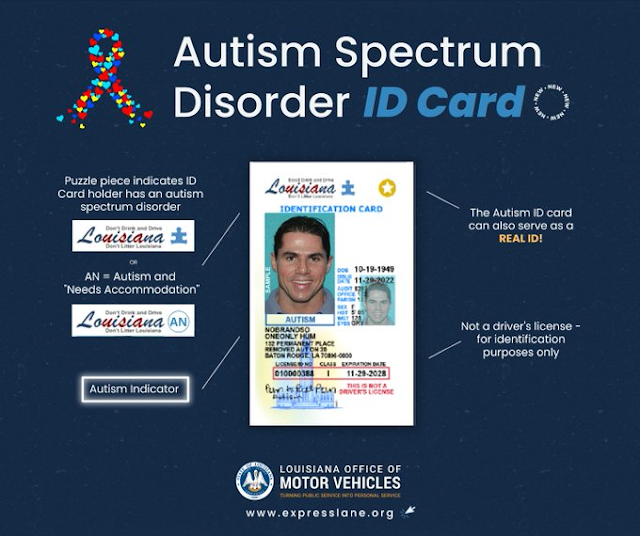
Eligible Louisiana Office of Motor Vehicles customers can now request to have an “Autism” indicator added to their identification cards. Qualified applicants include any person diagnosed with autism spectrum disorder by a qualified medical or mental health professional. The autism indicator will appear under the customer’s picture on the ID card.
The autism indicator is optional and can be removed from a credential at any time, as requested by the applicant. The “Autism” designation can be displayed on any class identification card, including the TIP, but may not be placed on Class H (Handicap Identification Card) credentials. Applicable fees are required for identification card processing if adding or removing the Autism indicator.
Applicants must provide one of the following documents to the Louisiana Office of Motor Vehicles in order to have the designation added to an ID card:
• Medical Examiner’s Certification of Autism Spectrum Disorder form completed by the medical or mental health professional
• A statement from a qualified mental health professional licensed in Louisiana or any other state or territory of the United States verifying the applicant’s disability.
An ID card with an Autism indicator cannot include the “Veteran,” “I’m a Cajun” or “100% DAV” indicators. The Autism indicator can only be combined with the “Needs Accommodation” indicator. If the driver’s license indicates “Autism,” but not “Needs Accommodation,” a puzzle piece symbol will appear on the license with the autism designation below the picture. If the driver’s license indicates both “Autism” and “Needs Accommodation,” the autism designation will appear below the picture in addition to “AN” above the picture.
LA Wallet users can display the Autism indicator on their ID Card in the LA Wallet app. If an applicable card is currently linked in LA Wallet, simply unlink it in the menu and add it back to get the updated image
Monday, December 5, 2022
Autism ID Cards in Alabama
In The Politics of Autism, I write:
[M]any police departments have trained officers and other first responders how to spot signs of autism and respond accordingly.[i] Some organizations have also published identification cards that ASD adults can carry in order to defuse potential conflicts. Virginia provides for an autism designation on driver licenses and other state-issued identification cards. Once again, however, the dilemma of difference comes into play. One autistic Virginian worries: “Great, so if I get into an accident, who’s the cop going to believe, the guy with the autistic label or the guy without it?” Clinical psychologist Michael Oberschneider is concerned about the understanding level of first responders: “I think many people still think of Rain Man or, more recently, the Sandy Hook Shooter, when they think of autism even though very few people on the autistic spectrum are savants or are homicidal and dangerous.”[ii]
Yesterday's post involved autism windshield decals in Florida. Here is a related story from Alabama;
Alabamians who have a diagnosis that falls within the autism disorder spectrum have access to a special identification card.
Alabama has created and implemented the first state-recognized Autism Identification Card in the U.S. The cards, distributed by county health departments, can assist with interactions with first responders and law enforcement officers during potentially stressful situations, such as a traffic stop.
Wording on the card explains that the holder falls within in the autism spectrum and may have difficulty communicating or understanding directions. The card also states that the person could become agitated if touched because of his or her medical conditions.
Tuesday, January 11, 2022
ID in NJ
[M]any police departments have trained officers and other first responders how to spot signs of autism and respond accordingly. Some organizations have also published identification cards that ASD adults can carry in order to defuse potential conflicts. Virginia provides for an autism designation on driver licenses and other state-issued identification cards. Once again, however, the dilemma of difference comes into play. One autistic Virginian worries: “Great, so if I get into an accident, who’s the cop going to believe, the guy with the autistic label or the guy without it?” Clinical psychologist Michael Oberschneider is concerned about the understanding level of first responders: “I think many people still think of Rain Man or, more recently, the Sandy Hook Shooter, when they think of autism even though very few people on the autistic spectrum are savants or are homicidal and dangerous.”
From New Jersey Senate Democrats:
The Senate today approved bipartisan legislation that would foster greater understanding and communication between law enforcement and the communicative disabilities community by requiring the Motor Vehicle Commission to allow the holder of a driver’s license or non-driver identification card to indicate that the person has been diagnosed with an autism spectrum disorder or communication disorder.
The bill, sponsored by Senator Nellie Pou and Senator Kristen Corrado, would require the MVC to indicate the diagnosis by notating the information on the person’s driver’s license or non-driver identification card under the column designated for restrictions. The goal is to make it easier for the person with the disability to more easily communicate with any law enforcement officer they may encounter and hopefully serve to limit the chances that an ordinary interaction, such as a routine traffic stop, will escalate into a more fraught or even violent confrontation.
“Too often, in recent years, some interactions between law enforcement and individuals with communicative disabilities have led to negative outcomes, simply because of a communication barrier. This legislation is designed to be a preventative measure that will help improve that communication and minimize the chance of escalation or a negative incident,” said Senator Pou (D-Bergen/Passaic).
The legislation, S-849, is aimed at protecting members of the communications disability community and also to help law enforcement better understand and communicate with them.
The bill was approved by the Senate by a vote of 39-0.
Sunday, November 7, 2021
Police Training in Texas
In The Politics of Autism, I discuss interactions between police and autistic people. Police officers need training to respond appropriately. When they do not -- as recent events have shown -- things get out of hand.
Some communities have such training. The next step is evaluation of what works.
At KWKT-TV, Jessica Rivera reports:
Crisis Intervention courses help ease communication between officers and people in need – especially in a high stress situation.
On Wednesday evening, officers sat in a Crisis Intervention course – a new way for officers to help those in our community who may have developmental or cognitive challenges.
“So all law enforcement in the last training cycle were required to take the 40-hour course, and we give them this time, where they get to learn specifically about autism,” says Waco police officer Bradley Delange.
For Tres Jackson, it’s important for him that law enforcement gets this kind of training.
“And it’s pretty common that they’re out to people who are like me, because I know some who have been arrested by police because they were doing something they should have done,” Jackson says.
On his driver’s license, it has a notification to alert the Police Department that Tres has communication challenges because of autism.
“It tips off the officer in a really bold way, that we see that on the license. And in addition, when we run that driver’s license, our dispatcher will tell us that that subject has a communication delay,” says Delange.
Last week the District Attorney’s Office donated Autism Sensory Kits to the Waco Police Department.
“Anything in this bag, it’s going to soothe them. It’s going to disarm them. It’s going to de-escalate the situation and help me connect,” says Anne Jackson, ADA with the McLennan County District Attorney’s Office.
Jackson and her son Tres travel all over the Central Texas area to give presentations for law enforcement on the importance of proper communication between officers and those who have special needs.
Thursday, June 25, 2020
Autism ID in Michigan and Iowa
[M]any police departments have trained officers and other first responders how to spot signs of autism and respond accordingly. Some organizations have also published identification cards that ASD adults can carry in order to defuse potential conflicts. Virginia provides for an autism designation on driver licenses and other state-issued identification cards. Once again, however, the dilemma of difference comes into play. One autistic Virginian worries: “Great, so if I get into an accident, who’s the cop going to believe, the guy with the autistic label or the guy without it?” Clinical psychologist Michael Oberschneider is concerned about the understanding level of first responders: “I think many people still think of Rain Man or, more recently, the Sandy Hook Shooter, when they think of autism even though very few people on the autistic spectrum are savants or are homicidal and dangerous.”
On June 11, Michigan State Senator Tom Barrett issued this release. Yesterday, Governor Gretchen Whitmer signed the legislation.
Kathie Obradovich at the Iowa Capital Dispatch reports on Tyler Leech, 27, an autistic person who had a stressful encounter with a police officer.The Michigan Senate on Thursday unanimously approved Sen. Tom Barrett’s legislation to help bridge the communications gap between law enforcement and drivers with autism.
“Last year I had the wonderful opportunity to work with autism advocates across the state — including, and perhaps most importantly, my constituent, Xavier DeGroat — on an initiative to help improve law enforcement’s approach when dealing with people on the autism spectrum,” said Barrett, R-Charlotte. “The result was a bipartisan, bicameral package of bills to provide officers with vital information regarding potential communication hurdles during traffic stops, and to equip them to have positive interactions with drivers with autism or other communication impediments.”
Senate Bill 278 would allow a vehicle owner or their family member who is on the autism spectrum, is deaf, or has hearing loss or other health condition that could impede communication with a law enforcement officer to choose to put a “Communication Impediment” designation on a vehicle registration, driver’s license or both. This voluntary designation would be visible to law enforcement when reviewing the vehicle’s registration or license through the Law Enforcement Information Network (LEIN) — signaling to the officer that the owner or a family member has a health condition that may impede communication.
LEIN is a secured system not accessible to members of the public, which will protect the privacy of those who volunteer this information about themselves or their family members. Police officers routinely access the system during traffic stops.
SB 279, sponsored by Sen. Curtis Hertel Jr., would also allow the same eligible applicants to add the designation to their enhanced driver license or enhanced state ID card application.
House Bill 5541, sponsored by Rep. Frank Liberati, would allow an individual to elect a communication impediment designation on their state ID.
Xavier DeGroat of Delta Township is the founder of the Xavier DeGroat Autism Foundation and was diagnosed with autism at age 4. He has been a tireless advocate for those with autism to improve their quality of life and opportunities.
The bills were part of ideas highlighted at a “Policing Autism” event in April 2019 attended by Barrett and hosted by DeGroat’s foundation and Lansing area local law enforcement leaders.
In January, he had an opportunity to visit the State Capitol with a friend, who introduced him to state Sen. Tony Bisignano, D-Des Moines. He told the senator his story.
On Thursday, the rest of the Iowa Senate heard it. Bisignano encouraged senators to pass legislation to allow drivers who have an autism spectrum disorder to request a designation on their driver’s license.
Bisignano said the measure would alert police officers that the driver has a disability that could account for a demeanor or behaviors that might otherwise be misinterpreted. “This symbol will be up front, when they ask for a license, they’ll know they’re dealing with someone on the spectrum,” Bisignano said in an interview.
Bisignano, who is in the minority party, needed to bypass the normal legislative process to attach the measure to an unrelated bill dealing with farm vehicles. He gained the cooperation of Sen. Dan Zumbach, R-Ryan, the Senate Agriculture Committee chairman, to move the legislation.
The bill provided a rare feel-good moment in the Iowa Senate.
“I’m so darn happy right now,” Sen. Brad Zaun, R-Urbandale said. “This is what is right about Iowa.”
The Senate approved the amendment on a voice vote and passed the final bill, House File 2372, unanimously. The House still needs to approve the bill with the Senate changes. Sheri Leech thinks the timing is perfect.
Saturday, January 4, 2020
Blue Envelopes in Connecticut
[M]any police departments have trained officers and other first responders how to spot signs of autism and respond accordingly. Some organizations have also published identification cards that ASD adults can carry in order to defuse potential conflicts. Virginia provides for an autism designation on driver licenses and other state-issued identification cards. Once again, however, the dilemma of difference comes into play. One autistic Virginian worries: “Great, so if I get into an accident, who’s the cop going to believe, the guy with the autistic label or the guy without it?” Clinical psychologist Michael Oberschneider is concerned about the understanding level of first responders: “I think many people still think of Rain Man or, more recently, the Sandy Hook Shooter, when they think of autism even though very few people on the autistic spectrum are savants or are homicidal and dangerous.”
A new state law is helping law enforcement during traffic stops, and supporters believe it improves the interaction between officers and drivers.
The new law was backed by the Connecticut Police Chief’s Association, Department of Motor Vehicles, and an autism advocacy group, who all rallied around the creation of the "Blue Envelope."
With the law, a driver would present a blue envelope to an officer, which should have registration and insurance papers. On each side, there’s information on how each party should respond during the stop.
The Commissioner of Motor Vehicles, in consultation with the Connecticut Police Chiefs
Association and at least one organization that advocates for persons with autism spectrum disorder, shall design and make available blue envelopes that (1) provide written information and guidance on the outside of the envelopes regarding ways to \enhance effective communication between a police officer and a person with autism spectrum disorder, and (2) are capable of holding a person's motor vehicle operator's license, registration and insurance identification card. On and after January 1, 2020, upon request by a person with autism spectrum disorder or if such person is a minor, such person's parent or guardian, the commissioner shall provide a blue envelope designed pursuant to this section to such person, parent or guardian
Friday, November 15, 2019
Good Doctor and Driver License Bill
[M]any police departments have trained officers and other first responders how to spot signs of autism and respond accordingly.[i] Some organizations have also published identification cards that ASD adults can carry in order to defuse potential conflicts. Virginia provides for an autism designation on driver licenses and other state-issued identification cards. Once again, however, the dilemma of difference comes into play. One autistic Virginian worries: “Great, so if I get into an accident, who’s the cop going to believe, the guy with the autistic label or the guy without it?” Clinical psychologist Michael Oberschneider is concerned about the understanding level of first responders: “I think many people still think of Rain Man or, more recently, the Sandy Hook Shooter, when they think of autism even though very few people on the autistic spectrum are savants or are homicidal and dangerous.”[ii]
A New York dad is lobbying for driver’s licenses and state-issued ID cards to start carrying a symbol identifying drivers with autism — an idea he says was inspired by an episode of The Good Doctor.
The ABC medical show, which stars Freddie Highmore as a surgical resident with autism, featured a scene in its Season 3 premiere in which Highmore’s character Shaun struggles on a first date due to a series of unexpected incidents that agitate him. The importance of order and the havoc that unpredictability can wreak on a person with autism got Peter Gagliardo thinking about what someone like his son might do in a tense situation out of the blue — like being pulled over by a police officer while driving.
“It popped into my mind about kids that are on the spectrum,” Gagliardo, a retired firefighter whose 18-year-son Ryan has autism, told WABC. “What happens to my son now that he is driving if he gets pulled over in this instance? What is he going to do if something happens out of the norm?”
Gagliardo’s suggestion: Driver’s licenses and state-issued ID cards that bear symbols notifying officers and officials that someone is on the spectrum. (A mock-up features the puzzle piece logo for the Autism Speaks advocacy organization, but Gagliardo clarified to Yahoo Lifestyle that the design is just a placeholder example of what an autism symbol might involve, and his project currently has no affiliation with the group.)
Saturday, February 23, 2019
ID Cards in New York State
The Politics of Autism includes an extensive discussion of policy initiatives in the states. New York enacted ID legislation by Assemblyman Angelo Santabarbara.
The state Office for People With Developmental Disabilities has started issuing standardized identification cards for people with intellectual and/or developmental disabilities, upon request, the agency announced on Friday.
The goal of the ID cards for individuals with disabilities is to help first responders – such as law enforcement, firefighters and emergency medical services personnel – better understand and interact with people with developmental disabilities who may not be able to communicate their situation effectively.
The program grows out of legislation sponsored by Assemblyman Angelo Santabarbara, D-Rotterdam, and state Sen. Pamela Helming, R-Canandaigua. Santabarbara said he was inspired to push for the new ID cards by his teenage son, who has autism. Governor Andrew M. Cuomo signed the legislation last year and charged the Office for People With Disabilities Disabilities with creating the ID card program.
Thursday, August 30, 2018
A Case for State Law on Autism ID Cards
The Politics of Autism includes an extensive discussion of policy initiatives in the states. New York recently enacted ID legislation by Assemblyman Angelo Santabarbara. Speaking to Bethany Bump of the Albany Times-Union, he explains the need for state law:
[The] bill, sponsored by Santabarbara in the Assembly and Pamela Helming in the Senate, will create an optional, standardized identification card for individuals with a developmental disability. It could include information about the person's diagnosis, as well as an emergency contact number and address.
The goal, Santabarbara said, is to help vulnerable individuals convey important information to first responders in the event of an emergency or during an interaction with law enforcement.
He pointed to an incident in Arizona last year in which a police officer forcibly restrained an autistic 14-year-old who was playing with a piece of string in a public park, slammed him against a tree and pinned him to the ground, believing his repetitive behavior was a sign of drug use.
It wasn't. It was what's known in the autism community as self-stimulation or "stimming" — a common behavior involving repetitive movements or sounds that helps individuals with developmental disorders cope with their surroundings. The incident caused outrage after body camera footage was released.
"I said look, 'If we don't do something this is going to happen here and nobody wants that,'" Santabarbara said. "It would have been a different situation if, when the officer frisked the teen he found his ID card or had some training."
The ID bill, he said, will work in concert with an earlier bill he sponsored that created a statewide program to train police officers and first responders in recognizing the signs of autism, as well as how to respond to such individuals.
A number of local municipalities and organizations have offered unofficial versions of ID cards over the years, but they don't contain standardized language and may not be readily recognized by first responders, he said.
Tuesday, August 28, 2018
Cuomo Signs ID and Screening Bills
The Politics of Autism includes an extensive discussion of policy initiatives in the states.
Gov. Andrew M. Cuomo has signed into law two pieces of autism legislation sponsored by a local assemblyman.
On Friday, the governor signed a bill authorizing the state Office for People with Developmental Disabilities to create a standardized identification card, and another mandating that early screening for autism be a recommended part of routine early-childhood pediatric exams.
Both bills were sponsored by Assemblyman Angelo Santabarbara, D-Rotterdam, who has a 16-year-old son with autism.
"Hundreds and hundreds of families go through the exact same challenges that my family goes through," said Santabarbara, who is chairman of the Assembly Subcommittee on Autism Spectrum Disorders.
"It's a big win for my Autism Action Plan, and it's a big win for people with disabilities," he said. "This makes New York a leader in addressing the issues of people with autism."
Tuesday, November 21, 2017
Buckeye Scandal Update: Wristbands?
In The Politics of Autism, I discuss interactions between police and autistic people. Police officers need training to respond appropriately. When they do not, things get out of hand.
Recently, a police officer in Buckeye, Arizona, abused an autistic teen who was peacefully stimming in a public park. Now the department wants to create a registry for people with autism and other disabilities. They could wear wristbands so that police could more easily identify them. Dave Biscobing at KNXV-TV:
Buckeye will give people on the registry a color-coded wristband according to their condition.
Recently, a police officer in Buckeye, Arizona, abused an autistic teen who was peacefully stimming in a public park. Now the department wants to create a registry for people with autism and other disabilities. They could wear wristbands so that police could more easily identify them. Dave Biscobing at KNXV-TV:
“I think it’s disgusting that you have to label someone with a disability with a special mark so they don’t have to live in fear from being hurt by police,” said Danielle Leibel, who told ABC15 her son Connor was traumatized during the incident.
“If my son were on a registry, how would that have changed this situation at all?” she asked. “How would that have kept him safe?"
Buckeye will give people on the registry a color-coded wristband according to their condition.
ABC15 obtained a copy of the registry application and the color codes.
“It sounds like an idea with good intentions but I’m curious to see how successful it is,” said Dr. Aaron Blocher-Rubin, CEO of Arizona Autism United.
According to information provided by Buckeye, the registry’s purpose is “to compile and maintain a list of individuals who have ‘Special Needs’ due to mental or neurological disabilities and who may reside or frequently visit the City of Buckeye.”
...
“It publicly labels someone which certainly has some drawbacks,” he said.
Most importantly, Blocher-Rubin hopes the registry and wristbands don’t replace training and awareness.
“You would hate to see that it becomes an expectation,” he said. “Hopefully, this is just some extra thing to provide some help and not over time becomes an expectation to where police say, ‘You didn’t sign up, so how did you expect us to know.’”
...
“People with disabilities shouldn’t be required to broadcast their diagnosis to the world just because police officers have insufficient training,” said ACLU Arizona policy director Will Gaona. “I think a better solution would be to have special wristbands for officers who engage in excessive use of force so the public knows who they are dealing with.”
Subscribe to:
Posts (Atom)