Search This Blog

Showing posts with label license. Show all posts

Wednesday, May 13, 2026

Governor Kemp Signs Rio's Law

In The Politics of Autism, I write:

[M]any police departments have trained officers and other first responders how to spot signs of autism and respond accordingly.  Some organizations have also published identification cards that ASD adults can carry in order to defuse potential conflicts. Virginia provides for an autism designation on driver licenses and other state-issued identification cards. Once again, however, the dilemma of difference comes into play. One autistic Virginian worries: “Great, so if I get into an accident, who’s the cop going to believe, the guy with the autistic label or the guy without it?” Clinical psychologist Michael Oberschneider is concerned about the understanding level of first responders: “I think many people still think of Rain Man or, more recently, the Sandy Hook Shooter, when they think of autism even though very few people on the autistic spectrum are savants or are homicidal and dangerous.”

A May 5 release from Georgia State Senator Brian Strickland:
This week, Sen. Brian Strickland (R–McDonough) celebrated Governor Brian Kemp’s signing of Senate Bill 433, also known as “Rio’s Law.” This landmark legislation aims to improve interactions between law enforcement officers and individuals with autism spectrum disorder or developmental disabilities.

Authored by Sen. Strickland, the bill creates a voluntary specialized license plate designation for individuals with autism spectrum disorder or developmental disabilities and their families, and requires specialized training for Georgia peace officers beginning January 1, 2027.

“Today is a major step forward for families across Georgia who simply want safer, more informed interactions with law enforcement,” said Sen. Strickland. “Rio’s Law is about compassion, understanding and ensuring officers have the tools and training necessary to recognize and appropriately respond to individuals with developmental disabilities. This legislation has been one of my top priorities because these families deserve to feel seen, protected and supported.”

Under SB 433, the Georgia Peace Officer Standards and Training Council will work alongside the Department of Community Health, the Department of Behavioral Health and Developmental Disabilities and nonprofit organizations to develop training on effective communication, behavioral recognition, de-escalation techniques and emergency response protocols involving individuals with autism spectrum disorder or developmental disabilities.

“Rio’s Law represents the kind of thoughtful, people-centered policy that can make a real difference in everyday lives,” Sen. Strickland added. “I’m grateful to my colleagues in both the Senate and House for unanimously supporting this effort, and I thank Governor Kemp for signing it into law.”

Senate Bill 433 takes effect on January 1, 2027. You can find more information about the measure here.

Thursday, March 26, 2026

Georgia Legislature Passes Rio's Law

In The Politics of Autism, I write:

[M]any police departments have trained officers and other first responders how to spot signs of autism and respond accordingly.  Some organizations have also published identification cards that ASD adults can carry in order to defuse potential conflicts. Virginia provides for an autism designation on driver licenses and other state-issued identification cards. Once again, however, the dilemma of difference comes into play. One autistic Virginian worries: “Great, so if I get into an accident, who’s the cop going to believe, the guy with the autistic label or the guy without it?” Clinical psychologist Michael Oberschneider is concerned about the understanding level of first responders: “I think many people still think of Rain Man or, more recently, the Sandy Hook Shooter, when they think of autism even though very few people on the autistic spectrum are savants or are homicidal and dangerous.”

Nark Niesse at Capitol Beat:
When police pull over someone with autism, those stops can quickly escalate into confrontations because of miscommunications and stress.

The General Assembly gave final approval Wednesday to a bill designed to alert police so they handle those situations better.

The legislation, which is now heading to Gov. Brian Kemp’s desk, would create a specialty license plate for people with autism or developmental disabilities. It also calls for police to receive training in effective communication and using alternatives to handcuffs.
...

The bill is called “Rio’s Law,” named after a boy with autism whose mother, Layla Luna, advocated for a similar law that passed in South Carolina after a difficult traffic stop.

“This is a tool for law enforcement. It allows responders to approach a vehicle with situational awareness before escalation into a sensory overload with an individual with autism,” said Rep. Eddie Lumsden, R-Armuchee.

Under Senate Bill 433, the autism license plate would include a symbol to represent autism. It would be issued only to Georgians whom medical practitioners swear have autism or a developmental disability.

Tuesday, February 3, 2026

Rio's Law

In The Politics of Autism, I write:

[M]any police departments have trained officers and other first responders how to spot signs of autism and respond accordingly.  Some organizations have also published identification cards that ASD adults can carry in order to defuse potential conflicts. Virginia provides for an autism designation on driver licenses and other state-issued identification cards. Once again, however, the dilemma of difference comes into play. One autistic Virginian worries: “Great, so if I get into an accident, who’s the cop going to believe, the guy with the autistic label or the guy without it?” Clinical psychologist Michael Oberschneider is concerned about the understanding level of first responders: “I think many people still think of Rain Man or, more recently, the Sandy Hook Shooter, when they think of autism even though very few people on the autistic spectrum are savants or are homicidal and dangerous.”

 Georgia lawmakers are proposing a new, voluntary license plate for drivers with autism spectrum disorder or other developmental disabilities.

Senate Bill 433, also called Rio’s Law, would create a special license plate for people and vehicles with drivers or family members with eligible conditions.

According to the legislation, license plates would feature a “Just Bee Yourself” symbol or other appropriate signage deemed appropriate by the Georgia Department of Driver Services Commissioner.

The bill also amends state code to provide additional training for peace officers and members of law enforcement regarding encounters with those on the autism spectrum or with developmental disabilities.

In 2019, Layla Luna was driving in Los Angeles with her autistic son Rio when a police car pulled them over.  The flashing lights upset him greatly.  Last year, Shaun Chornobroff reported at The South Caroline Daily Gazette:
Luna founded Just Bee, an organization that aims to make communities more autism friendly, in 2019, while still living in California. After her family was told to leave a pizza restaurant when Rio started to have sensory overload, Luna said she asked herself, “Why can’t people just be nice?”

She wondered if the situation would’ve gone differently if the employees understood that Rio was autistic and were trained on how to respond: “That was my call to action,” she said.

In 2021, Luna ditched Los Angeles for Mount Pleasant, leaving behind her previous career as a dancer and choreographer.

She met Gov. Henry McMaster later that year at a state Chamber of Commerce event. She shook his hand and said she was going to make South Carolina the first autism-friendly state.

It’s a moment she chuckles when reflecting on. But Luna was sincere.

In 2023, Just Bee launched an app Luna describes as “the Yelp of autism.”
...

Her advocacy also led to the creation of a specialty license plate with the Just Bee emblem. It’s meant to alert officers before they approach the vehicle that someone inside is autistic or neurodivergent and could have a sensory reaction.


A sample license plate for South Carolina drivers who are autistic or are the parents of children with autism spectrum disorder. (Courtesy of the S.C. Department of Motor Vehicles)

Luna first mentioned the idea of a specialty license plate to Carl Ritchie when he was a Mount Pleasant City councilman — a year before he was elected Charleston County sheriff.

He connected Luna with Rep. Kathy Landing, R-Mount Pleasant, who introduced legislation in January 2024 to create the Just Bee plates. Her proposal got wrapped into a broader bill creating multiple specialty plates, which the Legislature passed unanimously and McMaster signed last May.
...
She and Luna see “Rio’s law” as a step toward minimizing those situations.

The plate became available in February.

Sunday, February 23, 2025

Autistic People and First Responders, School Employees, and Healthcare Professionals

In The Politics of Autism, I discuss interactions between first responders and autistic people.  Some jurisdictions allow autistic drivers to ask for a blue envelope to disclose the driver's diagnosis in case of an accident or traffic stop Others have ID cards.

Lauren Jones at The Henrico [VA] Citizen:

A bill aimed at enhancing professional development opportunities for school employees and healthcare professionals working with students with autism spectrum disorder passed the Senate and House unanimously.

SB1293 , proposed by Sen. William Stanley, R-Franklin County, directs the Board of Education to provide guidance and optional yearly training for staff who regularly interact with students, helping them communicate with and support those with autism.

Stanley emphasized the need for the bill, noting a lack of training among educators and healthcare professionals when working with autistic students.

Christine Sloan at CBS New York:

New Jersey residents on the autism spectrum can soon apply for a designation on their driver's license or ID to help them with interactions with police.

The notation will appear as the number 5 in the "Restrictions" section of an ID.

They'll also be issued a Motor Vehicle Commission "pink card" describing their diagnosis, which must be carried with the license or ID card.

"So law enforcement, when they interact with them, they know how to treat them with respect and make sure that everyone can be treated safely," New Jersey Attorney General Matthew Platkin said.

The card includes a designation section, with boxes to check such as "autism spectrum," "communication disorder" and "disorder hearing aid." It also has a restriction section, with boxes such as "hearing impaired," "mechanical aid," "prosthetic aid" and more.

 KNXV-TV

On Saturday, cops went to the Greater Phoenix Autism Society to bridge the gap between individuals with autism and local law enforcement.

Emily Iland is an autism advocate who leads similar educational initiatives across the country and helped make the "Be Safe" movie which shows different types of interactions people can have with law enforcement.

"It’s hard for people with autism to relate with the police because of the communication and social difficulties that are part of autism,” Iland said.

Grant Kirwan was a participant in the “Be Safe” program, getting paired up with a cop from Gilbert.

“My journey with autism has been a rollercoaster. I, for example, have struggled with loud noises,” Kirwan said.


Thursday, July 11, 2024

An Investigation in Minnesota

In The Politics of Autism, I discuss the day-to-day challenges facing autistic people and their families.   Scams plague the world of autism. Some involve shady or abusive providers.

Deena Winter at The Minnesota Reformer:
The state of Minnesota is investigating 15 autism providers and has already completed other investigations, withheld payments due to credible fraud allegations and forwarded cases to law enforcement “when appropriate,” according to the Minnesota Department of Human Services.

DHS said in a statement that these investigations “follow a national trend of identifying fraud in Medicaid-funded autism services.” DHS administers Minnesota’s version of Medicaid, known here as Medical Assistance, which is a federal-state health plan for poor and disabled people.

The Reformer reported in mid-June that the FBI is investigating possible fraud in Minnesota’s autism program, which has exploded in growth since launching in mid-2015.

The number of providers — who diagnose and treat people with autism spectrum disorder — has increased 700% in the past five years, climbing from 41 in 2018 to 328 last year. The amount paid to providers during that time has increased 3,000%, from about $6 million to nearly $192 million — according to DHS data.

“DHS has systems in place to identify fraud, waste and abuse, and the agency takes swift action when we suspect or find it,” the agency said in a statement to the Reformer. “Early identification and access to services are life-changing for people with autism – especially children. That’s why it’s so important to make sure every dollar spent on services is accounted for.”

Minnesota doesn’t license autism centers, but DHS is studying the prospect. When autism providers enroll for reimbursement through Medical Assistance, DHS verifies that they have the appropriate credentials. But beyond that, DHS is not out in the field checking in on what’s happening in autism centers.

Tuesday, April 30, 2024

Autistic Youths, Healthcare Providers, and Driving


Myers, R.K., Labows, C., McDonald, C.C. et al. Preparing to “Live a Life of Possibilities”: Experiences of Healthcare Providers Readying Autistic Adolescents and Their Families for Independent Driving. J Autism Dev Disord (2024). https://doi.org/10.1007/s10803-024-06335-0
Autistic adolescents and their families may experience barriers to transportation, including independent driving, which is critical to supporting quality of life and engagement in social, educational, and employment opportunities. Healthcare providers may feel unprepared to provide guidance to autistic adolescents, although they are among the professionals families turn to for guidance. This study describes providers’ experiences supporting autistic adolescents and families in the decision to pursue licensure and identifies barriers experienced in providing support. We conducted interviews with 15 healthcare providers focused on how they support autistic adolescents and their families in navigating topics related to independence, driving, and transportation. Key themes identified included: importance of understanding adolescents’ perspectives and motivations, approaches to readying caregivers for children to pursue driving, and role of providers in fostering agreement between adolescents and caregivers. Results reflect healthcare providers as intermediaries between autistic adolescents and caregivers making the decision to pursue licensure and bring families to consensus. Our findings emphasize the importance of healthcare providers, in collaboration with community-based providers, in supporting autistic adolescents and their families considering licensure. Improving conversations between providers and families provides opportunity to better support quality of life among autistic adolescents and their caregivers navigating the transition to independence.

Tuesday, February 20, 2024

Helping Disabled People Get Licenses


WBZ-TV's Penny Kmitt:
There's a non-profit north of Boston that's helping students of all abilities get their driver's licenses in Massachusetts.

The Northeast Independent Living Program (NILP) in Lawrence provides services to people with disabilities who want to live independently.

"We're just really out there to try to help consumers live independent lives. It can be as small as tying their shoes or as big as getting their license," said NILP's Youth Services Program Manager Steven Michelson.

NILP is hosting a Massachusetts Driver's Manual Training Program during February vacation. From Tuesday to Friday, students will learn the driver's manual in a way that is fun, engaging, and caters to all different learning styles.

The courses are accessible in person and via Zoom.

"We've gone through the entire manual, broke it down into PowerPoints. We're able to break it down, easy to read fonts, fun exercises throughout the week. We cover one to two chapters. We give multiple opportunities for breaks," Michelson told WBZ-TV.

Nineteen-year-old Adi Chunduru has autism and took the course last year. Despite working with NILP for years he believes this was the group's most beneficial program.

"I would say driving was the thing, the barrier, that they've helped me overcome. I think it did what it set up to do. Their goal is to help people with disabilities get to where they want to be," he explained.


Sunday, February 18, 2024

Blue Envelopes in a Massachusetts Community

In The Politics of Autism, I discuss interactions between first responders and autistic people.  Some jurisdictions allow autistic drivers to ask for a blue envelope to disclose the driver's diagnosis in case of an accident or traffic stop .

Temi-Tope Adeleye at WJAR-TV:

Dartmouth [Massachusetts] police are participating in a program to ease interactions with drivers on the Autism spectrum. Detective Kyle Costa said the Blue Envelope program allows drivers with Autism to share their status while following orders. "If somebody is out there that can't communicate as well as others that the program is obviously an awesome option for them," said Costa. 

Saturday, March 25, 2023

Pushback Against RI License Bill

In The Politics of Autism, I write:

[M]any police departments have trained officers and other first responders how to spot signs of autism and respond accordingly.[i] Some organizations have also published identification cards that ASD adults can carry in order to defuse potential conflicts. Virginia provides for an autism designation on driver licenses and other state-issued identification cards. Once again, however, the dilemma of difference comes into play. One autistic Virginian worries: “Great, so if I get into an accident, who’s the cop going to believe, the guy with the autistic label or the guy without it?” Clinical psychologist Michael Oberschneider is concerned about the understanding level of first responders: “I think many people still think of Rain Man or, more recently, the Sandy Hook Shooter, when they think of autism even though very few people on the autistic spectrum are savants or are homicidal and dangerous.”[ii]

Antonia Noori Farzan at The Providence Journal:
A proposal to create special driver's licenses and car decals bearing the word "autism" is generating backlash.

Advocates described the legislation introduced by two Westerly Democrats — at the request of an autistic teenager — as well-intentioned but misguided.

The bill, which will probably be revised, aims to ensure that an autistic driver is not perceived as a threat during a police stop. But opponents say that it could lead to harassment and discrimination.

"It is literally labeling us and putting us into a box, rather than uplifting and supporting us," said Camille Shea.

...

People who testified against the bill on Tuesday expressed concerns that drivers with a special driver's license or car decal could face harassment, bullying or discrimination.

"Licenses are shown for many purposes, and this designation would lead to stereotyping and breaches of the individual's confidentiality," wrote Mireille Sayaf, executive director of the Ocean State Center for Independent Living.

...

Adria Marchetti, a self-described "Black autistic person and parent of autistic children," suggested that the creation of a voluntary registry would "only be used as an excuse for police brutality when Black and brown people don't register."

"If this bill takes effect, could lack of disclosure during an incident be used against the autistic person, aka 'you should have opted in?'" wrote Heather Bryant of North Providence.

Hannah Stern of the American Civil Liberties Union of Rhode Island said the group understood the intention behind the legislation, but took issue with the fact that it "puts the burden on an individual with a disability."

Sunday, February 26, 2023

Nevada License Designation

In The Politics of Autism, I write:

[M]any police departments have trained officers and other first responders how to spot signs of autism and respond accordingly.[i] Some organizations have also published identification cards that ASD adults can carry in order to defuse potential conflicts. Virginia provides for an autism designation on driver licenses and other state-issued identification cards. Once again, however, the dilemma of difference comes into play. One autistic Virginian worries: “Great, so if I get into an accident, who’s the cop going to believe, the guy with the autistic label or the guy without it?” Clinical psychologist Michael Oberschneider is concerned about the understanding level of first responders: “I think many people still think of Rain Man or, more recently, the Sandy Hook Shooter, when they think of autism even though very few people on the autistic spectrum are savants or are homicidal and dangerous.”[ii]

Michael Bell at KVVU-TV:
A bill being considered in the Nevada Legislature would require - under certain circumstances - the DMV to place a designation on a driver’s license for certain persons with autism.

AB161, acknowledges that current regulations with the DMV have symbols or other indicators of medical conditions on driver’s licenses. If passed, it would put such a designation if that person had autism.

The application for a license would include a statement from a licensed physician or an advanced practice registered nurse that the person does indeed have autism.

When cops encounter autistic people they may not respond in the same way as NT people, and things can get out of hand.  A letter of support for the bill makes this point:

My name is Troyce Krumme and I am the Vice Chairman of the Las Vegas Police Managers and Supervisors Association (PMSA). I am writing to express support for Assembly Bill 161.
If approved, this bill will help reduce the likelihood of harmful encounters between individuals with a communications impairment and law enforcement, primarily during traffic encounters. By creating a system where individuals with communication impairments can voluntarily advise the DMV of a communication impairment and the DMV can subsequently denote such on a driver’s license and vehicle registration, the likelihood of miscommunication during a police encounter is likely to reduce.
In policing, when officers have contact with citizens, we are always looking for indicators. Those indicators can go a long way in hinting to the officer how the contact will progress. Is the person going to be compliant? Is the person not going to be compliant? Why is the person not going to be compliant? Is the person showing signs of aggression? Why is the person being aggressive? Is the person showing signs that they might run? Is the person showing signs they might try and hurt me? These are all examples of things an officer working need to consider, to keep themselves and the people they have contact with safe. When trying to decipher these indicators, knowledge is power.
This bill offers an opportunity for individuals diagnosed with certain impairments that may impact their behavior patterns and could be misconstrued by an officer as aggression. Having this information potentially available for officers before or as an interaction is progressing, could give officers pause and a reason to explain the person’s behavior when the officer is deciding if force will be necessary for their protection. In a nutshell, I believe this bill could go a long way in avoiding potentially tragic outcomes from certain police encounters. I urge the members of the committee to pass this bill and put that information into the hands of Nevada’s police professionals.
I would like to add something I believe should be seriously considered. Police officers have access to other databases that show information such as local criminal history, various permits, and offender registrations. In Clark County one such database is SCOPE. The sponsors of this bill and this committee should consider adding these types of databases to this piece of legislation to increase the chances of this information getting into the hands of law enforcement. 


Thursday, January 12, 2023

ID Cards in Louisiana

In The Politics of Autism, I write:

[M]any police departments have trained officers and other first responders how to spot signs of autism and respond accordingly.[i] Some organizations have also published identification cards that ASD adults can carry in order to defuse potential conflicts. Virginia provides for an autism designation on driver licenses and other state-issued identification cards. Once again, however, the dilemma of difference comes into play. One autistic Virginian worries: “Great, so if I get into an accident, who’s the cop going to believe, the guy with the autistic label or the guy without it?” Clinical psychologist Michael Oberschneider is concerned about the understanding level of first responders: “I think many people still think of Rain Man or, more recently, the Sandy Hook Shooter, when they think of autism even though very few people on the autistic spectrum are savants or are homicidal and dangerous.”[ii]

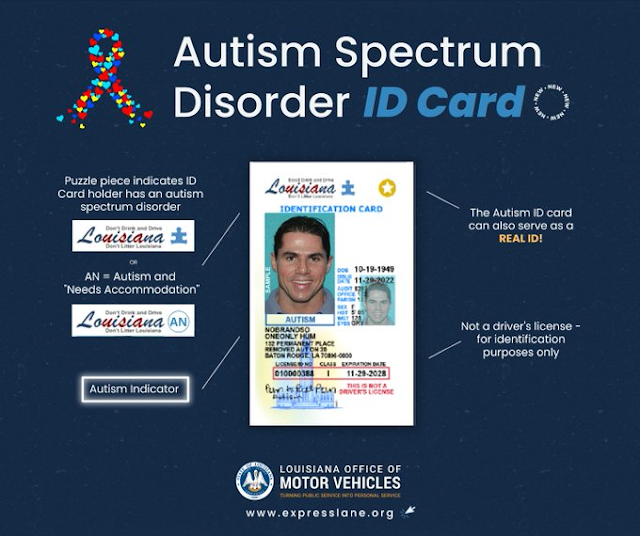
Louisiana has now acted. In addition to the underlying issue, some self-advocates might object to the puzzle piece.

 From the Louisiana Office of Motor Vehicles:


Eligible Louisiana Office of Motor Vehicles customers can now request to have an “Autism” indicator added to their identification cards. Qualified applicants include any person diagnosed with autism spectrum disorder by a qualified medical or mental health professional. The autism indicator will appear under the customer’s picture on the ID card.

The autism indicator is optional and can be removed from a credential at any time, as requested by the applicant. The “Autism” designation can be displayed on any class identification card, including the TIP, but may not be placed on Class H (Handicap Identification Card) credentials. Applicable fees are required for identification card processing if adding or removing the Autism indicator.

Applicants must provide one of the following documents to the Louisiana Office of Motor Vehicles in order to have the designation added to an ID card:


• Medical Examiner’s Certification of Autism Spectrum Disorder form completed by the medical or mental health professional
• A statement from a qualified mental health professional licensed in Louisiana or any other state or territory of the United States verifying the applicant’s disability.

An ID card with an Autism indicator cannot include the “Veteran,” “I’m a Cajun” or “100% DAV” indicators. The Autism indicator can only be combined with the “Needs Accommodation” indicator. If the driver’s license indicates “Autism,” but not “Needs Accommodation,” a puzzle piece symbol will appear on the license with the autism designation below the picture. If the driver’s license indicates both “Autism” and “Needs Accommodation,” the autism designation will appear below the picture in addition to “AN” above the picture.

LA Wallet users can display the Autism indicator on their ID Card in the LA Wallet app. If an applicable card is currently linked in LA Wallet, simply unlink it in the menu and add it back to get the updated image

Thursday, November 3, 2022

Antivaxxer Might Lose Medical License

  In The Politics of Autism, I write:

Many articles and blog posts arguing for the vaccine-autism link have the trappings of genuine academic research: tables, graphs, citations, and scientific jargon. Some of the authors have credentials such as M.D. or Ph.D. degrees. None of these things is a guarantee of scientific value, as the history of science is full of crackpot theories (e.g., AIDS denialism) that are the heavily-footnoted products of people with letters after their names. But most people will not be able to spot the scientific weaknesses of such work. Outside of academia, few understand concepts such as peer review. Jordynn Jack describes one dubious article that appeared in a non-peer-reviewed publication: “Regardless of the scientific validity of the article, though, the writers perform the writing style quite effectively. It would be difficult for the layperson to distinguish this article from any other scientific research paper, especially if one did not investigate the nature of the journal … or of the scientific response to the article.”

Dr. Sherri Tenpenny is one of the Disinformation Dozen,  In an example of the overlap of multiple conspiracy theories, her name appeared on a whiteboard at a Flynn-Lindell event.


Jake Zuckerman at Cleveland.com:
A Cleveland area physician who told an Ohio House committee in the summer of 2021 that coronavirus vaccines could “interface” with cell towers and magnetize recipients now is in danger of losing her license to practice medicine in Ohio.

A state board that licenses doctors notified Dr. Sherri Tenpenny, a Cleveland area osteopathic physician, that it’s considering punishment that could go as far as revoking her license to practice medicine in Ohio after she ignored investigators and flouted a subpoena. Tenpenny made national headlines in June 2021 when she appeared before the Ohio House Health Committee to spread false claims about COVID-19 vaccines.

A Sept. 14 letter from the State Medical Board doesn’t specify what prompted the regulators to launch their investigation. However, it alleges that Tenpenny for months ignored investigators’ requests for information and defied a subpoena seeking her deposition.

Ohio law allows the board to limit, revoke or suspend a medical license for an array of offenses including failure to cooperate with an investigation. Tenpenny, per the letter, told the board it had no “lawful basis” issuing her a subpoena.

Tenpenny’s conspiratorial June 8, 2021, testimony to the Ohio House Health Committee included a series of false claims about purported dangers of vaccines. She baselessly claimed vaccines run a risk of causing ALS, cancer, and other potentially lethal diseases. Her claims about vaccines’ magnetizing effects drew Ohio into lampooning national media coverage and cemented enough political opposition to kill a broad anti-vaccination bill Tenpenny testified to support.

Saturday, October 29, 2022

Special Ed Teacher Standards


Madeline Will at Education Week:
In the face of teacher shortages, many states have lowered licensing standards to get teachers in classrooms as quickly as possible. But here’s a Catch-22: they can’t do that with special education teachers.

The Individuals with Disabilities Education Act, the federal law on educating students with disabilities, requires that special education teachers be “appropriately and adequately prepared and trained” and “have the content knowledge and skills to serve children with disabilities.”

The U.S. Department of Education has taken note that some states and districts may be skirting the law. On Oct. 4, Valerie Williams, the director in the office of special education programs at the education department, warned state directors of special education that those requirements haven’t changed—despite the challenges many states are facing in recruiting enough special educators to fill vacancies.

From the memo by the Office of Special Education and Rehabilitative Services:

Those qualifications must ensure that each person employed as a public school special education teacher in the State who teaches in an elementary school, middle school, or secondary school: (1) has obtained full State certification as a special education teacher (including certification obtained through an alternate route to certification as a special educator, if such alternate route meets minimum requirements described in 34 C.F.R. § 200.56(a)(2)(ii) as such section was in effect on November 28, 2008), or (2) passed the State special education teacher licensing examination and holds a license to teach in the State as a special education teacher, except in the case of a teacher teaching in a public charter school. A teacher teaching in a public charter school must meet the certification or licensing requirements, if any, set forth in the State’s public charter school law. In addition, public school special education teachers may not have special education certification or licensure requirements waived on an emergency, temporary, or provisional basis; and must hold at least a bachelor’s degree.

Thursday, March 17, 2022

Blue Envelopes and Implementation

[M]any police departments have trained officers and other first responders how to spot signs of autism and respond accordingly. Some organizations have also published identification cards that ASD adults can carry in order to defuse potential conflicts. Virginia provides for an autism designation on driver licenses and other state-issued identification cards. Once again, however, the dilemma of difference comes into play. One autistic Virginian worries: “Great, so if I get into an accident, who’s the cop going to believe, the guy with the autistic label or the guy without it?” Clinical psychologist Michael Oberschneider is concerned about the understanding level of first responders: “I think many people still think of Rain Man or, more recently, the Sandy Hook Shooter, when they think of autism even though very few people on the autistic spectrum are savants or are homicidal and dangerous.”
Another problem:  identification methods do no good if cops don't know about them.

Siobhan McGirl at WVIT-TV:
Sonia Turner said she will never forget the day her son, Jordan, got his license. She remembers him coming back from his test with a huge grin, telling her that he had passed.

"It was one of the happiest days of his life," said Turner, who lives in Windsor.

Turner said she was also happy, but she felt mixed emotions.

"Very, very nervous," said Turner. "Very scared, but I knew this was something he had to do."

Jordan Turner is on the autism spectrum. His mom said that he might communicate differently, especially in a potentially high stress situation like a traffic stop.

"Someone who doesn't know that he has autism might think that he's being disrespectful, or that he is being unruly, or he's resisting what they are telling him to do and that's not the case," said Turner.

In January of 2020, a new program was created in Connecticut to address concerns just like Turner's. The 'Blue Envelope' was created to enhance communication between a police officer and a driver with autism.

But when Turner went to her local police department to get an envelope for her son, she had some trouble actually finding one.

"The sergeant that came to the window had no idea what I was talking about," said Turner. "If we have tools like the blue envelope put into place - why is it so difficult to get?"


Tuesday, January 11, 2022

ID in NJ

[M]any police departments have trained officers and other first responders how to spot signs of autism and respond accordingly. Some organizations have also published identification cards that ASD adults can carry in order to defuse potential conflicts. Virginia provides for an autism designation on driver licenses and other state-issued identification cards. Once again, however, the dilemma of difference comes into play. One autistic Virginian worries: “Great, so if I get into an accident, who’s the cop going to believe, the guy with the autistic label or the guy without it?” Clinical psychologist Michael Oberschneider is concerned about the understanding level of first responders: “I think many people still think of Rain Man or, more recently, the Sandy Hook Shooter, when they think of autism even though very few people on the autistic spectrum are savants or are homicidal and dangerous.”

 From New Jersey Senate Democrats:

The Senate today approved bipartisan legislation that would foster greater understanding and communication between law enforcement and the communicative disabilities community by requiring the Motor Vehicle Commission to allow the holder of a driver’s license or non-driver identification card to indicate that the person has been diagnosed with an autism spectrum disorder or communication disorder.

The bill, sponsored by Senator Nellie Pou and Senator Kristen Corrado, would require the MVC to indicate the diagnosis by notating the information on the person’s driver’s license or non-driver identification card under the column designated for restrictions. The goal is to make it easier for the person with the disability to more easily communicate with any law enforcement officer they may encounter and hopefully serve to limit the chances that an ordinary interaction, such as a routine traffic stop, will escalate into a more fraught or even violent confrontation. 

“Too often, in recent years, some interactions between law enforcement and individuals with communicative disabilities have led to negative outcomes, simply because of a communication barrier. This legislation is designed to be a preventative measure that will help improve that communication and minimize the chance of escalation or a negative incident,” said Senator Pou (D-Bergen/Passaic). 

The legislation, S-849, is aimed at protecting members of the communications disability community and also to help law enforcement better understand and communicate with them. 

The bill was approved by the Senate by a vote of 39-0.

Saturday, December 25, 2021

Readiness for Driving

In The Politics of Autism, I discuss interactions between police and autistic people.  Sometimes they occur on the road.  A number of ASD people drive cars.

A release from Children's Hospital of Philadelphia:
A collaborative study from the Center for Injury Research and Prevention (CIRP) and the Center for Autism Research (CAR) at Children’s Hospital of Philadelphia (CHOP) found that only 8% of pediatric healthcare and behavioral service providers feel prepared to assess whether their autistic patients are ready to drive. These findings, recently published in the Journal of Autism and Developmental Disorders, suggest a critical need to develop resources that prepare providers and others who work with autistic youth to effectively facilitate independence and mobility as their patients become adults.

This study is part of a body of research that aims to understand the transportation needs of autistic adolescents. Prior studies have examined how individualized training, parental support, and driving patterns contribute to safe driving. Other studies have found that, whether autistic adolescents decide to drive or not, being able to get where they want to go on their own improves psychosocial, health and employment outcomes. While making decisions about transportation, families of both autistic and non-autistic youth seek guidance from their child’s pediatric healthcare and behavioral service providers. However, little is known about these conversations or how providers approach these topics with patients.

The researchers surveyed a total of 78 providers who care for both autistic and non-autistic patients in March and April of 2019. Most providers were attending pediatric physicians and psychologists located in Pennsylvania and New Jersey. Half reported they had general transportation-related discussions with their non-autistic patients, while only 1 in 5 had these conversations with their autistic patients. When discussing driving, 33% of providers believed they could assess if their non-autistic patients were ready to drive, while only 8% believed they could do so for their autistic patients.

“It was also surprising to learn that only 1 in 4 providers refer their patients, autistic or not, to other providers for driving-related issues,” says Emma Sartin, PhD, MPH, lead author and a postdoctoral fellow at CIRP. “Our next steps will be to start developing resources and tools so that families, and the professionals who support them, are not left largely on their own to make or guide important decisions about driving.”

A lack of guidance for families on how to navigate transportation decisions could be critical, as previous CHOP research found that two-thirds of 15- to 18-year-old autistic adolescents without intellectual disability are currently driving or planning to drive, and 1 in 3 autistic individuals without intellectual disability get licensed by age 21. Other recent research conducted at CHOP found that newly licensed young autistic drivers have similar to lower crash rates than their non-autistic peers, suggesting those who do become licensed are generally safe drivers. Additionally, young autistic drivers are much less likely to have their license suspended or to receive a traffic violation than their non-autistic peers.

“One important way that providers can help autistic teens and their families is to start talking about driving and transportation before they get to high school,” says Benjamin E. Yerys, PhD, study author and a clinical psychologist at CAR. “We know this seems early, but it provides more time for them to benefit from supports, including those services that come from outside of healthcare, including tailored instruction from a driving rehabilitation specialist.”

Resources for families to help their autistic teens transition to adulthood are available at the Center for Autism Research at CHOP and TeenDriverSource.org.

This research was supported by the Eunice Kennedy Shriver National Institute of Child Health and Human Development at the National Institutes of Health Awards R01HD079398 and R01HD096221.

Sartin et al, “Brief Report: Healthcare Providers’ Discussions Regarding Transportation and Driving with Autistic and Non-autistic Patients.” J Autism Dev Disord. Online December 1, 2021. DOI: 10.1007/s10803-021-05372-3

Monday, May 24, 2021

New Jersey Driver License Bill


In The Politics of Autism, I discuss interactions between police and autistic people.  Sometimes they occur on the road.  A number of ASD people drive cars.

Jerry Carino at The Asbury Park Press:
In 2019, a 22-year-old Virginia driver with autism was sentenced to 10 years in prison for his involvement in a car accident. Due to a communication breakdown at the scene, police — who were unaware of driver Matthew Rushin’s autism — determined he intentionally caused the crash.

Rushin later was pardoned by Virginia’s governor, but the case left a deep impression on Marlboro’s Deb Fisher. Her son Jay has autism, functions well enough to drive and has experience with a traumatic misunderstanding.

“That age was coming up when Jay’s going to start driving,” she said, “and I was really nervous about his independence as far as driving and what would happen if he were to be pulled over and in any kind of stressful situation.”

In late 2019 she caught wind of a New York bill that provided a simple solution: a voluntary notation on a driver’s license that informs police of a person’s autism.

“I thought, what a great idea,” Fisher said.

Thus began a campaign of letter writing and phone calls. A year and a half later, a similar bill is on track to become law in New Jersey. The bill, S-741 in the state Senate and A-3191 in the Assembly, permits people diagnosed with autism or a communication disability to voluntarily make a notation of it on their driver’s license and in the motor vehicle commission’s registry, and establishes a program to train law enforcement officers in these kinds of interactions.

It has cleared the transportation committees with bipartisan support and could get sent to Gov. Phil Murphy’s desk sometime this summer.

Monday, May 17, 2021

NC Governor Signs ABA Bill

In The Politics of Autism, I discuss the day-to-day challenges facing autistic people and their families.  In many states -- particularly those with large rural populations -- one problem is a shortage of behavior therapists.

AP reports:
Supporters of children and dults with autism said legislation signed into law on Monday by Gov. Roy Cooper creating a licensing process for treatment specialists should expand services and rein in their costs.

The bipartisan measure that Cooper signed at an outdoor Executive Mansion ceremony says behavior analysts can now operate independently, rather than under the supervision of psychologists, as has been required. North Carolina was the only state until now mandating such control, bill supporters say, leading to higher costs and less access to therapy for those autism spectrum disorder.

“It’s more about access to care and the fact that depending on your zip code, you can be without,” said Rep. Zack Hawkins, a Durham County Democrat who helped shepherd the Senate bill through the House with Majority Leader John Bell, a Republican. Hawkins has two sons with autism disorders.

The new law, which creates a state Behavior Analysis Board to issue licenses, charge fees and conduct investigations of licensees, “is going to impact so many lives in our state,” GOP Sen. Jim Perry of Lenoir County, a chief bill sponsor, said during the ceremony.

Children, their parents and licensure proponents huddled around Cooper as he signed the measure.

Sunday, April 18, 2021

Zinger in Illinois Law Prevents Medicaid Coverage

The Politics of Autism includes an extensive discussion of insurance and  Medicaid services for people with intellectual and developmental disabilities.

In the Budget Implementation Act passed in 2019, legislators included coverage for behavioral therapy in the medical assistance program, which administers state and federal funds from Medicaid and similar services to qualifying residents. Any changes in how Medicaid funding is being used must be included in a State Plan Amendment that is submitted to the federal government for approval, which is where the mistake occurred.

The Illinois Medicaid plan requires that a practitioner must be a Board Certified Behavior Analyst, or BCBA, and possess a second credential as either a Licensed Clinical Social Worker or a Licensed Clinical Psychologist in order to receive Medicaid funding for behavioral therapy. That plan was submitted to and approved by the federal government.

A notice from the Illinois Department of Healthcare and Family Services released in October confirmed that dual credentials would be required to receive Medicaid funds through the department for behavioral therapy.

But the Illinois Autism Task Force, based in the Illinois Department of Human Services, warned in a February letter to Gov. JB Pritzker and the General Assembly that “the dual credential requirement will result in devastating barriers to access.” That same letter said only 26 BCBAs possessed one of the other required certifications and it was unclear whether any of the 26 provided behavioral therapy.

The Autism Task Force, in a 2020 meeting, claimed that $42 million placed in the state’s FY 2020 budget for behavioral therapy through Medicaid remained untouched due to the mistake.
...
HB 16, which currently sits in the House Rules Committee with about five weeks of the General Assembly’s session remaining, would amend the Illinois Public Aid Code to allow for just a BCBA certification for Medicaid coverage of behavioral therapy starting on July 1, the beginning of the 2022 fiscal year.


Thursday, January 28, 2021

Young Autistic Drivers Crash Less

In The Politics of Autism, I discuss interactions between police and autistic people.  Sometimes they occur on the road.  A number of ASD people drive cars.

 A release from  Children's Hospital of Philadelphia:

A collaborative study from the Center for Injury Research and Prevention (CIRP) and the Center for Autism Research (CAR) at Children's Hospital of Philadelphia (CHOP) found that compared with their non-autistic peers, young autistic drivers have lower rates of moving violations and license suspensions, as well as similar to lower crash rates.

The findings were recently published online by the Journal of the American Academy of Child and Adolescent Psychiatry.

Obtaining a driver's license is an important milestone for adolescents and young adults. One-third of autistic individuals without intellectual disability obtain their driver's license by the time they are 21 years old, increasing their mobility as they transition to adulthood.

Prior studies with driving simulators suggested that autistic drivers may be at higher risk for motor vehicle crashes, since autism spectrum disorder (ASD) can affect motor coordination and visual processing speed, both critical skills for safe driving. However, no previous research has objectively looked at the real-world risk of crashes and traffic violations among autistic adolescent and young adult drivers. This knowledge would help pinpoint specific skills instructors can build upon and inform tailored practice driving interventions and lessons to increase young autistic driver safety.

The researchers examined data from New Jersey residents born between 1987 and 2000 who were patients in the CHOP Care Network. Their electronic health records were linked with statewide driver licensing and crash databases. The data included 486 autistic and 70,990 non-autistic licensed drivers over their first four years of driving. The study team also examined the proportion of crashes that were attributed to specific driver actions and types of crashes.

"Our findings are noteworthy because they suggest newly-licensed autistic drivers may establish driving patterns that balance independent mobility and risk, bringing their crash risk in line with other young drivers," said Allison E. Curry, PhD, MPH, senior author of the study and a senior scientist and director of epidemiology at CIRP and an assistant professor of pediatrics at the Perelman School of Medicine at the University of Pennsylvania. "By learning more about their driving patterns and how their crashes differ from those of their peers, we can develop tailored training to help autistic adolescents and young adults develop the range of skills needed to become safe, independent drivers."

The study also found that young autistic drivers involved in crashes were substantially more likely to crash while making left- or U-turns and also more likely to crash due to not yielding for another vehicle or pedestrian.

The authors suggest that weaknesses in processing speed among young autistic drivers may make identifying, processing, or prioritizing potential hazards more difficult. Their motor speed and visual scanning skills may also be slower.

"Our study suggests that autistic adolescents and young adults may benefit from more on-road training than their non-autistic peers," said Benjamin E. Yerys, PhD, a co-author of the study, a psychologist in the Department of Child and Adolescent Psychiatry and Behavioral Sciences and director of the Data and Statistical Core at CAR. "They may need more tailored training in navigating turns and interacting safely with pedestrians and other vehicles."

###

This work was supported by the Eunice Kennedy Shriver National Institute of Child Health and Human Development at the National Institutes of Health Awards R01HD079398 and R01HD096221.

Curry et al, "Comparison of Motor Vehicle Crashes, Traffic Violations, and License Suspensions Between Autistic and Non-autistic Adolescent and Young Adult Drivers." J Am Acad Child Adolesc Psychiatry, online January 13, 2021. DOI: 10.1016/j.jaac.2021.01.001.

About

Children's Hospital of Philadelphia was founded in 1855 as the nation's first pediatric hospital. Through its long-standing commitment to providing exceptional patient care, training new generations of pediatric healthcare professionals, and pioneering major research initiatives, Children's Hospital has fostered many discoveries that have benefited children worldwide. Its pediatric research program is among the largest in the country. In addition, its unique family-centered care and public service programs have brought the 595-bed hospital recognition as a leading advocate for children and adolescents. For more information, visit http://www.chop.edu.