Search This Blog

Showing posts with label Kentucky. Show all posts

Tuesday, June 13, 2023

Autism by the Numbers: Age of First Intervention

Uncertainty is a major theme of The Politics of Autism.  In the concluding section, I write:
A key question in autism policy evaluation is simple to pose, hard to answer: How do autistic people benefit? How much better off are they as a result of government action? While there are studies of the short-term impact of various therapies, there is surprisingly little research about the long term, which is really what autistic people and their families care about. As we saw in chapter 4, few studies have focused on the educational attainment of autistic youths. For instance, we do not know much about what happens to them in high school, apart from the kinds of classes that they take. One study searched the autism literature from 1950 through 2011 and found just 13 rigorous peer reviewed studies evaluating psychosocial interventions for autistic adults. The effects of were largely positive, though the main finding of the review is that there is a need for further development and evaluation of treatments for adults.

Autism by the Numbers, created by Autism Speaks in collaboration with the National Autism Data Center at Drexel University, has the potential to transform the way we understand and meet the needs of autistic individuals and their families. This central, authoritative hub of reliable data about people with autism will allow insight into the strengths and weaknesses of systems that exist to improve health, education, employment and advocacy. The Autism by the Numbers Annual Report and Dashboard can also be used to support the creation of precision public health programs specific to the diverse needs of the autistic community.


 Autism by the Numbers data also show variation between states in access to diagnosis and early  intervention. 
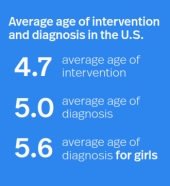
Infographic showing average age of intervention and diagnosis in the U.S.
  • Average age of first intervention ranges from 3.7 to 7.2 years of age across states.
  • Average age of diagnosis ranges from 3.6 years to 7.6 years across states.
  • Delaware and Kentucky have the youngest age of first intervention, at 3.7 years in each state.
  • Oklahoma (5.3 years), Mississippi (5.5 years), Ohio (5.6 years), North Dakota (6.0 years) and West Virginia (7.2 years) show an average age of intervention above the national average, indicating a possible need to improve screening processes or access to intervention services.

More in-depth research is needed to understand why some states are able to effectively screen for ASD and provide early intervention services, while others experience significant delays in care.
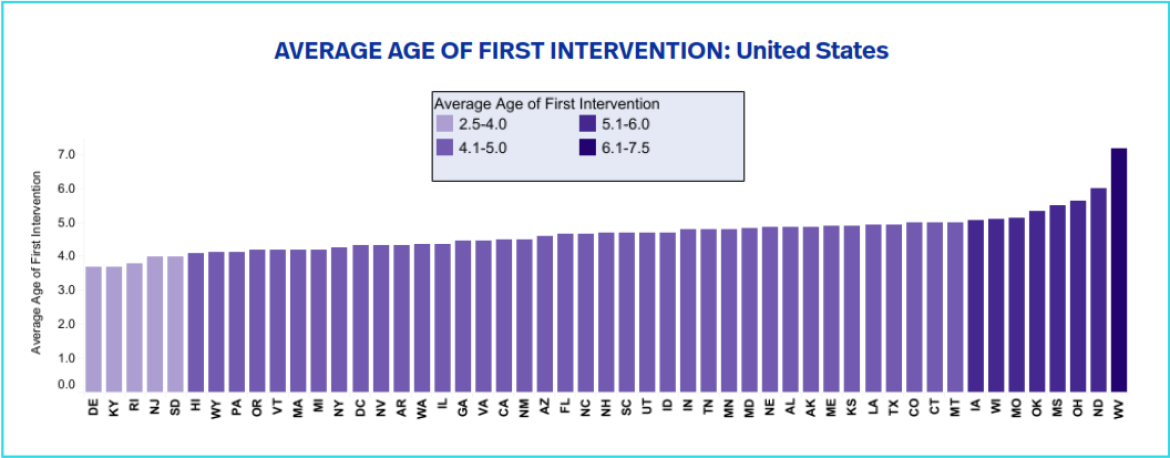
Bar graph showing average age of first intervention by state in the U.S.

Thursday, March 9, 2023

Louisville Police and People with Disabilities

In The Politics of Autism, I discuss interactions between police and autistic people.  When cops encounter autistic people they may not respond in the same way as NT people, and things can get out of hand. Among other things, they may misinterpret autistic behavior as aggressive or defiant, and respond with tasers, batons, chokeholds, or worse.

Posts have discussed incidents in the following places:

The Justice Department has a report titled Investigation of the Louisville Metro Police Department and Louisville Metro Government.  It finds that the police and the metro government discriminate against people with behavioral health disabilities when responding to them in crisis.

In some cases, officers’ animosity toward people with behavioral health disabilities may have led to a worsening of their mental health symptoms. According to stakeholders, the treatment faced by these individuals is not uncommon. Stakeholders told us about officers making jokes about mental illness, taunting individuals in crisis, and treating unhoused individuals with “disdain.” Unnecessary and inappropriate LMPD involvement also can also lead to avoidable arrests and incarceration, which carries unique risks for people with behavioral health disabilities.

LMPD officers sometimes arrest people on multiple, redundant criminal charges, even when it is clear that the person is experiencing behavioral health problems. In one incident, officers were dispatched to a white woman who was having thoughts of self-harm, a typical scenario that can often be handled by a behavioral health response such as a mobile crisis team. Upon officers’ arrival, she was clearly experiencing illogical, disorganized thinking and delusions. The officer approached her quickly, closely, and confrontationally. She stated that she wanted to go to prison, spit in the direction of the officer, and, several minutes later, gave the officer a very light push. The officer aggressively handcuffed her and told her that she was “acting like a child” and that “quite a bit is wrong with” her. The officer arrested her and charged her with menacing, giving false identifying information, and disorderly conduct. Officers once again encountered this woman in April 2022 while she was experiencing a crisis and took her to the hospital. During this interaction, one officer stated: “They could have handled that with a social worker, right?”

Similarly, our review of body-worn camera footage revealed that LMPD officers frequently escalate situations rather than de-escalate them. Officers frequently fail to give people experiencing crisis time or space, do not engage in verbal de-escalation for enough time to be successful, and shout orders rather than speaking calmly.77 Additionally, in some videos we witnessed LMPD officers rapidly surrounding individuals experiencing a behavioral health crisis with weapons drawn and failing to designate an officer to be the primary communicator. Both tactics tend to escalate rather than de-escalate the situation. In some cases, officers’ escalation of the behavioral health crisis led to increased safety risks to themselves and the person in crisis and increased the likelihood of the use of force. At other times, officers’ behavior toward people may have created the entire crisis. What we saw was confirmed more broadly by community stakeholders. For example, one service provider stated, “Things don’t end well when LMPD gets involved.”


Tuesday, June 8, 2021

Chokehold

In The Politics of Autism, I discuss interactions between police and autistic people.  Police officers need training to respond appropriately.  When they do not, things get out of hand.  Autistic people can suffer serious injury or death.

Tom Lally at WHAS-TV:
A 14-year-old boy was in a moment of crisis on Saturday. When he started threatening his mother Christina Brooking, her sister called the police to intervene. Brooking told WHAS11 News, "He had one of his moments, I guess his PTSD moments." She explained that her son Corey lives with autism, PTSD, and a physical disability. Graymoor-Devondale Police Chief Grady Throneberry said first responders have been called to Brooking's home 20 times during the past six months for similar issues. On three of those occasions, he said, officers had to fight or wrestle with Corey before he calmed down.

Two officers entered the apartment around 7:30 p.m. Saturday, to see Corey standing in the hallway with a broomstick. Corey called out for the officers to slide their guns and tasers to him, as he might have heard in his video games. Officers tried to help Corey calm down and his mother said she thought it was working. Then, she heard a struggle.

"The one cop was trying to put the cuffs on one of his arms and was kind of struggling," Brooking said. "And the other cop just put him in a chokehold."

She described her son's face turning blue and his eyes rolling back in his head.

Chief Throneberry described the move as a "lateral vascular restraint." Rather than restricting oxygen to the lungs, this chokehold restricts blood from the head. Both chokeholds are legal in Kentucky.

"The officers applied that correctly for less than ten seconds," Throneberry said. "I think they did exactly the right thing." 

Wednesday, January 9, 2019

Another Dragging in Kentucky

In The Politics of Autismdiscuss the use of restraint and seclusion, along with cases of abuse.

Previous posts discussed dragging incidents in Kentucky.  Here is another.

Lindsey Bever at the Washington Post:
A special-education teacher emerged from a classroom, dragging a student with autism through the hallwaysof an elementary school in Kentucky.
After a moment, the teacher, whom authorities later identified as Trina Abrams, stopped and asked the 9-year-old boy, “You want to walk?”
“No,” he said.
“Okay,” she responded, then the boy let out a moan as she continued to pull him by his wrists, dragging his limp body across the floor.
The child’s mother, Angel Nelson, told ABC affiliate WCHS she was “horrified” when she learned that her son, who has autism among other special needs, was allegedly dragged by a teacher through his school. Nelson said she posted surveillance footage of the October incident on Facebook last weekend because she wanted him “to have a voice.” The video has since been viewed hundreds of thousands of times, prompting widespread outrage and calls for change.

Sunday, November 4, 2018

Subtle Barrier to Voting

In The Politics of Autism, I write:  "Support from the general public will be an important political asset for autistic people. Another will be their sheer numbers, since a larger population of identified autistic adults will mean more autistic voters and activists"

At WFPL-FM In Louisville, Lisa Gillespie reports that complaints about voting access can lead to change.
That’s what happened in the case of 26-year-old Lexington resident Amelia Mullins, who has severe autism and gave permission for her mother, Wendy Wheeler-Mullins, to speak on her behalf.

“When [Amelia] gets anxious, she tends to recite TV shows and movies, verbatim, kind of a self-calming mechanism,” Wheeler-Mullins said. “I think that’s what made the people look at us like, this person doesn’t have a brain in her head, she shouldn’t be voting.”
The two had a particularly bad voting experience in 2015, where they faced what Wheeler-Mullins called “judgmental, skeptical” looks from poll workers.
“I just got the impression that they thought like, I was trying to buy her vote or something,” Wheeler-Mullins said. “They didn’t stop her from voting, but their behavior would have been a discouragement to someone from voting.”
Wheeler-Mullins said she complained and was told poll workers would be spoken with and receive more training.

Saturday, October 27, 2018

Another Dragging Incident in Kentucky

In The Politics of Autismdiscuss the use of restraint and seclusion, along with cases of abuse.

In Lexington, Kentucky, Valerie Honeycutt Spears reports at The Herald-Leader:
A few days after school started in August, Ashley Horton said a state child protective service worker knocked on her door with some unsettling news about how Horton’s 6-year-old autistic son had been injured at Lexington’s Picadome Elementary School.
The details are similar to another recent dragging incident of a Fayette autistic student that drew national attention. A description was included in a Kentucky Cabinet for Health and Family Services investigative report that state officials finished Oct. 19. Horton and her attorney shared the report with the Herald-Leader.
Picadome school staff identified as witnesses told state investigators that a teacher’s aide — found not to have completed re-certification in safe crisis management — dragged the boy by the ankles into a classroom “when he would not cooperate with her,” the report said.
She put him in a room by himself while standing outside and holding the door closed, the report stated. She also picked him up from behind and sat down with him in a rocking chair, causing him to bump his head. The techniques were not appropriate or approved, the report said, and the boy could have hurt himself when placed in isolation.
State officials found enough evidence to support the allegations, which the teacher’s aide denied, the report said.


Monday, September 10, 2018

EMPOWER Care Act Advances

The Politics of Autism includes an extensive discussion of insurance and  Medicaid services for people with intellectual and developmental disabilities.  

A Friday release from Rep. Brett Guthrie (R-KY):
Today the House Energy and Commerce Committee’s Health Subcommittee approved Congressman Brett Guthrie’s (KY-02) and Congresswoman Debbie Dingell’s (MI-12) Ensuring Medicaid Provides Opportunities for Widespread Equity, Resources (EMPOWER) and Care Act (H.R. 5306), which will help certain Medicaid participants receive long-term care in their homes or communities if they voluntarily choose to receive in-home care.

The EMPOWER Care Act reauthorizes the federal Money Follows the Person (MFP) demonstration program for one year. This program allows certain Medicaid users, such as seniors and individuals with disabilities, transition from a nursing home or institutional care back to their home. Since the MFP program was created over a decade ago, it has successfully helped over 88,000 individuals receive care in their own homes. The MFP program does not require people to leave institutional care; rather, it allows individuals who choose to go home to do so.

“There’s a reason we named our bill the EMPOWER Care Act – because we want to empower individuals with disabilities and seniors to choose the care that works best for them,” said Guthrie. “Kentucky Transitions, which administers the MFP program in the Commonwealth, has allowed hundreds of Kentuckians in nursing homes and other institutions to choose to go back to their own homes for care, and other states have had similar success. This program is a cost-effective way for people to receive the care that is best for them where they want to be. I was proud to introduce this bill with Congresswoman Dingell and I urge the full committee to approve this bill as soon as possible.”

“Our long-term care system is completely broken. Unfortunately I am witnessing its problems firsthand and am meeting people in crisis almost daily,” said Dingell. “The Money Follows the Person program has demonstrated it works, has strong bipartisan support, and saves taxpayers money by successfully transitioning thousands of people from institutions to a community setting where they can be with their loved ones. This is why I’m proud to author the EMPOWER Care Act with my friend and colleague Congressman Brett Guthrie to reauthorize the program. Advancing this bill through the Health Subcommittee is a critical step to getting it signed into law this year, and I’m looking forward to working with my colleagues on the Energy and Commerce Committee to ensure we get this done.”

Now that the Health Subcommittee has approved the EMPOWER Care Act, it must be marked up by the full Energy and Commerce Committee before heading to the House floor for a vote.

Saturday, January 6, 2018

Wandering: One Sad Story

The Politics of Autism discusses the problem of wandering, which has been the topic of legislation before Congress

Beth Warren reports at the Louisville Courier Journal:
Shalom Lawson, an 8-year-old Louisville boy who loved hugging people he just met, wandered from a relative's home last summer and drowned.

He had autism, a disorder that causes many children to walk off. "Elopers,"as they are called, are especially drawn to water and are unaware of the risks.

"Water makes them feel calm, but water is very, very dangerous," said Shalom's mother, Magdalene Lawson, who came to America from West Africa with her husband, Charles.

She told Courier Journal she tried to protect her son by locking her bathroom to keep him from filling up the bathtub. She feared he would burn himself or drown. And she said she kept an alarm on her front door that would beep if he tried to get out.
But on a visit with family near Indianapolis last July, Shalom wandered off and drowned in a retention pond.
The story of Shalom's death is being shared with MetroSafe dispatchers and others who respond to emergencies in the Louisville area by trainers who are working with them on how to help people with autism.
"The police, fire department and EMS are in our society to be that resource to every individual," said Deborah Morton, executive director of Families for Effective Autism Treatment in Louisville. She said a tense situation can turn chaotic if emergency personnel don't know how to respond.

Monday, August 17, 2015

Shackled

In The Politics of AutismI discuss the use of restraint and seclusion in schools.

Christina Samuels reports at Education Week:
Restraint and seclusion in schools, particularly when used with students with disabilities, has been a simmering national issue for years.
But when video of a Kentucky school resource officer handcuffing an 8-year-old boy was released earlier this month by the American Civil Liberties Union, debate over the practice of restraining students erupted anew. The ACLU filed a lawsuit against the school resource officer, Kevin Sumner, and his employer, the Kenton County, Ky., sheriff's department.
The seven-minute video, which shows a whimpering and crying boy with attention deficit hyperactivity disorder cuffed at the biceps behind his back while Sumner stands nearby, is also stirring debate about disability, race (one of the children in the lawsuit is Hispanic, and one is African-American), and the role of school resource officers. And experts in school security say that the incident brings up another vexing issue: School resource officers are too often pulled into disciplinary issues that are better left to school staff.

 From a Connecticut report (See post for 2/8/15)
In Connecticut, children with Autism Spectrum Disorders (ASD) are the most likely children to be restrained or secluded in school. Experts have strongly cautioned against reliance on seclusion and restraint for children and adults with Autism. In 2011, the Interagency Autism Coordinating Committee (IACC), authorized under federal law as an advisory committee per the Combating Autism Act of 2006 (P.L. 109-416), issued a public letter to the U.S. Department of Health and Human Services outlining significant concerns regarding the pervasive use of restraint and seclusion for children with autism. The IACC—chaired by Thomas Insel, M.D., Director of the National Institute of Mental Health—stated:
[U]tilization of restraint or seclusion should be viewed as a treatment failure that exacerbates behavioral challenges and induces additional trauma.
In its letter, which specifically addressed seclusion and restraint in schools, the IACC endorsed numerous recommendations for federal agencies including regulatory reform, improved data collection, guidance and technical assistance for providers, concluding:
“[F]ederal legislation is urgently needed to ensure the safety of all students and staff” by requiring standards for monitoring and enforcement of restraint and seclusion practices, as well as prohibition of mechanical, chemical, and high-risk physical restraints . . . “the use of seclusion and restraint in every setting is a critical issue for people with ASD and other disabilities and their families that requires immediate Federal attention.” xiv

Sunday, April 21, 2013

Implementation Problems in Kentucky and California

In Kentucky, The Lexington Herald-Leader reports on implementation of the Kentucky insurance mandate:
he bill, which took effect in January 2011, required large group insurance plans to pay for autism-related therapy — up to $50,000 a year for children ages 1 to 6 and up to $12,000 a year for kids ages 7 to 12. In particular, it required coverage for a costly therapy called applied behavioral analysis — an intensive one-on-one therapy that uses behavioral techniques to teach children skills.
"It made everyone feel really great," said Shelli Deskins, director of the Highlands Center. "The legislators, the providers, families and everyone involved thought this would finally help kids with autism. But there are still families that are trying to get reimbursed for something that this law entitles them to."
In particular, insurance companies have balked at paying for services in an institutional setting such as the Highlands Center and the Academy at St. Andrews, a private school for autistic children in Louisville. Generally, insurance companies are not required to pay for treatment that is viewed as educational rather than medical.
"It's a loophole in the law," said Dr. Mark Miller, whose autistic daughter attends St. Andrews.
The school does not bill insurance for treatment, but Miller and his wife — who also is a doctor — tried to submit claims to Anthem Blue Cross and Blue Shield and United Healthcare for their daughter's treatment at St. Andrews.
Those claims were repeatedly denied because St. Andrews is a school, Miller said.

A recent post noted that hundreds of California children transitioning from Healthy Families to Medi-Cal may not have access to ABA in the Medi-Cal health plan. At The San Francisco Chronicle, Laura Shumaker provides some background:
...Medi-Cal “carves out” mental and behavioral health services from contracts with health plans. These services are to be provided by County Mental Health Departments for those with Asperger’s and Pervasive Developmental Disorder–Not Otherwise Specified or PDD-NOS (about 2/3 of individuals with ASD). County Mental Health Departments do not provide ABA therapy. Twenty-one Regional Centers (nonprofit private corporations that contract with the state’s Department of Developmental Services (DDS) to provide or coordinate services and supports for individuals with developmental disabilities) provide services for some of those with autistic disorder (individuals with autistic disorder make up about 1/3 of those with ASD). Funds for DDS and county mental health services have been cut over the past several years and while providers do their best to offer all children services, there can be long wait times and/or limitations on services. School districts may provide access to ABA therapy, but only as it relates to educational activities. As a result of all of the above, a majority of beneficiaries with ASD are unable to access the standard-of-care treatment for autism in Medi-Cal.
The transition of 875,000 children from the Healthy Families Program to Medi-Cal began in January, and 264,000 children moved in the most recent phase on April 1st. At that time, over 200 children receiving ABA therapy lost coverage of those services, despite families being notified by the state in writing that, “Your child will continue to have all of the same services during this move. Your child’s coverage will not be interrupted.”
In fact, families were specifically told: “The Medi-Cal program covers mental health services. Your county mental health plan will provide the services, and your Medi-Cal health plan will help coordinate them.”
However, this is not what many families are experiencing.

Saturday, September 22, 2012

Restraint and Seclusion: Updates

Howard County school officials are investigating an incident involving an 11-year-old autistic boy who was handcuffed by police officers on a school bus after he allegedly bit several adults and students.
The child, who does not speak and has limited social skills, according to his mother, was being transported from the Kennedy Krieger Institute in Baltimore, which accepts students whose severe learning disabilities require specialized education not provided by public school systems.
Perhaps the most notorious recent incident is the "therapy bag" case in KentuckyAP reports:
Some Kentucky school superintendents are expressing concerns about a proposed state regulation on the use of student restraint.
Pendleton County Schools Superintendent Anthony Strong told The Kentucky Enquirer (http://bit.ly/RIsuqJ) that the proposal is too vague. He says employee expectations need to be defined better.
"There appears to be subjectivity as to when the staff member should intervene," said Strong. "There is a huge question as to where the line is."
Kentucky Department of Education spokeswoman Lisa Gross says the proposal is still in draft form and wording could be changed. A public hearing on the issue will be held Tuesday in Frankfort.
The issue came to the forefront late last year after state officials received three complaints about students being restrained or confined alone in small rooms. The department cited two schools for violating the rights of disabled students who were subjected to such treatment.
Read more here: http://www.kentucky.com/2012/09/21/2345175/superintendents-concerned-about.html#storylink=cpy

Read more here: http://www.kentucky.com/2012/09/21/2345175/superintendents-concerned-about.html#storylink=cpy

Read more here: http://www.kentucky.com/2012/09/21/2345175/superintendents-concerned-about.html#storylink=cpy
In Massachusetts, the Lexington Patch reports on Robert Ernst, a 17-year-old student with ASD:
According to him and his mother, Wendy Ernst, Robert was put on an individualized education program (IEP) since pre-school, but wasn’t diagnosed with Asperger’s until fifth grade. During the intervening years is when, according to the family, Robert was shut in a seclusion room and physically restrained on several occasions by teachers and aids at the Fiske and Estabrook elementary schools.
The Ernst family decided to share Robert’s story last week, after allegations of the mistreatment of special needs students and use of seclusion rooms in the Lexington Public Schools were thrust into the spotlight by a former Lexington resident’s op-ed in the New York Times. Going public is something family members said they wouldn’t have done otherwise, but which they hope will bring awareness to the community and closure to the family.
“I hope this starts with people becoming aware that these things can happen, and stop wearing those rose-colored glasses,” said Robert, “Because these things have happened in our town.”
Allegations of abuse within the special education system in the Lexington Public Schools came to the fore last week when former resident Bill Lichtenstein shared the story of his daughter’s “seclusion room” experiences while a kindergartner at Fiske during the 2005-2006 school year.
A second story emerged during a School Committee meeting last Tuesday, and the following daydistrict administrators asked the state Department of Children and Families to conduct an investigation into those cases. The Ernst family has asked for Robert’s case to be included, but as of Wednesday evening had not definitively heard back about its inclusion.
In Wilmington, NC, the StarNews reports:
New Hanover County Schools' use of seclusion rooms to deal with students' aggressive behavior does not violate North Carolina law, according to Rick Holliday, assistant superintendent for support services.

On Aug. 27, the U.S. Department of Education Office for Civil Rights (OCR) completed an investigation into the district's seclusion rooms that was opened in February. The inquiry found that the district had no compliance issues with N.C.'s Greenblatt Act, which gives schools strategies, such as seclusion rooms, to deal with students' aggressive behavior.
The paper then followed up:
Sara Reider, mother of two special-needs students in New Hanover County, spoke to the board during the public comment section at Tuesday's meeting. She said that while OCR found no violations against one student, it did find larger violations during the course of its investigation.
On Aug. 27, OCR completed an investigation into the district's seclusion rooms that was opened in February. The inquiry found that the district had no compliance issues with N.C.'s Greenblatt Act, which gives schools strategies, such as seclusion rooms, to deal with students' aggressive behavior.
The investigation stemmed from a two-fold complaint filed in January by parents of a 5-year-old special education student. The complaint alleged that the student was being placed in a seclusion room and forced to stay inside and that the district was only using its seclusion rooms for students with disabilities.
Reider cited what she said was OCR's report on the investigation during her comments to the board. A StarNews request for the official report through the Office for Civil Rights is pending.

Friday, May 11, 2012

Implementing the Kentucky Mandate

A release from Autism Speaks:
Autism Speaks praised the Kentucky Department of Insurance for issuing an advisory opinion directing health insurers to start covering services provided by supervised ABA providers, finding that autism treatment would be "severely compromised" without their services.
Kentucky law explicitly exempts persons who provide Applied Behavior Analysis (ABA) under the supervision of a licensed professional from themselves having to gain certification, according to the opinion, signed by Insurance Commissioner Sharon Clark. Their services should therefore be reimbursed under Kentucky's 2010 autism insurance reform law, the department concluded.
“This opinion eliminates a significant and unnecessary hurdle that has blocked many Kentucky families from obtaining appropriate levels of ABA therapy for their children with autism,” said Lorri Unumb, Esq, vice president for state government affairs. “The Kentucky Department of Insurance correctly interpreted the text of the state’s 2010 autism insurance reform law and the will of the Legislature in directing health insurers to start covering these services.”
The opinion noted that ABA therapy requires a functional assessment and behavior plan developed by a Board Certified Behavior Analyst (BCBA) or Board Certified Assistant Behavior Analyst (BCaBA). The direct services ultimately provided under the treatment plan, however, are typically rendered by "supervisees" – the front-line personnel who carry out the intervention.
"Clearly, Kentucky's statutes pertaining to ABA and the treatment of autism spectrum disorders contemplate the active involvement of supervisees, provided that they are acting under the extended authority and direction of a BCBA or a BCaBA," the opinion states.
"To exclude coverage for supervisees undermines the intent of (state law) which is to mandate coverage for the diagnosis and treatment of autism spectrum disorders," the order said. "Without the direct services provided by supervisees, the treatment of autism is severely compromised."

Saturday, January 28, 2012

"Therapy Bag" and Viral Issues

At WebProNews, Abby Johnson reports on the Kentucky "therapy bag" case:
Lydia Brown, an autistic college student at Georgetown University, saw the story and decided to create a petition onChange.org. The petition, which has received over 180,000 signatures already, calls for the school to take action against the teacher involved as well as comprehensive training for all school personnel.
However, as with many viral stories, the Christopher Baker case has generated a fair share of controversy. Some people from the autism community have spoken out in defense of the school saying that therapy bags are often used for treating autistic individuals.
Another debatable issue is in regards to how the bag was used. Christopher’s mother says he was put into the bag for misbehaving, which raises concerns over the use of seclusion and restraint in the treatment of individuals with disabilities.
Amy Dawson, the Founder of the Autism Advocacy & Law Center LLC, told us that seclusion or restraint could be harmful to any child but especially those with disabilities since he or she may not be able to fully understand what is happening.
At this time, the school board has said that it has concluded its investigation and is moving on. Sandra Baker, who now has legal support from The Gallini Group in Alabama and Chevalier Ginn Shirooni & Kruer in Kentucky, is continuing to fight the incident.


Thursday, January 19, 2012

"Therapy Bag" Mom Has a Petition

WHAS-TV reports
Her son who has autism was stuffed in a duffel bag by a teacher. Thursday, that mom will head to the school board meeting armed with a petition. Sandra Baker says that petition has nearly 170,000 signatures on it. It calls on the board in Mercer County to discipline the teachers involved and to institute a training program for teachers dealing with special needs children.
 

Thursday, January 5, 2012

Saturday, December 24, 2011

"Therapy Bag" and the Social Media Response

Social media are responding to the case in Kentucky where a school used a duffel bag for seclusion and restraintLaura Shumaker writes at The San Francisco Chronicle:
Lydia Brown, an 18-year-old university student who also has autism , learned about Chris from a story on Landon Bryce’s blog ThAutcast.com and launched the petition on Change.org calling on the school to fire the teacher and institute a comprehensive training program in the school district.
More than 7,000 people have joined the campaign in the first 24 hours.
“Clearly there is anger over the alleged treatment of this boy, and the growth of this campaign is quite remarkable,” said Benjamin Joffe-Walt, director of communications for Change.org, the world’s fastest growing online campaigns platform. “Armed with only a laptop and without any funding or support, an autistic 18-year-old has recruited some 10,000 supporters in less than 24 hours, with dozens joining every minute.”
There is no doubt that teachers and aides that work with students with autism spectrum disorders need training (Click HERE to learn about the program at Alliant Universtiy, and HERE to learn about the program at Dominican University.)
Working with students with autism can be confounding and exhausting, but it can also be incredibly rewarding. Thanks to petitions like Lydia’s, more teachers and aides will be better equipped to work meaningfully with our kids and reap those rewards.
To learn more about Change.org, CLICK HERE.To sign Lydia’s petition, CLICK HERE.To learn about Landon Bryce and ThAutcast, CLICK HERE.Need to explain autism to someone? CLICK HERE for a primer.

Friday, December 23, 2011

"Therapy Bag" -- More on the Kentucky Case

Ensuring national attention, AP is covering the story of a Kentucky school that stuffed a 9-year-old autistic boy, Chris Baker, into a bag.
At a meeting with school district officials, the bag was described as a "therapy bag," [Sandra] Baker said, though she wasn't clear exactly what that meant. She said her son would sometimes be asked to roll over a bag filled with balls as a form of therapy, but she didn't know her son was being placed in the bag. She said school officials told her it was not the first time they had put him in the bag.
So far, almost 700 people have signed a petition on the website change.org. Lydia Brown, an autistic 18-year-old Georgetown University freshman from Boston, said she started it after reading a story about Chris. 
"That would not be wrong just for an autistic student. That would be wrong to do to anyone," Brown said.
Advocates for the autistic were outraged.
Landon Bryce of San Jose, Calif., a former teacher who blogs about issues related to autism, said the school's treatment of Chris was "careless and disrespectful."
"A lot of the damage that we do to students with all kinds of disabilities is by treating them as though they deserve to be treated in a way that's different from other people," Bryce said.
Baker said she heard different accounts about her son's behavior that day.
Baker stopped short of calling for the dismissal of school employees, but she said they should be suspended. They also need more training, she said.
In Kentucky, there are no laws on using restraint or seclusion in public schools, according to documents on the state Department of Education's website.
Nirvi Shah reports at Education Week:

A U.S. Senate bill filed late last week would limit physical restraint and locked seclusion of students—measures often used with students with disabilities who are considered out of control, harmful to themselves or others, or in need of being calmed.
Iowa Democratic Sen. Tom Harkin's "Keeping All Students Safe Act," is similar to a bill filed by Rep. George Miller, D-Calif., in April. The U.S. House has previously passed the bill, but it wasn't taken up by the Senate. However Rep. Miller's bill has bipartisan support. Sen. Harkin's bill has no cosponsors, at least not yet.
Among other things, the bill would: ban the use of physical restraints except in emergency situations; prohibit physical restraints that affect a student's primary means of communication; forbid putting seclusion or restraint into a student's individualized education program or IE; require states to collect data on the use of the measures, and ask schools to meet with parents and staff after a restraint is used and plan interventions that would prevent their use in the future.


Thursday, December 22, 2011

Bad Case of Seclusion and Restraint in Kentucky

From Kentucky comes a story about seclusion and restraintWKYT in Lexington reports:
A young Kentucky boy and his mother have become the center of a national petition after she says a school employee put her son in a bag.
Sandra Baker says her nine-year-old son Chris, who has autism, was placed in the bag as punishment for acting out at school in Mercer County. Since then hundreds of people from across the country have signed a petition in support of the family....
You can read the online petition by following this link:http://www.change.org/petitions/petition-to-board-of-education-of-mercer-county-kentucky