Search This Blog

Tuesday, July 16, 2024

State of the States on IDD

The Politics of Autism includes an extensive discussion of insurance and  Medicaid services for adults with intellectual and developmental disabilities

Kansas University Center on Developmental Disabilities, and director, State of the States in Intellectual and Developmental Disabilities project
In FY2021, 87% of the total public funding for IDD services was distributed through Medicaid-related services.
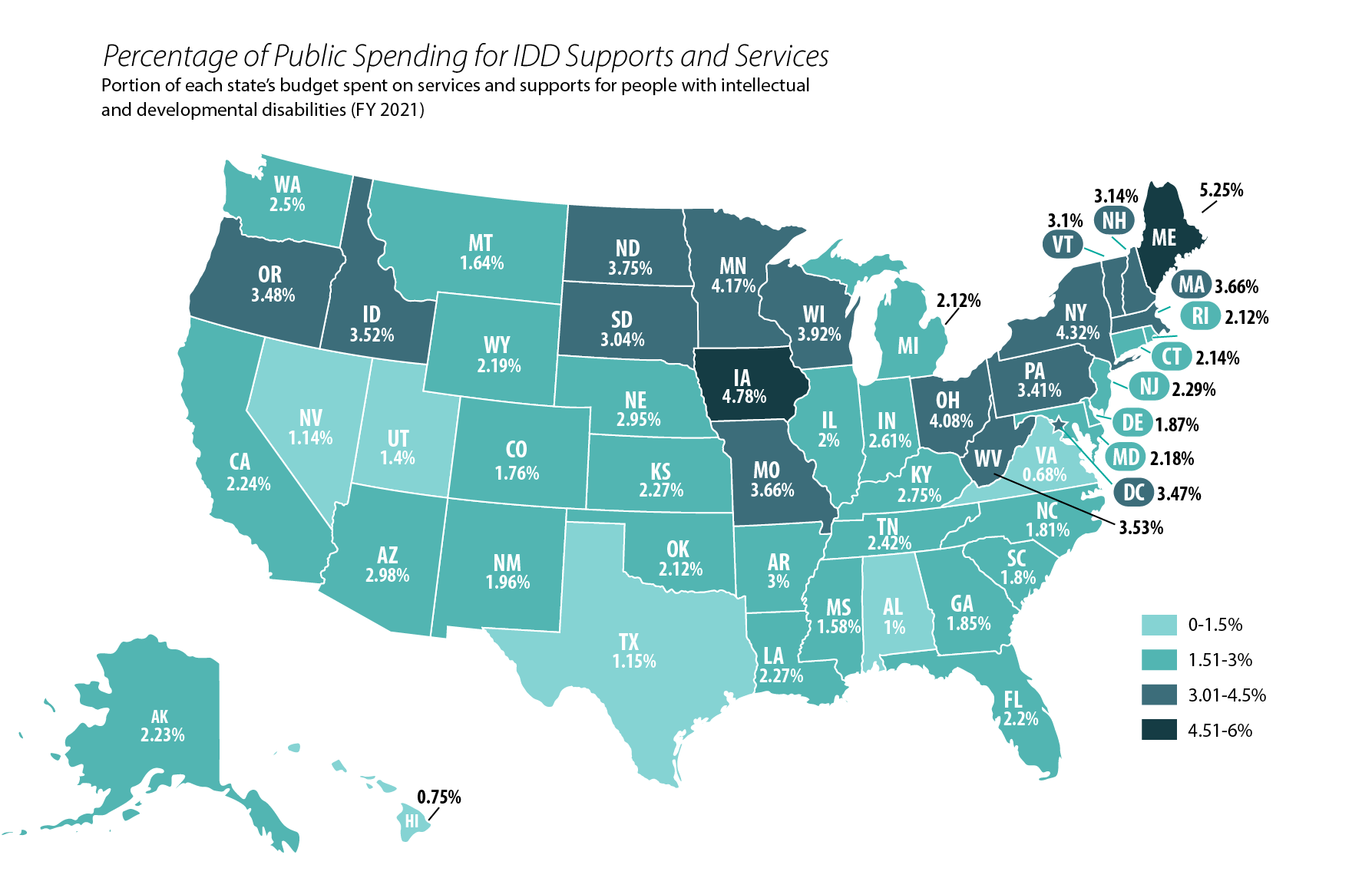
As a percentage of each state’s budget, supports for intellectual and developmental disability services make up between less than 1% and up to 6% of any state’s budget, or an average of 2.57%. This is illustrated in the map below.

This map of the United States shows the percentage of public spending in each state for IDD supports and services, ranging from .75% in Hawaii to 5.25% in Maine.


After Olmstead, funding shifted away from congregate settings:


Monday, July 15, 2024

Data on Autism and Public Insurance

The Politics of Autism includes an extensive discussion of insurance and  Medicaid services for adults with intellectual and developmental disabilities

Center for Medicaid and CHIP Services, Division of Quality and Health Outcomes. 2024 Medicaid and CHIP Beneficiaries at a Glance: Autism. Centers for Medicare & Medicaid Services. Baltimore, MD. Released July 2024.

Approximately 5 percent of children ages 3 to 17 with public insurance have Autism or Autism Spectrum Disorder (ASD), as reported by parents. The Centers for Medicare & Medicaid Services (CMS) provides states with several options under the federal Medicaid program for providing services to eligible individuals with Autism or ASD, including access to therapy services, preventive services and other licensed practitioner services. The Early and Periodic Screening, Diagnostic, and Treatment (EPSDT) benefit requires that all children enrolled in Medicaid, and at state option children enrolled in the Children’s Health Insurance Program (CHIP), receive screenings designed to identify health and developmental issues, including ASD, as early as possible. EPSDT also requires that Medicaid programs provide medically necessary diagnostic and treatment services to covered children. 

 Key Findings • Children with public coverage were reported to have significantly higher rates of Autism or ASD than children with private or no current coverage. • Half of children with public coverage who were reported to have Autism or ASD were diagnosed by age 4.
Sunday, July 14, 2024

Appropriations and Autism

In The Politics of Autism, I write:

For those who remain at larger residential institutions, the horrors of yesteryear have generally ended. In 2012, however, a ten-year-old video surfaced, showing disturbing image of an electric shock device at the Judge Rotenberg Center in Canton Massachusetts. Staffers tied one student to a restraint board and shocked him 31 times over seven hours, ignoring his screamed pleas to stop. The Rotenberg Center is the only one in the nation that admits to using electric shocks on people with developmental disabilities, including autism. Center officials said that they had stopped using restraint boards but insisted that shocks were necessary in extreme cases to prevent officials insist the shock program is a last resort that prevents people with severe disorders from hurting themselves or others.

From the Autism Society:

The House Appropriations Committee passed a bill on July 10 to fund the Departments of Labor, Health and Human Services (L-HHS-ED) for Fiscal Year 2025 FY25. The bill report language can be found here. Two separate summaries were developed. One summary was developed by the majority (Republicans); another summary was developed by the minority (Democrats). The Autism Society is still reviewing the bill. At first glance, we are disappointed to see significant cuts to programs within the CDC that support drowning prevention and suicide prevention. There are also cuts to maternal and child health and Kevin and Avonte programs. We are also analyzing a proposal to consolidate NIH institutes and their impact on funding
ASAN welcomes the removal of Section 722 from the Agriculture, Rural Development, Food and Drug Administration, and Related Agencies Appropriations Act. In June, some members of Congress introduced a rider to the act that would stop the FDA from banning electric shock devices for behavior modification, such as the devices used at the Judge Rotenberg Center. Section 722 said the FDA cannot ban a device that is used by court order. All of the electric shock devices used at the Judge Rotenberg Center are used because of a court order.

If this rider had passed, it would have taken away the FDA’s power to move forward with the proposed rule that ASAN and many grassroots advocates commented to support. Because of your powerful activism, this rider failed to make it into the final bill, and the FDA still has the power to #StopTheShock.

This was only possible thanks to the hard work of our grassroots. You called, emailed, and shared across social media to make your voices heard. Members of our community have fought to end the use of shock devices at the JRC for over a decade, and we will not be ignored. Your calls, along with the hundreds of public comments sent in support of the FDA’s proposed rule, have gotten us that much closer to ending this tortuous practice once and for all.

We also thank the many members of the House Appropriations Committee who supported removing Section 722. At last night’s markup of the bill, Ranking Member Rosa DeLauro and Representatives Chellie Pingree and Debbie Wasserman-Schultz all used their opening remarks to point out the harm this rider would have caused, and the urgent need to remove it. Subcommittee Ranking Member Sanford Bishop spoke in his remarks about our community’s work to educate the Committee members on this issue. We are thrilled that the House Appropriations Committee listened to our community on this urgent issue and acted to protect disabled people from torture.

We are grateful that this rider did not make it into the current version of the bill, but the fight isn’t over yet. The full House of Representatives, and the Senate, still need to vote on this bill. Thanks to your efforts, we have built strong bipartisan opposition to Section 722. We will continue to work with Congress to make sure this rider stays out of the final bill. Meanwhile, the FDA still needs to do their part with the power our community fought for them to keep. ASAN calls upon the FDA to swiftly release the final version of their proposed rule “Banned Devices; Proposal to Ban Electrical Stimulation Devices for Self-Injurious or Aggressive Behavior.”

Saturday, July 13, 2024

Happy Postscript to a Disturbing Story

 In The Politics of Autism, I write about the everyday struggles facing autistic people and their families, including violence against autistic children.


Cell phone video of the confrontation went viral on social media, leaving community members outraged. A police report was also filed by the family.

Alfredo’s family is homeless and lives out of a broken truck at a Sun Valley park. The boy’s father, Miguel Morales, recently lost his job at a restaurant and is struggling to make ends meet.
Following a successful GoFundMe campaign and fundraising event, the Morales family said they were overwhelmed by the generosity and kindness of strangers.

On July 12, their broken pickup truck was towed to a local dealership, Airport Marina Ford, for a complete makeover.

“It’s situations like this when you see it and if there’s something you can do, it’s imperative to step up and do what you can,” said Dan Theroux, General Manager of Airport Marina Ford.

Alfredo and his sister ride the bus daily to make a food and grocery run for the family. They were taking their usual bus route on July 1 when the confrontation happened. Many community members resonated with the story and wanted to support the Morales family in any way they could.

...

A GoFundMe to help the Morales family can be found here.

Friday, July 12, 2024

Disability Onscreen


Matt Grobar at Deadline:
Inevitable Foundation, the non-profit advocating on behalf of the disabled filmmaking community, on Wednesday unveiled a new report examining how the global disability audience continues to be underserved across the streaming and theatrical landscapes, despite representing a large and engaged demographic.

The “Audiences Are Waiting for Hollywood to Greenlight Disability” report, from the Foundation’s Research Institute, surveyed over 1,000 people — both disabled and non-disabled — about the current state of disability and mental health representation on-screen.

The findings were as follows:
  • 66% of audiences are unsatisfied with current representations of disability and mental health in film and TV.
  • 35% of disabled people watch 20+ hours of TV per week, compared to 25% non-disabled people.
  • 20% of all audiences would subscribe to a new streaming service and go to more movies in theaters if they included authentic representations of people with disabilities and mental health conditions.
  • 40% of audiences, disabled and non-disabled alike, are very likely to recommend a film or TV show to friends and family if it showcases authentic representations of disability and/or mental health conditions.
...

The full Greenlight Disability Report can be found at the link.

Thursday, July 11, 2024

An Investigation in Minnesota

In The Politics of Autism, I discuss the day-to-day challenges facing autistic people and their families.   Scams plague the world of autism. Some involve shady or abusive providers.

Deena Winter at The Minnesota Reformer:
The state of Minnesota is investigating 15 autism providers and has already completed other investigations, withheld payments due to credible fraud allegations and forwarded cases to law enforcement “when appropriate,” according to the Minnesota Department of Human Services.

DHS said in a statement that these investigations “follow a national trend of identifying fraud in Medicaid-funded autism services.” DHS administers Minnesota’s version of Medicaid, known here as Medical Assistance, which is a federal-state health plan for poor and disabled people.

The Reformer reported in mid-June that the FBI is investigating possible fraud in Minnesota’s autism program, which has exploded in growth since launching in mid-2015.

The number of providers — who diagnose and treat people with autism spectrum disorder — has increased 700% in the past five years, climbing from 41 in 2018 to 328 last year. The amount paid to providers during that time has increased 3,000%, from about $6 million to nearly $192 million — according to DHS data.

“DHS has systems in place to identify fraud, waste and abuse, and the agency takes swift action when we suspect or find it,” the agency said in a statement to the Reformer. “Early identification and access to services are life-changing for people with autism – especially children. That’s why it’s so important to make sure every dollar spent on services is accounted for.”

Minnesota doesn’t license autism centers, but DHS is studying the prospect. When autism providers enroll for reimbursement through Medical Assistance, DHS verifies that they have the appropriate credentials. But beyond that, DHS is not out in the field checking in on what’s happening in autism centers.

Wednesday, July 10, 2024

Workplace Accommodations

IThe Politics of Autism, I discuss the employment of adults with autism and other disabilitiesMany posts have discussed programs to provide them with training and experience.  

Steven Kurutz at NYT:
A number of large employers across the United States, including Microsoft, Dell and Ford, are taking steps to make workplaces more accessible and welcoming for neurodivergent employees as the number of autism diagnoses rises.

...
Workplaces with too much light and noise can overwhelm those who are autistic, leading to burnout, said Jessica Myszak, a clinical psychologist in Chicago who specializes in testing and evaluations for autism. Remote work “reduces the social demands and some of the environmental sensitivities” that autistic people struggle with, Dr. Myszak added.

But navigating the job market remains a challenge for autistic people, who are more likely to be unemployed or underemployed, according to advocacy groups. And autistic job candidates hoping to make good first impressions might be reluctant to disclose their diagnoses or ask for accommodations upfront.

...
Back when Natalie Worden-Cowe, 32, was a professional musician, she struggled with the networking side of the business, a key to landing gigs. When she decided, a few years ago, to switch careers and became a software engineer, she had trouble making it through job interviews. Her professional life changed when she discovered Microsoft’s neurodiversity hiring program, which was established in 2015.

The company’s program was modeled after a venture created by the German software firm SAP, and has since been adopted in some form by companies including Dell and Ford. So far, the initiative has brought in about 300 full-time neurodivergent employees to Microsoft, said Neil Barnett, the company’s director for inclusive hiring and accessibility.

“All they needed was this different, more inclusive process,” Mr. Barnett said, “and once they got into the company, they flourished.”

Mrs. Worden-Cowe, who was diagnosed at 29, noticed the difference at Microsoft during the interview process: She was given extra time to answer questions and downtime between meetings with company employees.T

Tuesday, July 9, 2024

College Students with Disabilities


Government Accountability Office, Higher Education:
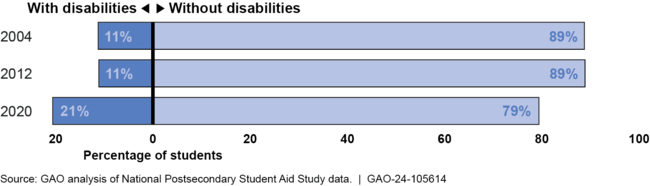
    The percentage of college students with disabilities has increased since 2004 according to GAO's analysis of Department of Education data (see figure). The increase is largely driven by more students reporting mental health conditions or attention deficit disorder. Students with disabilities graduated from college at lower rates than those without disabilities. Further, those with disabilities who did graduate were less likely to be employed full-time than peers without disabilities.

    Estimated Percentage of College Students by Disability Status, 2004–2020


    Note: “College students” includes undergraduates from postsecondary institutions of all types. Estimates are within a 1 percent margin of error.

    Students with disabilities face several challenges while transitioning to and attending college, according to college disability services staff and students GAO spoke with. For example, some students are unaware of or unprepared for the self-advocacy necessary to request accommodations without help from their parents, who can play a pivotal role in obtaining academic supports in high school. In addition, some students experience reluctance from faculty to provide accommodations. To help mitigate these challenges, college staff reported holding orientation sessions for students on how to request accommodations and training faculty on how to make their courses accessible, among other steps.

    Education has also taken steps to help address challenges faced by college students with disabilities. Education provides a range of supports including guidance, technical assistance, grants, and other resources. Education's priorities and federal standards highlight the need for prompt communication of guidance and other information affecting college students with disabilities. However, college staff GAO spoke with identified information gaps. For example:

  • Education has issued guidance materials on the importance of self-advocacy for students with disabilities in college, but this information may not reach students transitioning from high school. By encouraging state and local educational agencies to disseminate resources about the need for self-advocacy to assist students who wish to attend college, Education could help ensure that college students with disabilities are prepared to obtain needed accommodations.
  • Education does not provide notifications to college staff of newly issued guidance and other information about accommodations for students with disabilities, despite notifications on other topics. As a result, college staff report difficulties staying current on information that could help them support students with disabilities
  • .
  • ...
  • GAO is making two recommendations to Education to (1) encourage state and local educational agencies to disseminate resources about the importance of self-advocacy to obtain accommodations in college, and (2) enable college staff to receive notifications of newly issued guidance and other information about accommodations for postsecondary students with disabilities. Education generally agreed with GAO's recommendations.

Monday, July 8, 2024

CAM: A Lit Review

In The Politics of Autism, I write:

The conventional wisdom is that any kind of treatment is likely to be less effective as the child gets older, so parents of autistic children usually believe that they are working against the clock. They will not be satisfied with the ambiguities surrounding ABA, nor will they want to wait for some future research finding that might slightly increase its effectiveness. They want results now. Because there are no scientifically-validated drugs for the core symptoms of autism, they look outside the boundaries of mainstream medicine and FDA approval. Studies have found that anywhere from 28 to 54 percent of autistic children receive “complementary and alternative medicine” (CAM), and these numbers probably understate CAM usage.

Doherty, M., Foley, KR. & Schloss, J. Complementary and Alternative Medicine for Autism – A Systematic Review. J Autism Dev Disord (2024). https://doi.org/10.1007/s10803-024-06449-5

Complementary and Alternative Medicine (CAM) is a therapeutic option currently used by autistic people with continued interest and uptake. There remains limited evidence regarding the efficacy of CAM use in autism. The aim of this systematic review is to comprehensively review published clinical trials to explore the efficacy of CAM in autism. A systematic literature review of available research published from June 2013 to March 2023 was conducted. Our literature search identified 1826 eligible citations, and duplications removed (n = 694) with 102 articles eligible for title/abstract screening. After full text review, 39 studies were included. The results of this systematic review identified that for autistic people, vitamin and mineral supplements may only be of benefit if there is a deficiency. The results also found that the main interventions used were dietary interventions and nutraceuticals, including targeted supplements, vitamins and minerals, omega 3 s and prebiotics, probiotics and digestive enzymes. The evidence does not support some of the most frequently utilised dietary interventions, such as a Gluten Free Casein Free (GFCF) diet, and the use of targeted nutraceutical supplements may be of benefit, but more conclusive research is still required to direct safe and effective treatment.

Sunday, July 7, 2024

Fauci on RFK Jr.

  In The Politics of Autism, I analyze the discredited notion that vaccines cause autism. This bogus idea can hurt people by allowing diseases to spread  And among those diseases could be COVID-19.

Antivaxxers are sometimes violent, often abusive, and always wrongA leading anti-vaxxer is presidential candidate Robert F. Kennedy, Jr.  He has repeatedly compared vaccine mandates to the Holocaust.  Rolling Stone and Salon retracted an RFK article linking vaccines to autism.

He is now running for president as an independent

 Nick Robertson at The Hill:

Former White House COVID-19 response lead Dr. Anthony Fauci went after independent presidential candidate Robert F. Kennedy Jr. on Monday, recalling a prior meeting where Kennedy railed against vaccines.

Kennedy, an anti-vaccine activist, has long pushed the disproven theory that vaccines are connected to autism and cause some diseases. Fauci shared in a podcast interview with CNN’s David Axelrod about when the pair met to discuss vaccines in the early Trump administration.

Kennedy was giving a presentation to Fauci, lobbying to be named the head of a White House commission investigating vaccine safety.

“The first slide I remember he showed is that ‘It has been shown that vaccinations are responsible for the following diseases,’ and he gave every disease in the world,” Fauci said. “For the next 40 minutes or so, he showed slide after slide after slide that day that make no sense at all.”

Fauci recalled tracking down Kennedy after the meeting and attempting to talk some sense into him.

“We were walking out of the room at the [National Institutes of Health], I went over to and I said, ‘Bobby, I believe you care about children, and you care that you don’t want to hurt them,” Fauci said. “‘But you got to realize that from a scientific standpoint, what you’re saying does make no sense.’”

Kennedy went on to write a book about Fauci in 2021, “The Real Anthony Fauci,” which attacks Fauci for his leadership of the National Institute of Allergy and Infectious Diseases and his work leading the country’s early COVID response. Fauci said the book claims he was “responsible for killing so many people with vaccines.”

“I don’t know what’s going on in his head, but it’s not good,” Fauci said of Kennedy.


Saturday, July 6, 2024

Public Rallies Behind Homeless Autistic Kid

 In The Politics of Autism, I write about the everyday struggles facing autistic people and their families, including violence against autistic children.

Karla Rendon at KNBC-TV:
Residents of Pacoima rallied together to support the family of a young boy with autism after he was slapped in the face by a grown man in a disturbing on-camera assault.

Alfredo Morales and his family were crossing the street in Pacoima on Monday near the intersection of Laurel Canyon Boulevard and Osborne Street when the child touched the logo of a Mercedes Benz that was stopped while waiting for the traffic light to change. Video captured that moments later, the driver of that vehicle furiously approached Morales and slapped him across the face.

“No child in the world deserves to be beaten,” the boy’s mother, Claudia Acevedo, told NBC4’s sister station Telemundo 52.

In wake of the assault, an online fundraiser was created for the family and it has since reached $50,000 in donations. Those funds will help the family, who have been experiencing homelessness recently.

Morales and his family live in a broken-down van in Sheldon Arleta Park. With the generosity of the public, however, they’ll be able to secure more stable housing.

Friday, July 5, 2024

Autism Therapy in the US and Israel


Arkady Bukh at The Times of Israel
In the U.S., ABA therapy is heavily supported by both the government and insurance companies. Many states require insurance to cover ABA, making it more accessible for families. This support has helped the ABA market grow significantly, with projections indicating it could reach $4 billion by 2032.
In Israel, ABA therapy is also widely used for treating autism and is incorporated into public and private healthcare systems, schools, and specialized centers. Attitudes towards ABA therapy in Israel are varied. Many parents and professionals appreciate ABA for its structured methods and positive outcomes. However, similar to the U.S., the autistic community and some professionals are growing critical of ABA’s ethics and intense behavior modification focus. The Israeli government and health insurance providers strongly support ABA therapy.

...

Parents and professionals in both countries value ABA’s structured, evidence-based approach. Both have integrated ABA into their healthcare and educational systems.

Nevertheless, cultural differences greatly influence the implementation and perception of ABA therapy, which in turn shape societal attitudes towards it. The focus on individualism in the USA aligns with ABA’s goals of increasing independence and specific skills. American parents and professionals often prioritize interventions that help children gain autonomy, explaining ABA’s wide acceptance.

Conversely, Israel’s collectivist culture promotes a holistic view of therapy, considering the family unit and community alongside individual progress. Israeli families and professionals emphasize communal well-being and cohesion, adapting interventions to include family dynamics and collective goals.

Thursday, July 4, 2024

Mercedes Driver Slaps Autistic Kid

In The Politics of Autism, I write about the everyday struggles facing autistic people and their families, including violence against autistic children.

 Vivian Chow at KTLA-TV:

Cell phone video captured the moment a man slapped a child with autism for touching his car in Pacoima.

Alfredo Morales, 10, and his older sister were crossing the street at Laurel Canyon Boulevard and Osbourne Street when the boy reached out and touched the emblem on the man’s Mercedes-Benz sedan.

The man made an immediate U-turn and followed the two siblings to a bus stop where he pulled over. That’s when he walked over to Alfredo who was sitting on a bench and slapped him.

His sister, who was heard apologizing, tried to intervene, but the man was still able to strike the boy.