Search This Blog

Saturday, December 17, 2022

Reauthorization of Kevin and Avonte's Law

The Politics of Autism discusses the problem of wandering, which has been the topic of legislation before Congress.

Earlier this year, the Senate voted to reauthorize Kevin and Avonte's Law and has now attached it to the National Defense Authorization Act, which is likely to pass next week.

Ashley Walker at KTTC-TV:
Senators Amy Klobuchar, DFL of Minnesota, and Chuck Grassley, Republican of Iowa, highlighted the re-authorization of their legislation to help families locate missing loved ones with autism and Alzheimer’s Thursday.

Kevin and Avonte’s Law was named in honor of two young boys with autism that wandered from their homes and drowned in nearby bodies of water in Iowa. The legislation brings back the Missing American Alert Program, which helps families locate missing loved ones with Alzheimer’s disease, other forms of dementia, autism and other developmental disabilities.

Klobuchar and Grassley were joined by ‘Autism Speaks’ president and CEO, Keith Wargo, as well as many national and state autism organizations and the Alzheimer’s Association of Minnesota-North Dakota.

“It’s a savior for families that have taken care of their loved ones and do everything they can to keep them safe. Having programs in place where they can alert and locate them because of a device or the like is going to make all the difference,” said Senator Amy Klobuchar.

Devices used to help locate these people come in forms of bracelets, necklaces, clips and more.

Friday, December 16, 2022

MMR Risk and Party Polarization

 In The Politics of Autism, I analyze the discredited notion that vaccines cause autism. This bogus idea can hurt people by allowing diseases to spread.   And among those diseases could be COVID-19.

Unfortunately, Republican politicians and conservative media figures are increasingly joining up with the anti-vaxxers.   Even before COVID, they were fighting vaccine mandates and other public health measures. 

Kaiser Family Foundation:

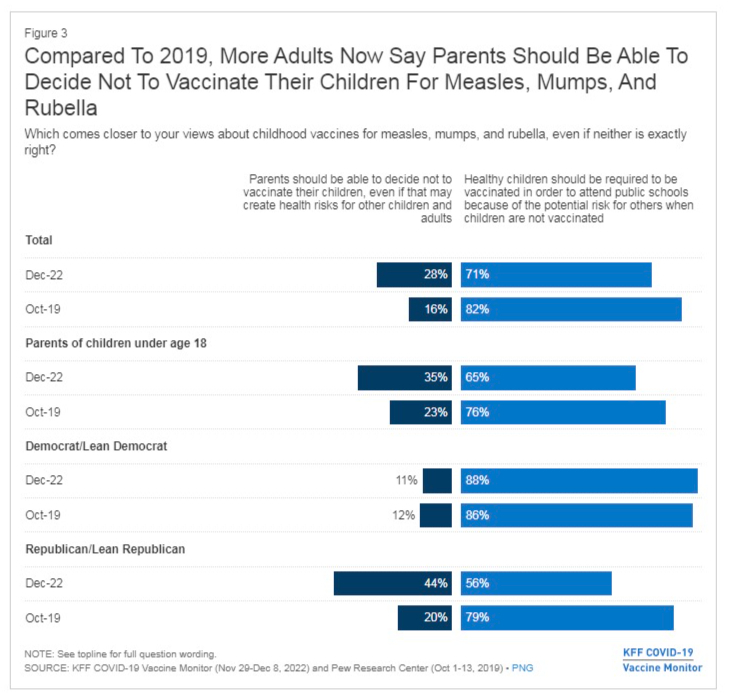
While most of the public continue to have confidence in the benefits of childhood vaccines for measles, mumps, and rubella, the experience of the COVID-19 pandemic and debates over vaccine requirements and mandates appear to have had an impact on public attitudes towards MMR vaccine requirements for public schools. The latest KFF COVID-19 Vaccine Monitor survey finds that about seven in ten adults (71%) say healthy children should be required to get vaccinated for MMR in order to attend public schools, down from 82% who said the same in an October 2019 Pew Research Center poll. Almost three in ten (28%) now say that parents should be able to decide not to vaccinate their school-age children, even if this creates health risks for others, up from 16% in 2019. Among Republicans and Republican-leaning independents, there has been a 24 percentage-point increase in the share who hold this view (from 20% to 44%).


Thursday, December 15, 2022

The Words of Autism

 From the preface to The Politics of Autism.

A major theme of this book is that just about everything concerning autism is subject to argument. There is not even any consensus on what one should call people who have autism and other disabilities. “In the autism community, many self-advocates and their allies prefer terms such as `Autistic,’ `Autistic person,’ or `Autistic individual’ because we understand autism as an inherent part of an individual’s identity,” writes blogger Lydia Brown.[i] Other writers prefer “people-first” language (e.g., “persons with autism”) since it puts the persons ahead of the disability and describes what they have, not who they are.[ii] For the sake of stylistic variety, this book uses both kinds of language, even though this approach will satisfy neither side. I can only say that I mean no offense.
At Disability Scoop, Michelle Diamaent reports that IACC is considering changing some of the language in its strategic plan.
Sam Crane, legal director at the Quality Trust for Individuals with Disabilities and a member of the IACC, said that the current draft the committee is considering contains “significant changes,” many of which are “for the purpose of reducing stigma and reflecting the community’s prioritization of well-being over a ‘cure.'” She noted that the changes are in line with efforts to refocus research on improving quality of life.
Alison Singer, Amy Lutz, Jill Escher, Alycia Halladay have an article at Autism Research titled "A full semantic toolbox is essential for autism research and practice to thrive,"
Individuals diagnosed with autism spectrum disorder (ASD) present with a highly diverse set of challenges, disabilities, impairments and strengths. Recently, it has been suggested that researchers and practitioners avoid using certain words to describe the difficulties and impairments experienced by individuals with ASD to reduce stigma. The proposed limitations on terminology were developed by only a subset of the autism community, and the recommendations are already causing negative consequences that may be harmful to future scientific and clinical endeavors and, ultimately, to people with ASD. No one should have the power to censor language to exclude the observable realities of autism. Scientists and clinicians must be able to use any scientifically accurate terms necessary to describe the wide range of autistic people they study and support, without fear of censure or retribution.

Wednesday, December 14, 2022

DeSantis Panders to Antivaxxers

 In The Politics of Autism, I analyze the discredited notion that vaccines cause autism. This bogus idea can hurt people by allowing diseases to spread.   And among those diseases could be COVID-19.

Unfortunately, Republican politicians and conservative media figures are increasingly joining up with the anti-vaxxers.   Even before COVID, they were fighting vaccine mandates and other public health measures. 

Eric Bradner and Kit Maher at CNN:

Florida Gov. Ron DeSantis on Tuesday asked his state’s Supreme Court to green-light an investigation of “any and all wrongdoing in Florida with respect to Covid-19 vaccines,” his latest move to cast doubt on the vaccines’ effectiveness and amplify fears about side effects.

In the petition filed with the Florida Supreme Court, the Republican governor requests the empaneling of a grand jury to investigate a broad group of entities associated with the development, distribution and promotion of the vaccines, including pharmaceutical manufacturers and their executive officers, as well as medical associations.

DeSantis also said Tuesday he was launching a public health integrity committee – a panel that would counter the US Centers for Disease Control and Prevention, which DeSantis said “is not serving a useful function; it’s really serving to advance narratives rather than do evidence-based medicine.” The panel would assess guidance and actions from federal agencies, such as the National Institutes of Health, US Food and Drug Administration and the CDC.

DeSantis has made Covid-19 vaccine skepticism his calling card ahead of a potential run for the 2024 Republican presidential nomination. The governor, who cruised to victory in his bid for a second term in November, is positioning himself to the right of former President Donald Trump, a potential rival who who was in office when the vaccine was developed.

The announcements Tuesday came at a roundtable focused on vaccines that DeSantis led. The Florida governor’s surgeon general, Dr. Joseph Ladapo, during the roundtable pointed to examples of the vaccine causing myocarditis, inflammation of the heart, and said pharmaceutical companies need to provide more data to independent researchers so they can further study the side effects from vaccines.

“We will answer this question. It is a question that I am sure keeps the CEOs of Pfizer and Moderna up late at night, hoping no one ever looks. But we’re going to look here in Florida,” Ladapo said during the roundtable.

Tuesday, December 13, 2022

HCBS Problems and the Pandemic

The Politics of Autism includes an extensive discussion of insurance and  Medicaid services for adults with intellectual and developmental disabilities. Home and Community-Based Services (HCBS) are particularly important.

 A November 16 release from the National Council on Disability:

Today the National Council on Disability releases a report examining weaknesses in the home- and community-based services (HCBS) ecosystem, taking stock of the preventable disproportionate death toll in congregate settings during the COVID-19 pandemic.

Strengthening the HCBS Ecosystem – Responding to Dangers of Congregate Settings during COVID-19 builds upon findings in NCD’s 2021 Progress Report: The Impacts of COVID-19 on People with Disabilities and 2012 report Deinstitutionalization: Unfinished Business. The report illustrates the interworking of the HCBS ecosystem, including the direct care workforce and an adequate accessible, affordable housing inventory, and how HCBS is safer, costs less, and is the preference of most individuals over institutional settings.

Currently, 820,000 people with disabilities remain on wait lists to transfer out of institutional settings. During the first year of the pandemic, 35,000 nursing home residents died of COVID-19, representing 42% of the total deaths in the U.S.

“For many people with disabilities during the pandemic, congregate settings had a devastating impact,” said NCD Chairman Andrés Gallegos. “In many instances, social distancing wasn’t achievable and the inability to transition out of such a setting became a death trap.”

NCD found that approximately 14 million Americans of all ages need HCBS, with 40% being adults under 65 years old, and people younger than 30 years old making up the fastest growing nursing home population.

“Severe shortages of direct care workers and available affordable, accessible housing are just two examples are longstanding fragilities in the HCBS ecosystem,” said the Chairman. “The neglect in addressing these matters led to the preventable deaths of scores of Americans with disabilities and will again if policymakers don’t act.”

The report offers NCD’s key recommendations to create a new paradigm – the Community Living Bias – with pointed recommendations for policymakers for Medicaid, the direct care workforce, housing policy, hospital discharge planning, COVID-19 flexibilities and waivers, and data collection.

From the report:

 Intersectional inequities are also present in an analysis of HCBS outcomes and successful interventions. A 2019 study focused on the potential of HCBS waivers to reduce disparities in unmet need among children of color with autism spectrum disorder.136 States with 1115 waivers from the Federal Government offered expanded eligibility for HCBS, which differed in the “generosity” (i.e., the amount of services offered, number of participants allowed and duration). The study found that waivers with the highest “generosity” were most effective in closing disparities between Black and White children with autism.137 The State of Washington also used 1115 waivers to expand access to HCBS services to “pre-Medicaid” individuals to divert institutionalization.138 These findings provide important implications that the presence of a waiver alone, without consideration of the inequitable baseline, may not address racial, ethnic, age, or other inequities.

  • 136 LaClair, Michelle, David S. Mandell, Andrew W. Dick, Khaled Iskandarani, Bradley D. Stein, and Douglas L. Leslie. “The effect of Medicaid waivers on ameliorating racial/ethnic disparities among children with autism.” Health services research 54, no. 4 (2019): 912-919. Strengthening the HCBS Ecosystem 85 
  • 137 Id.
  • 138 Anthony, Stephanie, Arielle Traub, Sarah Lewis, Cindy Mann, Michelle Herman Soper, and Stephen A. Somers. “Expanding Access to HCBS for “Pre-Medicaid” Individuals to Prevent or Delay Nursing Facility Utilization: A Strategy for Strengthening Long-Term Services and Supports.”


Monday, December 12, 2022

Tracking Disability Inclusion on TV


Jennifer Maas at Nielsen:
Nielsen’s TV content analysis company Gracenote will begin tracking on-screen disability representation as part of its inclusion data, which currently covers talent gender, race, ethnicity and sexual orientation.

“As of September 2022, there were 923,229 total television program titles available to audiences, up 43% since the third quarter of 2019,” per Gracenote. “And while the volume of disability-inclusive content has increased over time, progress is slow, especially when compared to the increase in available programming generally. According to Nielsen Gracenote Inclusion Analytics, disability inclusion in video content peaked in 2019, when 518 productions were released featuring people with disabilities. But this number is just a drop in the bucket when it comes to total content production. As of December this year 7,556 video titles included disability thematic attributes, but that represents just 4.1% of the 183,089 total titles with descriptor metadata released during the same period
...

The company will now begin tracking these disability-representation points in its Inclusion Analytics:
  • Neurodivergence
  • Intellectual/Developmental
  • Visual
  • Hearing
  • Physical
  • Mental Health

Sunday, December 11, 2022

Vaccines, COVID, and Deaths in Texas

 In The Politics of Autism, I analyze the discredited notion that vaccines cause autism. This bogus idea can hurt people by allowing diseases to spread.   And among those diseases could be COVID-19.

The fraudulent Wakefield article led to the unfounded rejection of the MMR vaccine, which has morphed into a rejection of vaccines in general.

At PLOS Global Public Health, Dr. Peter Hotez has an article titled "The Great Texas COVID Tragedy."

In fact, approximately 40,000 of the 90,000 COVID-19 deaths in Texas occurred after May 1, 2021, when any American who wished to take COVID vaccine could do so [3]. Data from the Texas Department of State Health Services (Texas DSHS) reports that 85% of COVID-19 deaths in Texas in 2021 occurred among the unvaccinated [6], while in the first three months of 2022 during the omicron wave the CDC finds rates of death in the US were 20 times higher among unvaccinated people compared to people who were vaccinated and had received a booster [7]. Therefore, the vast majority of the 40,000 deaths occurred among the unvaccinated. To put these numbers in perspective, just over 20,000 Texans lost their lives in World War II, while 6,000 died in the 1900 Galveston storm and flood. Approximately 4,000 Texans die annually from either gun deaths or road traffic annually, and 1,300 Texans died in its worst indigenous war, the Battle of Medina in 1813.

The fact that almost 40,000 Texans might have lost their lives because they refused a COVID-19 vaccination is unique–and no accident. Multiple analyses identify a strong political divide over the acceptance COVID-19 immunizations and death rates, with vaccinations the lowest and death rates the highest in the conservative or “red” states and counties [8]. The term “red COVID” has been invoked to understand this phenomenon [8]; it reflects the strong antivaccine activism promoted by elected officials on the far right and spread on conservative news and social media sites [9]. The rhetoric derives from right wing politics around “health freedom”, both a framework and propaganda tool, which accelerated in Texas in the 2010s for childhood vaccination mandates in schools [10]. According to the Texas DSHS, even as late as September 1, 2022, in many if not most counties in Central Texas and the Panhandle as well as East Texas–all conservative areas of the state—the rates of “fully vaccinated” for adults remain below 50%. These numbers are well below national averages. By encouraging Texans to refuse COVID-19 vaccinations, health freedom propaganda has emerged as a deadly social force. Now, there is evidence that antivaccine activism arising out of Texas could spread internationally to affect both COVID-19 and childhood vaccination rates globally [11].

Saturday, December 10, 2022

Emergency HCBS Payments


This study’s aim was to examine the impact of pandemic emergency Home- and Community-Based Services (HCBS) payments on the continuity and security of people with intellectual and developmental disabilities (IDD). Using a multilevel logistic regression, we analyzed secondary Personal Outcome Measures interviews from 738 people with IDD (March 2020 through April 2022), and state pandemic emergency HCBS payment data from 16 states. The odds of people with IDD experiencing continuity and security during the pandemic increased by 3% for every 1% states increased their payment rates, and by 398% when states offered retainer payments. Increased reimbursement rates and retainer payments can help providers maintain operations and promote the continuity and security of people with IDD.

Thursday, December 8, 2022

Autism and Criminal Justice

In The Politics of Autism, I discuss interactions between the justice system and autistic people.

A release from Drexel University:

Across the United States, reports of autistic youth experiencing dangerous, life-altering and even fatal interactions with the criminal justice system are becoming more common. Research suggests that autistic individuals interact with police at high rates and individuals with disabilities disproportionately experience police violence.

Researchers from the A.J. Drexel Autism Institute at Drexel University recently published research that identified the experiences of autistic individuals and their caregivers across their interactions with the criminal justice system through analysis of a statewide survey in Pennsylvania.

The study analyzed free-text responses and multiple-choice questions about types of justice system interactions from the 2018 Pennsylvania Autism Needs Assessment (2018 PANA), a large survey of autistic individuals and their families that included questions about demographic and clinical information, as well as service needs and experiences.

The study sample of 3,902 individuals represents 47% of the full 8,240 respondents to the 2018 PANA. A total of 839 respondents reported information about their criminal justice system interaction through the free-text question.

The findings highlighted the detailed experiences of autistic individuals and their caregivers as victims of an interaction, criminal offenders and witnesses to a crime, with respondents reporting both positive and negative experiences. Researchers also identified an increased risk for interaction with the justice system, including being male and having a co-occurring psychiatric diagnosis. 
  • Among autistic adult respondents, males were almost twice as likely to be stopped and questioned by police, arrested or charged, while females were at 32% greater odds of being the victim of a crime.
  • Having a psychiatric co-occurring diagnosis was associated with about 2.7 times the odds of any justice system interaction and 2.4 times the odds of being a victim of a crime among autistic individuals.
  • Among caregiver respondents, having an annual household income greater than $40,000 were protective against being a victim of a crime.
  • Living with a roommate or family member was protective against being the victim of a crime among caregiver respondents regarding their autistic child.
Analysis of the free-text responses yielded several themes. 
  • One-quarter of respondents described being the victim of a crime.
  • One-quarter of respondents described being an offender.
  • A small number of respondents (1.5%) described being a witness to a crime.
  • Almost equal proportions of respondents described a positive perception of the justice system (8%) and negative perception of the justice System (9%).
  • Finally, a small but notable proportion of respondents (1.5%) identified having a concern for there being a future interaction with the justice system.
“These findings are impactful because they come directly from the voices of autistic individuals and their families,” said Kaitlin Koffer Miller, lead author of the study and director of Policy Impact in the Policy and Analytics Center in the Autism Institute. “Understanding the type and scope of justice interaction helps to plan for and address issues that could prevent future interactions of all types.”

The research team explained that increasing access for autistic individuals to home and community-based services and supports can prevent or mitigate interactions between autistic individuals and the justice system, both as victims and offenders. It is the hope of the study team that findings from this study will propel policy to increase access to the needed supports to prevent these unwanted outcomes for autistic individuals.

Additionally, expanding pilot justice programs that include mental health professionals in crisis responses, like the co-responder model, will be beneficial to ensure minimal trauma and escalation of a justice system interaction.

The study, “Justice System Interactions Among Autistic Individuals: A Multiple Methods Analysis,” was recently published in the journal Crime & Delinquency. Co-authors include Alec Becker, Dylan Cooper and Lindsay Shea, DrPH of Drexel University.

Tuesday, December 6, 2022

The Cost of Red Tape

Uncertainty and complexity are major themes of The Politics of Autism.

Political scientist Steven M. Teles has coined a term that comes in handy for any discussion of autism services: kludgeocracy. In computing, a “kludge” is a system consisting of ill- matched elements or parts made for other applications. Engineers patch it together and hook it up to an existing system in order to solve a new problem. Kludges are complicated, hard to understand, and subject to crashes. Teles says that this description fits much of American public policy: “From the mind-numbing complexity of the health care system … our Byzantine system of funding higher education, and our bewildering federal-state system of governing everything from the welfare state to environmental regulation, America has chosen more indirect and incoherent policy mechanisms than any comparable country."

 Steven M. Teles, “Kludgeocracy: The American Way of Policy,” New America Foundation, December 2012. Online: https://static.newamerica.org/attachments/4209-kludgeocracy-the-american-way-of-policy/Teles_Steven_Kludgeocracy_NAF_Dec2012.d8a805aa40e34bca9e2fecb018a3dcb0.pdf


 Justin Schweitzer, Emily DiMatteo, and Nick Buffie at the Center for American Progress:
Just as it is expensive to be poor, it is expensive to be disabled. Households with disabled adults need 28 percent more income, on average, to achieve the same standard of living as adults without a disability. Moreover, the added costs of medicines and medical procedures, accessibility accommodations in homes and transportation, and many other regular expenses are exacerbated by the fact that disabled workers—if they are able to work and are employed—earn just 74 cents for every dollar earned by their nondisabled counterparts; Black and Hispanic disabled workers, in particular, earn 60 and 61 cents, respectively, for every dollar earned by nondisabled, full-time white workers. The extra cost of living for disabled people is often referred to as the “disability tax.”

Administrative burdens within programs intended to help people with disabilities add another dimension to the disability tax, often financially but also through additional drains on disabled people’s time, energy, and physical and mental well-being. Broadly speaking, experts have identified three categories of costs that administrative burdens impose: 
  1. Learning costs derive from the complexity of these systems and a lack of public education and awareness about a program’s existence, eligibility, benefits, and rules as well as how best to navigate the entire process.
  2. Psychological costs are the health impacts of the stress, stigma, and lack of autonomy that come with navigating these programs’ administrative processes.
  3. Compliance costs are all the time, energy, and money spent completing administrative requirements. These have also been referred to as the “time tax.”
The disability community often uses a metaphor called the “spoon theory,” coined by writer Christine Miserandino, to describe how people with chronic illness have limited energy to spend on daily tasks. This energy—symbolized by spoons—can vary on a given day depending on the individual’s medical condition and other variables. According to this metaphor, each activity uses up a spoon, forcing individuals to make difficult decisions about what activities, no matter how small, they can do. Specifically, administrative burdens often sap what little energy disabled people have, which can make it challenging for them to complete the rest of their daily responsibilities.
  1. .


Monday, December 5, 2022

Autism ID Cards in Alabama

In The Politics of Autism, I write:

[M]any police departments have trained officers and other first responders how to spot signs of autism and respond accordingly.[i] Some organizations have also published identification cards that ASD adults can carry in order to defuse potential conflicts. Virginia provides for an autism designation on driver licenses and other state-issued identification cards. Once again, however, the dilemma of difference comes into play. One autistic Virginian worries: “Great, so if I get into an accident, who’s the cop going to believe, the guy with the autistic label or the guy without it?” Clinical psychologist Michael Oberschneider is concerned about the understanding level of first responders: “I think many people still think of Rain Man or, more recently, the Sandy Hook Shooter, when they think of autism even though very few people on the autistic spectrum are savants or are homicidal and dangerous.”[ii]
Yesterday's post involved autism windshield decals in Florida.  Here is a related story from Alabama;

Leada Gore at AL.com:
Alabamians who have a diagnosis that falls within the autism disorder spectrum have access to a special identification card.

Alabama has created and implemented the first state-recognized Autism Identification Card in the U.S. The cards, distributed by county health departments, can assist with interactions with first responders and law enforcement officers during potentially stressful situations, such as a traffic stop.

Wording on the card explains that the holder falls within in the autism spectrum and may have difficulty communicating or understanding directions. The card also states that the person could become agitated if touched because of his or her medical conditions.

Sunday, December 4, 2022

Autism Decals in Florida

In The Politics of Autism, I write:

[M]any police departments have trained officers and other first responders how to spot signs of autism and respond accordingly.[i] Some organizations have also published identification cards that ASD adults can carry in order to defuse potential conflicts. Virginia provides for an autism designation on driver licenses and other state-issued identification cards. Once again, however, the dilemma of difference comes into play. One autistic Virginian worries: “Great, so if I get into an accident, who’s the cop going to believe, the guy with the autistic label or the guy without it?” Clinical psychologist Michael Oberschneider is concerned about the understanding level of first responders: “I think many people still think of Rain Man or, more recently, the Sandy Hook Shooter, when they think of autism even though very few people on the autistic spectrum are savants or are homicidal and dangerous.”[ii]

Jackie Cardentey at WFTV:

 A new program created by the Orange County Sheriff’s Office lets emergency responders know that there is a person with autism involved.

This new initiative features a decal that residents in Orange County can use to let deputies know.

The decals will remind deputies to use their autism training, as the person in the home or car may not speak, respond to or comply with verbal commands. 

They may also have no awareness of danger.

OSCO is giving these decals out for free.

Decals can be placed near the front door of your house or on the rear window of your car.

\To learn more and register for the program, you can visit www.ocso.com/autism.

Friday, December 2, 2022

Fad Cures

 Autism parents are highly vulnerable to pitches for quack "cures."

In The Politics of Autism, I write:

The conventional wisdom is that any kind of treatment is likely to be less effective as the child gets older, so parents of autistic children usually believe that they are working against the clock. They will not be satisfied with the ambiguities surrounding ABA, nor will they want to wait for some future research finding that might slightly increase its effectiveness. They want results now. Because there are no scientifically-validated drugs for the core symptoms of autism, they look outside the boundaries of mainstream medicine and FDA approval. Studies have found that anywhere from 28 to 54 percent of autistic children receive “complementary and alternative medicine” (CAM), and these numbers probably understate CAM usage.

Bozena Zawisz at Psychology Today:

Like many parents of newly diagnosed children, I initially coped with the complexity and uncertainty surrounding autism by turning to Google in search of answers to the many questions I had about my child’s developmental potential. I found a variety of conflicting information, including advertisements about alternative interventions ranging from elimination diets to fidget spinners and anecdotal accounts that claimed to have cured autism. I was not alone in my quest. Research suggests that up to 95 percent of parents look into alternative treatments for their children (Hofer et al., 2019).

Some emerging therapies, such as music therapy or mindfulness interventions, have promising results and simply require more substantiated evidence to boost their level of recommendation. Others, such as gluten-free or casein-free diets, lack consistent evidence of effectiveness (NAC, 2015).

Over time, I experimented with many alternative therapies and supplements. I also accrued a deeper understanding of how my son experienced the world and came across increasingly more neurodiverse perspectives of people on the autism spectrum themselves, as they are becoming increasingly present in research.

I remember pausing amidst supporting my son with his homework and appreciating that “this is not going away.” I realized that the characteristics I loved about him, including those associated with being on the autism spectrum, such as taking things literally, being honest and direct, or seeing the details of a situation, are likely to be our ongoing companions (e.g., research finds that detailed-oriented cognitive style has been persistent in individuals on the autism spectrum across time (Bojda et al., 2021)).

I finally figured out where I wanted and needed to focus my attention: on acceptance, on advocacy around how the school environment can support my child’s needs (e.g., through breaking down tasks and offering visual support), and on my child’s emotional learning (supporting my son’s awareness of implicit emotion by making it explicit and deepening his practice of coping).