There is growing evidence that efficacious autism-related interventions rarely are adopted or successfully implemented in public schools, in part because of the lack of fit between the intervention and the needs and capacities of the school setting. There is little systematic information available regarding the barriers to implementation of complex interventions such as those addressing social engagement for children with autism. The present study used field notes from an implementation trial to explore barriers that emerged during the training of school personnel and subsequent implementation of a social skills intervention. A number of barriers at the individual (training) and school levels (policies surrounding recess, staffing, prioritization of competing demands, level of respect and support, and availability of resources) interfered with the continued use and sustainment of the intervention. We offer potential strategies to overcome these barriers and provide directions for future research in this critical area.
Monday, June 2, 2014
Challenges of School-Based Interventions
At Behavior Therapy, Jill Locke and colleagues have an article titled "A Tangled Web: The Challenges of Implementing an Evidence-Based Social Engagement Intervention for Children with Autism in Urban Public School Settings." The abstract:


Sunday, June 1, 2014
Beliefs About Autism
Gwen Mitchell and Kenneth Locke have an article in Autism titled "Lay Beliefs about Autism Apectrum Aisorder among the General Public and Childcare Providers." The abstract:
We conducted a survey of beliefs about autism among the general public in the United States and Canada (n = 823) and among individuals working in childcare facilities in the state of Idaho (n = 176). Results included the following. Almost all respondents correctly believed that autism’s primary causes are genetic and neurological (not parenting, drugs, or current diet), that it can be identified in early childhood, and that helpful interventions exist. Respondents generally distinguished diagnostic from non-diagnostic traits, but approximately half incorrectly labeled constant squirming as diagnostic and difficulties in making friends as non-diagnostic. College graduates and childcare workers were more likely to have learned about autism in professional/academic settings and to correctly recognize diagnostic traits. Of concern, 10% of respondents considered vaccinations to be among the two main causes of autism. Accurate public understanding of autism spectrum disorders can facilitate early identification and effective intervention; our results suggest that efficient channels for conveying accurate information include broadcast and online media (from which the general public, especially members of ethnic minority groups, were most likely to learn about autism), and professional development courses for childcare providers.The article contains an important caveat:
We obtained our general public sample through MTurk, an online crowdsourcing site that has been shown to generally yield diverse and representative samples (Buhrmester et al., 2011). For example, an investigation by US political scientists Berinsky et al. (2012) concluded that “the demographic characteristics of domestic MTurk users are more representative and diverse than the corresponding student and convenience samples typically used in experimental political science studies” (p. 352). Although their conclusion applies to the current sample as well, we should caution that compared to 2012 US population census data, our sample contained a larger percentage of college graduates and a smaller percentage of African Americans and Latinos, which is one reason we reported the findings separately for Whites and non-Whites and for individuals who had versus had not graduated from college. On the other hand, because our analyses showed that most beliefs about autism were not influenced by ethnicity or education, there is generally no reason to believe our sample produced biased estimates of lay beliefs about autism.
Saturday, May 31, 2014
Elliot Rodger Was Not Autistic
Some press reports suggested that alleged Isla Vista killer Elliot Rodger had a diagnosis of ASD. He did not. Emily Willingham writes at Forbes:
Just after the shootings, the family’s attorney made a statement claiming that Rodger had a diagnosis of Asperger’s. However, he backtracked on that a day later, saying instead that Rodger “had not been diagnosed with Asperger’s.”
Very little about what Rodger wrote and did suggests an autism spectrum disorder, including the fact that he had apparently remarkable executive function and social dissembling skills, which he demonstrated in deceiving the deputies dispatched to his apartment in one of the key turning points of this tragedy. While not all autistic people are the same, executive function and an ability to dissemble are more typically areas of deficit–if an inability to dissemble can be considered a deficit, which in many social situations, it probably is.
I’ve already tweeted and posted about autism and violence extensively. The bottom line is that autistic people are far less likely than non-autistic people to engage in criminal activity of any kind.
Some news outlets reported the attorney’s original assertion but then rewrote their stories to remove it. That is appropriate because reporting second-hand information about any mental health (or in the case of autism, neurobiological) condition is not in keeping with current journalistic guidelines. In fact, the AP updated those guidelines in the wake of the rampant speculation and misreporting about the Sandy Hook shooter in 2012.Enrico Gnaulati writes at The Atlantic
Making the case for the inappropriateness of an autism spectrum disorder diagnosis in Elliott [sic] Rodger’s case is critically important to address the public misconception that autistic individuals have an unusually high potential for violence. One in 68 children currently has a diagnosis of ASD, so the potential for misplaced fear is great. In fact, the Interagency Autism Coordinating Committee of the U.S. Department of Health and Human Services indicates that people afflicted with autism spectrum disorder are less prone to engage in any criminal behavior compared with the general population.ASD individuals do not obsess over Hugo Boss and Armani threads, BMWs, winning the lottery, and insisting that one's mother marry a multi-millionaire.
Nor, for that matter, do autistic individuals typically hyper-focus on their appearance, crave admiration and sex, act as if they are consumed by envy and the need for revenge, desperately try to undo shame and humiliation by shaming and humiliating others, or harbor grandiose fantasies of fame and fortune—all of which percolated in the mind of Rodger. We are squarely in the realm of pathological narcissism here.
Friday, May 30, 2014
A Van for Autism Screening
In Philadelphia, KYW-TV reports:
Officials at Drexel University unveil their brand new mobile REACH (Resources and Education for Autism and Community Health) Autism van. You may soon see this van in a neighborhood near you.
Director of Outreach for the AJ Drexel Autism institute Jennifer Plumb explains how the staffed van can help those who have yet to be diagnosed.
“One of our focuses is going to be doing screenings in the community, which is a huge need for individuals on spectrum.”
Clinical Director for the AJ Drexel Autism Institure James Connell says it’s critical to bring the care to the community.
“They can’t take the day off, they may have three or four children. Putting them on a bus, getting them to the subway and travelling down to the University is complicated for many families. So, we want to work with our governmental community partners to bring these settings out to them.”
Connell says once the children are diagnosed, the family can take the assessment they receive to ensure their loved one receives the proper services, including an IEP or Individual Education Plan.
Thursday, May 29, 2014
Measles on the Rise
A release from the Centers for Disease Control and Prevention (CDC)
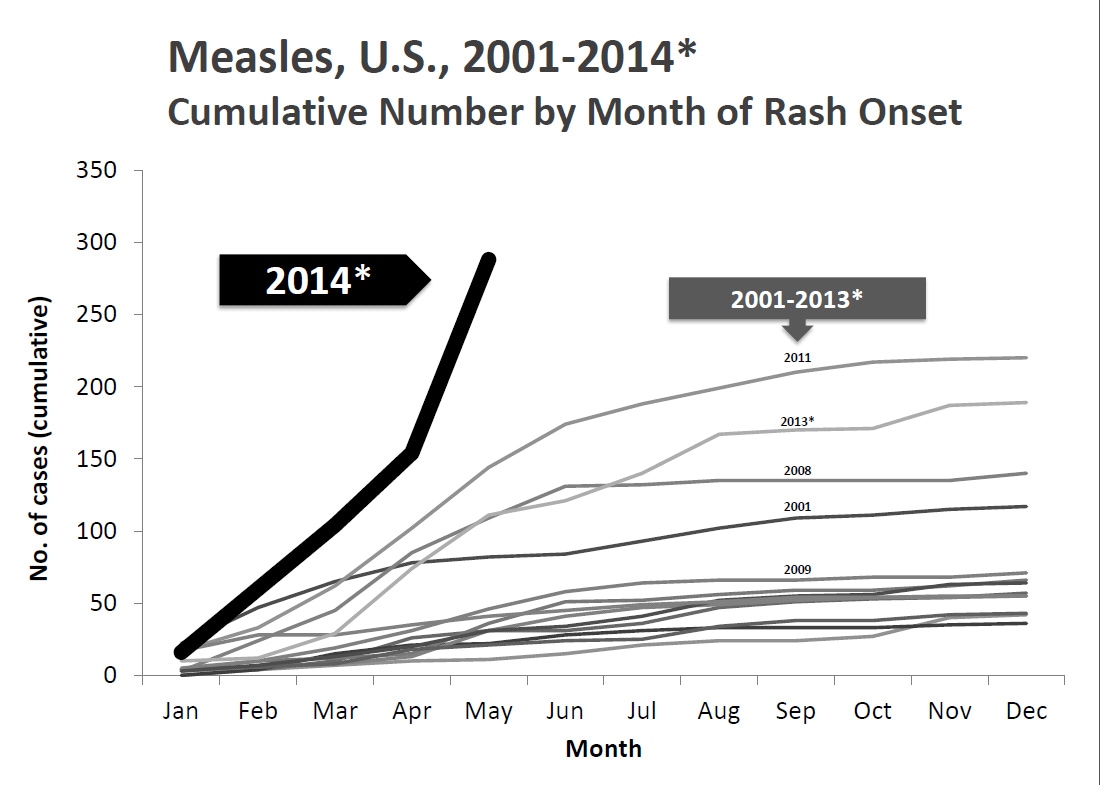
Two hundred and eighty-eight cases of measles were reported to the Centers for Disease Control and Prevention (CDC) in the United States between Jan. 1 and May 23, 2014. This is the largest number of measles cases in the United States reported in the first five months of a year since 1994. Nearly all of the measles cases this year have been associated with international travel by unvaccinated people.
“The current increase in measles cases is being driven by unvaccinated people, primarily U.S. residents, who got measles in other countries, brought the virus back to the United States and spread to others in communities where many people are not vaccinated,” said Dr. Anne Schuchat, assistant surgeon general and director of CDC’s National Center for Immunizations and Respiratory Diseases. “Many of the clusters in the U.S. began following travel to the Philippines where a large outbreak has been occurring since October 2013.”
Of the 288 cases, 280 (97 percent) were associated with importations from at least 18 countries. More than one in seven cases has led to hospitalization. Ninety percent of all measles cases in the United States were in people who were not vaccinated or whose vaccination status was unknown. Among the U.S. residents who were not vaccinated, 85 percent were religious, philosophical or personal reasons.
Dairy and Autism?
The list of purported causes of autism is long. People for the Ethical Treatment of Animals (PETA) claims that there is a link between dairy and autism. Steven Novella writes at Science-Based Medicine:
PETA provides us with a nice example of how having an ideological agenda can motivate an individual or a group to embrace dubious science. In an article currently on their website, and making the rounds in social media (this is repeating a claim from at least 2008, but the current article is undated), the group warns: Got Autism? Learn About the Link Between Dairy Products and the Disease.There are some anecdotes about the gluten-free, casein-free diet.
Such uncontrolled observations need to be confirmed by blinded observations. These studies have been done for both gluten-free and casein-free diets. A 2008 Cochrane review of these studies concluded:Current evidence for efficacy of these diets is poor. Large scale, good quality randomised controlled trials are needed.A more recent review from April 2014 came to a similar conclusion:We observed that the evidence on this topic is currently limited and weak.The pattern of evidence reveals that the methodologically poor studies, ones that are liable to confirmation bias, show some effect, but the properly blinded studies tend to show no effect. For example, a 2010 study (although small) observed children with autism on a gluten-free and casein-free diet, and then challenged them with either gluten, casein, or placebo in a blinded manner. There was no difference in behavior observed. A recent 2014 study also showed no association between dairy and behavior in autism.
Wednesday, May 28, 2014
CARA Controversy
Elise Viebeck reports at The Hill:
House lawmakers took a step toward moving a landmark autism-fighting law following a government investigation found that most federal autism research has the potential to be duplicative.
The Energy and Commerce Subcommittee on Health approved an amendment Wednesday that would require the Health and Human Services secretary to designate a deputy to oversee federal autism research and services.
The official would help coordinate anti-autism activities across federal agencies and ensure the projects "are not unnecessarily duplicative," according to the amendment.
The language comes after the Government Accountability Office found last year that 84 percent of autism research projects under current law have the potential to cover each other's ground.
Lawmakers from both parties praised the amendment and predicted it would improve existing programs.
Last week, she reported on opposition from the Autism Policy Reform Coalition (APRC) is against the bill, arguing a drastic overhaul is needed in order for the money to be used effectively.
"[The rise in autism] is nothing short of astronomical, and I would say, cataclysmic," said Craig Snyder, a longtime autism lobbyist and chief spokesman for the APRC.
...
Snyder’s group is taking a hard line, arguing it would be better for lawmakers to let the autism act expire on Sept. 30 rather than continuing it in its current form.
"We believe it is better for the country to face the end of these programs and to have a serious dialogue about what went wrong than to put another seal of approval on bad policy," Snyder said.ASAN opposes the bill:
Legislation from Menendez and Enzi is expected to include several of the reform coalition’s top priorities, Snyder said.
First, Snyder’s group wants to centralize federal autism research within a new office at the NIH modeled on the Office of AIDS Research.
The office would have its own budget and direct scientific work about autism in line with a strategic plan, shifting away from the current model of organic studies funded out of general NIH accounts.
Snyder argued that federal research on autism is overly concerned with genetics at the expense of exploring possible environmental risk factors and ways of treating patients.
Other agencies would also see big changes under the APRC plan.
The CDC, for example, would be required to revamp its autism prevalence survey and conduct it every year instead of every two years.
The Health Resources and Services Administration would be tasked with creating clinical guidelines to ensure that the appropriate clinician treats someone with severe autism during a medical emergency.
And finally, the APRC would create a new body to coordinate autism policy across federal agencies, similar to the White House Office of National Drug Control Policy.
1) H.R. 4631 continues to use language offensive to Autistic people and our allies. We don’t want to be “combated” – we want to be supported and respected. Despite numerous complaints by the Autistic community, the legislation continues to use disrespectful and offensive language. This has to change.
2) H.R. 4631 adds four congressionally appointed members to the Inter-Agency Autism Coordinating Committee, politicizing the IACC instead of letting it focus on analyzing autism research and policy from an objective perspective.
3) H.R. 4631 fails to require additional self-advocate representation on the IACC. Shouldn’t a government advisory committee about autism require more than one autistic representative on the committee? Tell Congress that they shouldn’t be acting about us, without us.
Tuesday, May 27, 2014
Legislation on Sheltered Workshops
Sheltered workshops have fallen into disrepute, and lawmakers want alternatives. Joy Resmovits writes at The Huffington Post:
On Wednesday, Sens. Tom Harkin (D-Iowa), Patty Murray (D-Wash.) and Lamar Alexander (R-Tenn.), along with Reps. John Kline (R-Minn.), Virginia Foxx (R-N.C.) and George Miller (D-Calif.), announced a sweeping bipartisan, bicameral deal that was long in the making. The bill aims to modernize the 1998 law, which oversees $3 billion in job training programs, by eliminating 15 programs and creating universal performance metrics. Many expect it to advance.
For students with special needs in particular, the bill aims to make states more responsible for making sure those students graduate into jobs that allow them to make minimum wage and work alongside adults who have no disabilities. This move extends the often-controversial concept of inclusion in public schools into the workforce. Under the 1975 Individuals with Disabilities Education Act, another Harkin initiative [sic], students with special needs must be given a "free and appropriate public education" in the "least restrictive environment."
But unlike IDEA, which covers students with special needs until they turn 21, workforce training programs for individuals with disabilities aren't entitlements, meaning that there are far more students who are eligible than receive the service, known as Vocational Rehabilitation.
Monday, May 26, 2014
More on the Isla Vista Shooting
Elliot Rodger, the alleged Isla Vista shooter, reportedly had Asperger's. From Marketwatch:
Dr. Daniel Son, a Los Angeles psychiatrist, says Asperger’s actually does not exist as an official diagnosis among mental health professionals anymore, though it still is a commonly used term. He says as of a year ago, it now is simply considered part of the autism spectrum, and most who had been diagnosed with Asperger’s are thought to be high functioning and able to live relatively normal lives.
Son, who treats a number of young autism patients, says that obsessive behavior can result from the disease and patients can become fixated on certain issues. But other factors usually come into play when behavior becomes overwhelmingly violent.
“It’s really more associated with a troubled upbringing rather than the autism,” Son said.
Rodger’s parents split when Elliot was young and his father, Peter, in the film business and an assistant director on “The Hunger Games,” traveled extensively as part of his career.
Meanwhile, Lanza is thought to have possibly suffered from schizophrenia in addition to his Asperger’s. Academics said at the time that Lanza’s condition probably did not lead to his violent behavior, and Lanza’s father told Time Magazine that it shouldn’t be blamed for his son’s actions.
Lanza’s parents split when he was a teenager and his mother was a gun aficionado, who had a number of weapons at her home where Adam lived. Lanza’s father is a corporate executive.
But a life of privilege may not be to blame either, according to one professor at theUniversity of Southern California who was diagnosed with Asperger’s, Lars Perner. Perner told a USC publication recently that his well-to-do family may have had more members with autism, but it was hard to tell because many could afford to be eccentric. He wasn’t diagnosed until he was 31, he said.
“Where I come from, you could afford to be strange,” Perner told the publication. “I shudder to think what would have happened to me if I had come from a less privileged background.”
Sunday, May 25, 2014
Another Killing
Rodger was being treated by multiple therapists and was a student at Santa Barbara City College, said family lawyer Alan Schifman.
Schifman said in recent weeks that Rodger’s parents were concerned for their son's well being and reported his disturbing YouTube videos to police, which lead to an investigation. According to Schifman, police interviewed Rodger and found him to be “polite and kind.” He did not specify which law enforcement division conducted the interview.
A social worker also contacted police about Rodger last week, said Schifman.
Schifman said Rodger was diagnosed as being a high-functioning patient with Asperger syndrome and had trouble making friends.It bears repeating: there is no link between violence and any form of autism -- except to the extent that autistic people are often crime victims.
Saturday, May 24, 2014
WHO on Disability and Autism
A release from the World Health Organization:
The World Health Assembly continued progress Friday, approving plans to better incorporate palliative care, expand inclusion of the needs of those affected by autism, improve access to health care for those with disabilities, better integrate the use of traditional medicine and raise awareness of psoriasis.
...
Disability action plan
A new WHO global disability action plan 2014–2021 aims to improve the health and quality of life of the one billion people around the world with disabilities by improving their access to health care and creating new and strengthening existing services and technologies that help them acquire or restore skills and functions. It also aims to strengthen data and research.
People with disabilities have the same general health care needs as others, but are three times more likely to be denied health care and four times more likely to be treated badly in health facilities. One in seven people worldwide has a disability. As people live longer and chronic diseases increase, more people are likely to develop disabilities. Road traffic crashes, falls, violence, natural disasters and conflict, unhealthy diet and substance abuse can also lead to disability.
Autism spectrum disorders
The Health Assembly urged Member States to include the needs of individuals affected by autism spectrum and other developmental disorders in policies and programmes related to child and adolescent health and development and mental health. This means increasing the capacity of health and social care systems to provide services for individuals with autism spectrum disorders and for their families and shifting the focus of care from long-stay health facilities towards non-residential services in the community. It also means improving health surveillance systems to capture data on autism spectrum disorders and ensuring countries are better able to diagnose and treat autism spectrum disorders.
The resolution highlights the need for the WHO Secretariat to help strengthen countries’ capacities to address autism spectrum and other developmental disorders; facilitate resource mobilization; engage with autism-related networks; and monitor progress. All efforts will be conducted in alignment with the WHO Mental health action plan 2013–2020.
Autism spectrum disorders comprise a range of development disorders which include autism, childhood disintegrative disorder and Asperger syndrome. Worldwide, most people with autism spectrum disorders and their families do not receive any care from health and social care systems.
Friday, May 23, 2014
TRICARE Amendment
Today, Congressman John B. Larson and Congressman Tom Rooney (R-FL) announced the passage of a National Defense Authorization Act amendment that would require TRICARE, the military healthcare program, to ensure access to behavioral treatments for military families who have children with development disabilities. The measure is nearly identical to legislation Larson and Rooney introduced (The Caring for Military Children with Developmental Disabilities Act) which has received wide support from military, veteran and disability advocacy groups.
“The House stood up for military families today- moving us one step closer to ensuring that children with developmental disabilities covered by TRICARE have access to the care they deserve,” said Larson. “The bottom line is that this is the right thing to do. I want to thank my colleague Tom Rooney whose steadfast work on this issue on behalf of military families across the nation has been integral in moving this forward. We must be doing everything we can to ensure that those who have sacrificed so much for our nation have the peace of mind that their children will be able to access the care they need. Passage of this amendment moves us one step closer and I look forward to working with my colleagues to ensure it is signed into law.
“Families across the country face incredible challenges in raising children with development disabilities,” said Rooney. “I’ve seen this firsthand with my two nephews. For our military families, these challenges can be particularly daunting. Passing this amendment helps ensure that the children of our troops and military retirees have access to the health care services they need.”
Despite proven effectiveness in helping children with developmental disabilities, families must navigate a patchwork of different policies, all with eligibility and coverage limitations, within TRICARE that allow access to a behavioral health treatment known as applied behavior analysis (ABA). Larson has joined Rooney in introducing a number of measures to expand access under TRICARE to behavioral health treatment, including ABA, for military families, including legislation earlier this month and the Caring for Military Kids with Autism Act (H.R. 2288) in the 112th Congress.
Click here to view a list advocacy groups that have expressed their support for Larson and Rooney’s TRICARE legislation (H.R. 4630)
Thursday, May 22, 2014
A Really Bad Study of Autism and Violence
A number of posts have discussed bad media coverage linking autism to violence. At Forbes, Emily Willingham kicks a bad academic study to the curb:
According to mental health professionals who personally diagnosed serial killer Jeffrey Dahmer, he had a personality disorder. That didn’t stop the authors of a recent paper attempting to link autism and mass murderers, serial killers, and other homicidal maniacs from listing Dahmer as “highly suspected” of having an autism spectrum disorder, along with a 61 other people who were never diagnosed with one, including Timothy McVeigh, Terry Nichols, and Dylan Klebold.
I’ve seen some recklessness in my wanderings through the world of autism science, but these authors reach depths I cannot fathom. If you doubt that, let me just point out that they use the Daily Mail as one of their citations to demonstrate that a killer not diagnosed with autism might have it and cite an author who very much wants to make up a diagnostic category called “Criminal Autistic Psychopathy” as a subset of Asperger’s. Which no longer exists.
In their paper, which is making a splash, of course, Clare Allely and co-authors claim that 67 of the 239 “eligible killers” they evaluated in their review had “definite, highly probable, or possible” autism spectrum disorder. But a closer look at their numbers shows that of these, only six were in the “definite” category [ETA: details on those six summarized here]. That’s 2.5% of the total of 239 they examined. It’s a percentage that happens to be just slightly less than the 2.6% identified in the most thorough study of autism prevalence in the general population to date, in South Korea.
The evaluations of the South Korean population were thorough, but perhaps no other population receives more expert attention and evaluation than killers like these who survive their crimes, as Dahmer, McVeigh, and Ramirez did, and killers who do not but whose writings and other leavings undergo deep scrutiny from experts involved in their cases. Their evaluations are not a mystery. Psychologists had access to Dahmer and evaluated him. Psychologists had access to Richard Ramirez (the Nightstalker) and evaluated him. Ditto McVeigh. These are professionals who personally evaluated these killers, and “autism” was not on their list of labels.
It is inappropriate for anyone–much less these authors, giving the imprimatur of science and peer review–to diagnose from a distance someone they have never even met and with whose case they are not deeply familiar. Add to that their conflation of mass murderers and serial killers, whose psychic motivations can be very different, and this entire paper is one big, hot, irresponsible mess.
Subscribe to:
Posts (Atom)