Search This Blog

Sunday, January 9, 2022

Credentialed Crackpots

  In The Politics of Autism, I write:

Many articles and blog posts arguing for the vaccine-autism link have the trappings of genuine academic research: tables, graphs, citations, and scientific jargon. Some of the authors have credentials such as M.D. or Ph.D. degrees. None of these things is a guarantee of scientific value, as the history of science is full of crackpot theories (e.g., AIDS denialism) that are the heavily-footnoted products of people with letters after their names. But most people will not be able to spot the scientific weaknesses of such work. Outside of academia, few understand concepts such as peer review. Jordynn Jack describes one dubious article that appeared in a non-peer-reviewed publication: “Regardless of the scientific validity of the article, though, the writers perform the writing style quite effectively. It would be difficult for the layperson to distinguish this article from any other scientific research paper, especially if one did not investigate the nature of the journal … or of the scientific response to the article.”

 Bill McCarthy at PolitiFact:

Besides [Dr. Simone] Gold, PolitiFact has fact-checked problematic claims by Florida osteopathic physician Dr. Anthony Mercola, Minnesota family physician Dr. Scott Jensen and Ohio osteopath Dr. Sherry Tenpenny, all of whom have become often-cited "experts" in anti-vaccination circles.

But the role physicians can play in promoting vaccine hesitancy predates COVID-19. In 19[9]8, Andrew Wakefield, a physician later stripped of his medical license, falsified research that wrongly claimed a link between the measles, mumps and rubella vaccine and autism. The paper, published in a prestigious medical journal that took years to retract it, fueled the kind of vaccine hesitancy that experts believe laid the groundwork for today’s anti-vaccine movement.

In addition to appearing with [Joe] Rogan, who has made and played host to several inaccurate claims about the COVID-19 vaccines, [Robert] Malone has given interviews to Fox News host Tucker Carlson, InfoWars reporter Kristi Leigh, and former Trump adviser Steve Bannon — all of whom have captured audiences while spreading misinformation about the vaccines.

Saturday, January 8, 2022

Disabilities, COVID, and Food Insecurity

In The Politics of Autism, I discuss the day-to-day challenges facing autistic people and their families.  One is food insecurity.

The pandemic burdened the disability community even more severely. The U.S. Census Bureau’s COVID-19 Household Pulse Survey data from March 2021 revealed that 55.7 percent21 of disabled Medicare recipients under the age of 65 reported not having enough food or not having access to the foods they wanted. Additionally, the U.S. Department of Agriculture (USDA) calculated that, in 2020, disabled adults faced food insecurity at more than twice the rate22 of their nondisabled counterparts—with nonworking disabled adults three times more likely to be food insecure than nondisabled adults—due to the numerous adverse impacts of the pandemic. These additional challenges include concerns among disabled people who are at higher risk of COVID-19 complications about the increased risk of exposure that comes with shopping in person at the grocery store,23 as well as difficulties with food delivery programs such as financial strains and inconvenient delivery times.24

21.Carli Friedman, “Food insecurity of people with disabilities who were Medicare beneficiaries during the COVID-19 pandemic,” Disability and Health Journal 14 (4) (2021), available at https://www.ncbi.nlm.nih.gov/pmc/articles/PMC8436149/.

22.US Department of Agriculture Economic Research Service, “Interactive Charts and Highlights,” available at https://www.ers.usda.gov/topics/food-nutrition-assistance/food-security-in-the-us/interactive-charts-and-highlights/#disability (last accessed November 2021).
23. Kendra Crighton, “Immunocompromised community call for more options to get groceries during COVID-19,” Nanaimo News Bulletin, April 6, 2020, available at https://www.nanaimobulletin.com/news/immunocompromised-community-call-for-more-options-to-get-groceries-during-covid-19/.
24. Melissa L. Caldwell, “Why people with disabilities are at greater risk of going hungry during the pandemic,” PBS News Hour, May 7, 2021, available at https://www.pbs.org/newshour/health/why-people-with-disabilities-are-at-greater-risk-of-going-hungry-during-the-pandemic.

Friday, January 7, 2022

COVID Keeps Claiming Antivaxxers

In The Politics of Autism, I analyze the discredited notion that vaccines cause autism. This bogus idea can hurt people by allowing diseases to spread.   And among those diseases could be COVID-19.

Antivaxxers are sometimes violent, often abusive, and always wrong.  

A growing number of them are getting COVID.

David Gilbert at Vice:
A QAnon and anti-vaccine podcaster has died from complications due to COVID-19 after contracting the virus at a conspiracy theory conference that turned into a superspreader event, and where fellow attendees baselessly blamed their illness on an anthrax attack.

Doug Kuzma, 61, from Newport News, Virginia, died on January 3 after being hospitalized 10 days earlier. Kuzma broadcasted on the FROG News podcasting network, which stands for “Fully Rely On God.” Kuzma and his FROG fellow hosts pushed an array of conspiracy theories ranging from QAnon to COVID denial and election fraud lies.

Kuzma attended the ReAwaken America conference in Dallas on the weekend of Dec. 11, posting a picture of his media pass on his Facebook page. Other images Kuzma posted from the conference show large crowds in confined spaces without any social distancing or masks.

Nicholas Goldberg at LAT:

Kelly Ernby was no doubt a good person, a friend to her friends, a companion to her husband, a crime-fighting prosecutor. She presumably had all the decent qualities we usually celebrate after a person dies, when we generally say only the kindest things we can think of.

But she was also a vocal critic of vaccine mandates whose posts on social media risked lives, denied science and confused Americans. She was an activist with a mini-megaphone — an Orange County deputy district attorney, a local Republican Party official and a 2019 GOP candidate for state Assembly — spreading the message of a dangerous populist movement.

So when Ernby died of COVID-19 this week at age 46 (unvaccinated, of course), her death set off an ugly public debate, reflecting all the bitterness, polarization and frustration in American pandemic society. A resident of Huntington Beach, she suddenly became a symbol rather than a person, a blank slate onto which we could all project our harshest gut reactions.


Thursday, January 6, 2022

Autism and the Insurrection

There is no evidence linking autism to planned violence, but in recent years, mass shootings by young men have led commentators in the mainstream media and on the Internet to suggest such a connection. After the 2007 Virginia Tech massacre, for instance, news reports said that the shooter was on the spectrum. The speculation made little sense to anyone who understood autism. Whereas autistic people have language delays and deficits, the killer had learned English as a second language — and learned it well enough to major in the subject in college. Later on, it turned out that he had an entirely different problem, a social anxiety disorder. Adam Lanza, who committed the Sandy Hook massacre in 2012, may have had an Asperger’s diagnosis, but his father emphasized that his behavior stemmed from the psychiatric illnesses that he also had. Nevertheless, the media speculated about Lanza’s place on the spectrum, which worried autism parents. One mother of an autistic child wrote: “This is the first time I'm truly afraid for him. Afraid of what may happen to my son with autism at the hands of a stranger; a stranger who has chosen to buy into the media-fueled misinformation that individuals diagnosed with an Autism Spectrum Disorder are dangerous and capable of horrendous acts of terror and violence.”

Capitol insurrectionist Jacob Chansley -- the "QAnon Shaman" -- unsuccessfully used autism as a defense earlier this year. 

Another insurrectionist has tried and failed with a similar argument.


Joe Henke at WXIA:
[Devlyn] Thompson reached a plea agreement and pleaded guilty to one count of Assaulting, Resisting, or Impeding Certain Officers Using a Dangerous Weapon. He was sentenced to three years and 10 months in prison, followed by three years of supervised release.

Thompson wrote an apology letter to the officer he assaulted during the riots according to court proceedings. Prosecutors in court said Thompson was part of a mob in a Capitol entrance that attacked officers. Surveillance video captured Thompson at the Capitol. Prosecutors said he struck a police officer’s hand with a baton he found. Prior to that attack, Thompson and others took riot shields from officers and he threw a large speaker striking the head of another rioter, drawing blood, according to prosecutors. His defense attorneys argued for a lighter sentence stating Thompson is on the Autism spectrum. The judge issuing Thompson’s sentence stated that isn’t an excuse for the defendant’s actions and noted he had a job with a $90,000 a year salary before the riot.

Wednesday, January 5, 2022

How to Improve Screening


A release from the Boston University School of Medicine:
Autism spectrum disorder (ASD) typically develops in children before age 3, but less than half of children are accurately diagnosed with ASD before age 4. Although pediatric advocates recommend that children at risk of ASD receive screening through early intervention (EI) services provided by states, the program often lacks effective screening tools to detect and diagnose this disorder.

Now, a new study led by a Boston University School of Public Health (BUSPH) researcher found that implementing a multi-stage screening protocol for ASD in early intervention services may lead to a 60 percent increase in ASD detection, compared to standard screening.

Published in the journal JAMA Pediatrics, the study also underscored the importance of monitoring for disparities in ASD. The increased rate of ASD detection was nearly twice as high for Spanish-speaking families as for non-Spanish-speaking families, helping to reduce a well-documented health disparity.

The study is the first comprehensive evaluation of ASD screening in EI settings and includes comparison with non-screened EI settings. Unlike standard approaches to screening, which are often limited to providing questionnaires for parents, the multi-component screening protocol in this study includes input from parents and EI providers in the decision-making process for a child’s ASD diagnosis, as well as training for EI providers and ongoing collaboration between the EI providers and the EI sites’ program directors and research assistants.

“When implemented with appropriate supports and access to diagnostic services, screening can really move the needle on the early detection of autism,” says Dr. Radley Chris Sheldrick, study lead author and research associate professor of health law, policy & management at BUSPH. “If implemented in a culturally sensitive way, it can also reduce health disparities in autism diagnoses, which have been well-documented in the literature.”

For the study, Dr. Sheldrick and colleagues analyzed administrative data that was collected by the Massachusetts Department of Public Health and included records for 33,326 children aged 14 to 26 months who were enrolled in services at 12 EI agencies in the greater Boston area from 2012 to 2018. The ASD screening was implemented at three of the EI sites, and the researchers used records from the nine non-screened sites for comparison.

Parents or caregivers began the multi-stage screening protocol by completing questionnaires about their children’s social and emotional behavior. If indicated, they and their children then completed an observational assessment known as the Screening Tool for ASD in Toddlers and Young Children (STAT) with their EI providers, who received specialized training to administer the STAT. EI providers were also encouraged to participate in the ASD diagnostic and feedback evaluations, which occurred in the final stage of the process.

Compared to standard practice, this multi-stage screening process was associated with an additional 8.1 diagnoses per 1,000 children—and an additional 15.4 diagnoses per 1,000 children in Spanish-speaking families. Among non-Spanish-speaking families, the researchers observed a smaller increase in the rate of ASD detection, at an additional 6.9 diagnoses per 1,000 children.

In addition to racial disparities, the researchers also observed gender disparities (consistent with prior research) that showed that boys were significantly more likely to be screened and diagnosed with ASD than girls: the screening was associated with an additional 14.8 diagnoses among boys versus an additional 0.5 diagnoses among girls.

“We did not anticipate this finding, and we believe it highlights the importance of monitoring all points in the care process—whether or not disparities are expected,” Dr. Sheldrick says, noting that the study was limited to diagnoses. “Further research is needed to ensure equitable access to effective services for those who need them.”

At SPH, the study was co-authored by Dr. Megan Cole Brahim, assistant professor of health law, policy & management.

Tuesday, January 4, 2022

IEPs of Transition Age Students

In The Politics of Autism, I write:

When disabled people reach their 22d birthday, they no longer qualify for services under IDEA. ... People in the disability community refer to this point in life as “the cliff.” Once autistic people go over the cliff, they have a hard time getting services such as job placement, vocational training, and assistive technology. IDEA entitles students to transition planning services during high school, but afterwards, they have to apply as adults and establish eligibility for state and federal help. One study found that 39 percent of young autistic adults received no service at all, and most of the rest got severely limited services.

 Jordan A.Findley, Lisa A.Ruble, and John H.McGrew have an article at Research in Autism Spectrum Disorders titled "Individualized education program quality for transition age students with autism." 

The abstract:

Background

Students with ASD have some of the worst postsecondary outcomes when compared to other students with disabilities indicating transition planning may not be working effectively. One source of support for postsecondary planning is development of the transition Individualized Education Program (IEP). However, little research is available to describe the current contents of transition IEPs for students with ASD. This study aimed to describe IEP and postsecondary planning quality for students with autism in their final year of high school.

Method

IEPs for 20 students with autism (Mage = 18.2 years; SD = 1.1) from two mid-southern states were analyzed. Descriptive analyses were used to identify strengths and weaknesses of IEPs and postsecondary goals based on federal law requirements and best practice recommendations.

Results

IEPs contained an average of 3.1 IEP goals and 1.6 postsecondary goals. IEP goals were most frequently related to academic, learning/work, or communication skills. All IEPs contained an employment postsecondary goal while less than half of the IEPs included an independent living postsecondary goal. Key findings include lack of goals related to social skills and the lack of alignment between present levels of performance, IEP goals, and postsecondary goals.

Conclusions

IEPs for students with ASD in their final year of school do not consistently meet standards outlined by federal law or best practice recommendations necessary for successful transition from high school.

Monday, January 3, 2022

RFK Jr. v. Black People

In The Politics of Autism, I analyze the discredited notion that vaccines cause autism. This bogus idea can hurt people by allowing diseases to spread.   And among those diseases could be COVID-19.

Antivaxxers are sometimes violent, often abusive, and always wrong.  

A leading antivaxxer is Robert F. Kennedy, Jr.

Kennedy has faced much-deserved criticism for his anti-vaccination documentary, Medical Racism: The New Apartheid, which spreads lies about vaccines and targets Black people to make its points—and a lot of money. Particularly sinister is the reality that Black people, who have suffered from a long legacy of medical racism, disproportionately suffer and die from a host of diseases, including COVID-19. The film claims vaccines are harmful to the health of Black people and compares the “dangerous experimental” vaccination of Black people in Haiti, Africa and the U.S. to the infamous Tuskegee syphilis experiment. In Tuskegee, the U.S. government used Black men as guinea pigs, leaving their syphilis infections untreated and allowing them to suffer and die from the disease. Penicillin would have treated those Black people, just as the COVID vaccine is saving Black lives today—a vaccine Kennedy believes Black people should not take.

Sunday, January 2, 2022

ASD and "General Hospital"

In The Politics of Autism, I discuss depictions of ASD in popular culture.  There are now efforts to improve the representation of autistic people in the performing arts. 

Amy Mistretta at Soaps:
General Hospital viewers have watched as Ned and Olivia’s marriage has further suffered over their difference of opinion when it comes to their son Leo. However, now that Austin’s suspicions have been confirmed, and a doctor officially diagnosed Leo with Autism, the parents will have to pull together in order to be there for their boy.
...

Many may not know this but Wally Kurth’s son, Brogan George, who was born in 2004, was diagnosed with Autism. Fans and Autism parents have flooded the ABC soap actor with thanks for being a part of this storyline. “As a parent of a son with ASD, I always say ‘it’s a journey,’” he replied to one fan and shared, “Its unexpected twists and turns have made me a better father, a better man. I wouldn’t trade it.”
..
And Leo’s portrayer, Easton Rocket Sweda, had something to tell fans as well, “[Leo] got diagnosed with Autism, but you know what’s cool? I have Autism too.” In a video posted on Twitter, he went on to tell his story about having been diagnosed very young and how he couldn’t speak until he was four years old. “Now look at me.” He smiled. “I have a cool life. Kids with Autism are cool.” To all of the others out there with Autism, Sweda wanted them to know, “You’ll have a good life too.”

Saturday, January 1, 2022

"Alternative Medicine" and Alternative Facts

In The Politics of Autism, I analyze the discredited notion that vaccines cause autism. This bogus idea can hurt people by allowing diseases to spread.   And among those diseases could be COVID-19.


Cameron English at the American Council on Science and Health:
According to the U.S. Centers for Disease Control and Prevention,” Mercola wrote, “the dramatic uptick [in autism] is in part due to improved and more comprehensive identification and diagnosis. However, improved diagnosis alone cannot explain this trend … No, something is going on.”

It's not clear why something has to be “going on.” Well-designed studies published over the last decade or so have shown that broadening the diagnosis to autism spectrum disorder (ASD) to account for a wider variety of symptoms explains the increase in cases.

For example, many people in the 1980s diagnosed with a developmental language disorder, up to 25 percent in one paper, would be “diagnosed unambiguously with autistic disorder” today. More extensive screening, broader public awareness, and expanded health care access have had a similar effect by uncovering previously undiagnosed cases. If this hypothesis is correct, there's been no unexplained increase in autism.

A variety of environmental exposures may contribute to autism, but this doesn't help Mercola's case. For one thing, some of the factors he wants to blame, like vaccination, aren't linked to ASD risk. “Current evidence suggests that several environmental factors including vaccination, maternal smoking, thimerosal exposure, and most likely assisted reproductive technologies are unrelated to risk of ASD,” a 2017 meta-analysis noted. More importantly, the evidence for environmental contributions to autism is still limited, the authors of a 2019 review concluded:
Our understanding of autism etiology could be advanced by research aimed at disentangling the causal and non-causal environmental effects, both founding and moderating, and gene-environment interplay using twin studies, longitudinal and experimental designs. The specificity of many environmental risks for ASD remains unknown and control of multiple confounders has been limited.
Taken together, this research suggests a less scandalous conclusion than Mercola's: there hasn't been a genuine increase in ASD, and we have much to learn about the possible environmental causes in cases that have been diagnosed.

Friday, December 31, 2021

Another Offensive Autism Defense

In The Politics of Autism, I write that there is no evidence linking autism to planned violence.  Such suggestions reflect prejudice.  But it is equally offensive to suggest that autistic people are mentally incapable of planning a crime.  Lawyers for domestic terrorists have attempted to play to this prejudice.


 Tresa Baldas at The Detroit Free Press:

He was referred to as "Captain Autism," the accused ringleader in the alleged plot to kidnap Gov. Gretchen Whitmer.

But with a nickname like that, the defense argues, it's clear the man's codefendants didn't take him seriously, or believe that he could commit a crime — like hatch a plan to snatch and kill the governor.

That was entirely the FBI's doing, the defense maintains, not Adam Fox's.

"No one would have conspired with Adam Fox because no one believed he had any ability to form, much less carry out, a plan," the defense argues in a new court filing that outlines how it plans to fight the government in the upcoming trial that highlights the growth of extremism in America.
...

The defense also wants jurors to hear a comment from one of Fox's codefendants, Ty Garbin, who in July 2020 allegedly said, “Captain Autism can't make up his mind.”

Garbin, who previously pleaded guilty to his role in the scheme and is serving a six-year prison sentence, was referring to Fox.

"(W)ith the “Captain Autism” remark ... The meaning of it lies in the defendants’ recognition that Adam Fox had no actual disposition toward truly committing wrongdoing . . . with a true plan and viability," the defense states.

Thursday, December 30, 2021

Campus Inclusion

 In The Politics of Autism, I discuss the growing number of college students on the spectrum. 

Mary Retta at Teen Vogue:

 Many autistic self-advocates — people with autism who believe that autistic people understand the condition best and should have control over what therapies they receive — are also working to ensure that autistic students have a safer, more accessible learning environment both in K-12 schooling and higher education. For [Eryn] Star, this has meant joining the Autistic Self Advocacy Network (ASAN)’s Campus Inclusion Program, a weeklong annual training program attended by about 20 autistic college students who want to ensure that college campuses are accessible for and accepting of neurodivergent and disabled students. During the program, Star, who is in the process of cofounding what they say will be the first disabled students' organization at Albion College in Michigan, attended workshops on topics ranging from creating student organizations by and for disabled students, centering intersectionality in on-campus activism, and crafting developmental disability policy. “I had never been in a space comprised of only autistic people before, so feeling that sense of community was something I've always wanted to experience,” Star said.

Wednesday, December 29, 2021

Census Data on Vaccine Hesitancy

In The Politics of Autism, I analyze the discredited notion that vaccines cause autism. This bogus idea can hurt people by allowing diseases to spread.   And among those diseases could be COVID-19.

Antivaxxers are sometimes violent, often abusive, and always wrong.  

Lindsay M. Monte at the Census Bureau:
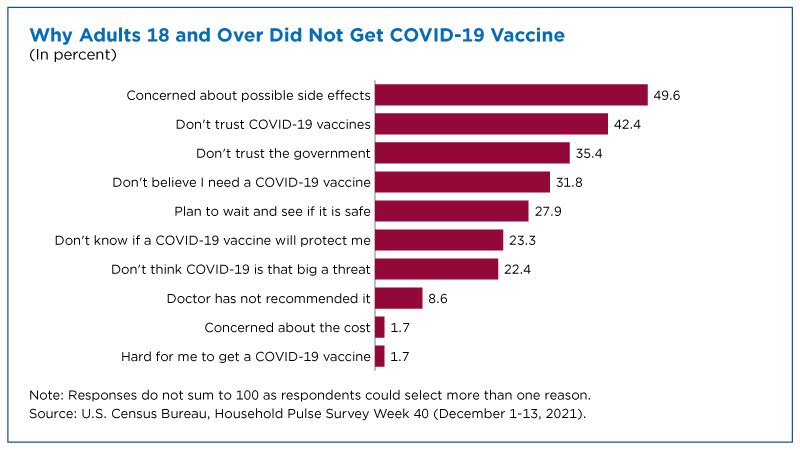
According to the U.S. Census Bureau’s newest phase of the experimental Household Pulse Survey (HPS), those who were unvaccinated against COVID in early December 2021, reported a variety of reasons why.

"Vaccinated" here refers to adults who have received at least one dose of any COVID vaccine, and "unvaccinated" refers to adults who have not received any.

Unvaccinated adults who responded to the survey could select more than one reason:
  • About half reported that they were concerned about possible side effects of the vaccine.
  • About 42% reported that they “don’t trust the COVID-19 vaccine.”
  • Less than 10% reported that they hadn’t gotten the vaccine because their doctor had not recommended it.
  • About 2% reported not getting the vaccine because of difficulty obtaining it. 

Why adults 18 and over did not get covid-19 vaccine

Tuesday, December 28, 2021

Cultural Differences and Autism Research

 In The Politics of Autism, I discuss diagnosis, which depends on observation of behavior.  There are multiple problems with this approach, including cultural differences.

At Autism Research, Megan Golson and colleagues have an article titled "Cultural differences in social communication and interaction: A gap in autism research."  The lay summary:

A diagnosis of autism requires the presence of deficits in social communication and interaction. Examples of these behaviors and skills include holding a back-and-forth conversation, the use of nonverbal communicative behaviors (e.g., gestures), and developing and maintaining social relationships. Culture influences the expectations for, and presentation of, these behaviors. However, research on this topic is lacking. Conducting more research related to culture and social communication could help reduce the disparities in autism identification across racially and ethnically minoritized populations.

From the article: 

Differing developmental and cultural expectations are problematic as the majority of diagnostic measures forautism are normed on fairly homogenous samples representing predominately White, Western individuals with minimal guidance on how practitioners can increase culturally responsive assessment practices (Harris et al.,2014). Stronach and Wetherby (2017) found that Black and Latinx caregivers reported more autism symptoms and SC/I deficits than White caregivers. Additionally,Black and Latinx children had significantly lower scores on speech-language observation measures than White children. Whether this is due to cultural differences inlanguage expression or examiner scoring bias is unclear.