Search This Blog

Sunday, June 4, 2017

Hyping Suramin

In The Politics of Autism, I discuss various ideas about what causes the condition.  I also write:  "If the science were not confusing enough, its coverage in the mass media has added another layer of murk.  News reports hype tentative findings and weak correlations as “breakthroughs” in the quest for autism answers. "  

Marijuana and stem-cell therapy are just two examples.

Emily Willingham writes at Forbes:
In the small clinical trial that is generating the huge buzz, 10 autistic boys were randomized to receive either one intravenous infusion of suramin or a placebo infusion. The boys, ages 5 to 14 years, were matched by age, IQ, and autism intensity. The study was published in the Annals of Clinical and Translational Neurology.

Following the treatments, Robert Naviaux at the University of California, San Diego, and his team monitored suramin blood levels and autism-related traits for six weeks. At one week after the infusion, scores on a battery of autism tests had improved for the five boys in the treatment group but not the five boys in the placebo group. A few weeks later, those improvements faded.
...
In addition, this study was supposed to be blinded so that no one knew who was getting the suramin infused, but the rash was likely a dead giveaway about which children got the drug. The study authors note that "Five children who received suramin developed a self-limited, evanescent, asymptomatic, fine macular, patchy, morbilliform rash over 1–20% of their body."
The risk of influence from such hints and high expectations is a real one. One parent in the study is quoted in the UC San Diego press release as seeing improvement within one hour of infusion of the drug, saying that their son began to make more eye contact with the clinicians in the room just following the treatment. In the same release, researchers describe children who said their first words in a decade within a week of receiving the drug.
From the press release:
Suramin is not approved for the treatment of autism. Like many intravenous drugs, when administered improperly by untrained personnel, at the wrong dose and schedule, without careful measurement of drug levels and monitoring for toxicity, suramin can cause harm. Careful clinical trials will be needed over several years at several sites to learn how to use low-dose suramin safely in autism, and to identify drug-drug interactions and rare side effects that cannot currently be predicted. We strongly caution against the unauthorized use of suramin.

Saturday, June 3, 2017

Pence Appears on Savage


Radio talk show host Michael Savage is a Trump cheerleader. In 2008, Savage said:
Now, you want me to tell you my opinion on autism, since I'm not talking about autism? A fraud, a racket. For a long while, we were hearing that every minority child had asthma. Why did they sudden -- why was there an asthma epidemic amongst minority children? Because I'll tell you why: The children got extra welfare if they were disabled, and they got extra help in school. It was a money racket. Everyone went in and was told [fake cough], "When the nurse looks at you, you go [fake cough], 'I don't know, the dust got me.' " See, everyone had asthma from the minority community. That was number one.
Now, the illness du jour is autism. You know what autism is? I'll tell you what autism is. In 99 percent of the cases, it's a brat who hasn't been told to cut the act out. That's what autism is.
What do you mean they scream and they're silent? They don't have a father around to tell them, "Don't act like a moron. You'll get nowhere in life. Stop acting like a putz. Straighten up. Act like a man. Don't sit there crying and screaming, idiot."
Autism -- everybody has an illness. If I behaved like a fool, my father called me a fool. And he said to me, "Don't behave like a fool." The worst thing he said -- "Don't behave like a fool. Don't be anybody's dummy. Don't sound like an idiot. Don't act like a girl. Don't cry." That's what I was raised with. That's what you should raise your children with. Stop with the sensitivity training. You're turning your son into a girl, and you're turning your nation into a nation of losers and beaten men. That's why we have the politicians we have.
Yesterday, Vice President Pence appeared on Savage's show.  Shame on him.

Friday, June 2, 2017

New IDEA Website

In The Politics of Autism, I write about special education and the Individuals with Disabilities Education Act. 

A Thursday release from the US Department of Education:
Today, the U.S. Department of Education launched a new website dedicated to the Individuals with Disabilities Education Act (IDEA).
 Secretary of Education Betsy DeVos directed the Department to expedite the development of a new, updated and more robust site specific to the IDEA after the Department's Building the Legacy: IDEA 2004 (Legacy) site experienced a prolonged outage in February due to technical issues.
"The launch of this new and improved site is a big win for children with disabilities, their families and the entire IDEA community," said Secretary DeVos. "It is incumbent upon the government to provide accessible and accurate information to our citizens. That's why one of my first actions as Secretary was to order the Department to fix and revitalize its woefully outdated IDEA site so that parents, educators and service providers could readily access the resources they need.
"The Department will continue to improve upon the new site by seeking and incorporating feedback from IDEA stakeholders in the coming months. We are committed to ensuring all children with disabilities and their families have the supports and services guaranteed under the IDEA."
The Department's Office of Special Education and Rehabilitative Services (OSERS) spent more than two months collecting feedback from parents, educators, administrators, service providers and advocates for infants, toddlers, children and youth with disabilities as to what they would like to see on a new IDEA site.
The initial launch of the new website incorporates feedback such as improved search capabilities, expanded content and an easier-to-navigate design compared to the previous Legacy site.
The IDEA is a law that ensures a free appropriate public education to eligible children with disabilities throughout the nation and ensures special education and related services to those children. IDEA stakeholders can continue to provide feedback on the new IDEA website to the Department on the OSERS Blog.
IDEA actually does not "ensure" anything.  It provides ways for parents to push for services, but in spite of a recent favorable Supreme Court decision, families still face major obstacles.

Thursday, June 1, 2017

Autistic Adolescents and Health Care Decisions

In The Politics of Autism, I discuss health care issues for people with intellectual and developmental disabilities.

A release from the University of Missouri:
For most people, trips to the doctor can be quite scary. For adolescents and young adults with autism, taking control of health care decisions is not only frightening, it also can be a barrier to independence. Now researchers from the University of Missouri have found that the health care process not only impacts adolescents with autism, but caregivers also feel they lack the skills and support necessary to help those adolescents achieve health-related independence. As more children with autism enter adulthood, improved communication between providers, adolescents and caregivers is needed to help those with autism transition to independence.
“A significant part of adulthood is managing health care, which includes regular trips to the doctor, following treatment plans, and being aware of symptoms and changes in health,” said Nancy Cheak-Zamora, an assistant professor in the MU School of Health Professions and researcher at the Thompson Center for Autism and Neurodevelopmental Disorders. “This can be especially challenging for adolescents and young adults with autism.”
Cheak-Zamora and her team conducted interviews with adolescents with autism and their caregivers. They found that both groups had a strong desire for the adolescents to manage their health care needs and that they attempted to take small steps toward independence, such as using pill boxes to help adolescents manage their own medications throughout the week. However, both groups lacked confidence when it came to building independence with adult health care. In many cases, caregivers were confused about their role in their adolescent’s path toward independence. Decisions about guardianship and who makes legal health care decisions were found to be especially problematic. Adolescents expressed feeling upset that health providers would not talk directly to them, instead speaking only to the caregivers.
“Many caregivers said they felt forced to remain involved in their adolescent’s care, even when their goal for the adolescents was independence,” Cheak-Zamora said.
“Meanwhile, adolescents want to overcome their fears. They feel it is important to have alone time with doctors and are frustrated when doctors communicate mainly with caregivers. These findings reiterate the importance of understanding the perspectives of both caregivers and adolescents and improving communication between caregivers, adolescents and providers to achieve shared independence goals.”
“Exploration and comparison of adolescents with autism spectrum disorder and their caregiver’s perspectives on transition to adult health care and adulthood,” recently was published in the Journal of Pediatric Psychology. Co-authors of the study were Michelle Teti, associate professor of health sciences; Anna Maurer-Batjer, a graduate student in the School of Social Work; and Erica Koegler, a post-doctoral fellow in the School of Health Professions. Research was supported by the Thompson Center for Autism, the U.S. Army Medical Research Acquisition Activity and the Assistant Secretary of Defense for Health Affairs through the Autism Research Program. The content is solely the responsibility of the authors and does not necessarily represent the official views of the funding agencies.

Wednesday, May 31, 2017

Developmental Disability Services for Adults

Uncertainty is a major theme of The Politics of Autism.  In the concluding section, I write:
A key question in autism policy evaluation is simple to pose, hard to answer: How do autistic people benefit? How much better off are they as a result of government action? While there are studies of the short-term impact of various therapies, there is surprisingly little research about the long term, which is really what autistic people and their families care about. As we saw in chapter 4, few studies have focused on the educational attainment of autistic youths. For instance, we do not know much about what happens to them in high school, apart from the kinds of classes that they take. One study searched the autism literature from 1950 through 2011 and found just 13 rigorous peer reviewed studies evaluating psychosocial interventions for autistic adults. The effects of were largely positive, though the main finding of the review is that there is a need for further development and evaluation of treatments for adults.
At Drexel University, Frank Otto reports:
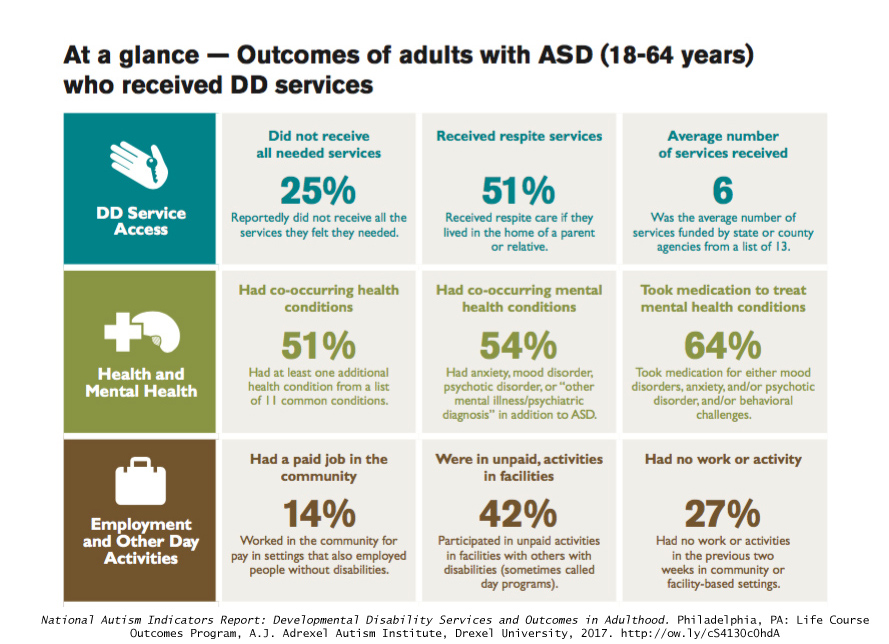
A quarter of adults with autism who use developmental disability services are not working or participating in other structured activities during the day, with only 14 percent holding a paying job in the community, according to the A.J. Drexel Autism Institute. 
Since 2015, the Institute has produced a National Autism Indicators Report. The past two reports showed that adults with autism have difficulty transitioning into jobs. This year’s version, “National Autism Indicators Report: Developmental Disability Services and Outcomes in Adulthood,” delved into the lives and needs of adults with autism who use developmental disability services — an estimated 111,000 nationwide.

“Billions are spent each year on services for people on the autism spectrum,” said Paul Shattuck, PhD, associate professor in Drexel’s Dornsife School of Public Health and director of the Autism Institute’s Life Course Outcomes program, which produces the annual reports. “Relatively little is spent trying to understand the types and amount of services people need, as well as the services they actually end up getting or the outcomes of them. This latest National Autism Indicators Report continues our tradition of publishing dashboard-like statistics about how life is turning out across the course of these people’s lives.” [emphasis added]
For the third year of the report, Anne Roux, a research scientist on Shattuck’s team, led a group that looked at data from 3,500 adults who used developmental disability services and took the 2014-15 National Core Indicators Adult Consumer Survey. This is a survey used by some states to monitor the effectiveness of their services.
In addition to the distressing information on lack of work and activities for most recipients the research team found that 25 percent did not believe they were getting the full services they needed.
“This dovetails with our team’s earlier reports on the ‘services cliff’ that transition-age youth encounter when they leave special education but have difficulty accessing services they may need to become employed, continue their education, or live more independently,” Roux said.
 A chart depicting findings from the report relating to health, work and service access.

Tuesday, May 30, 2017

Autism and the Portland Attack

In The Politics of Autism, I write:
People with disabilities are victims of violent crime three times as often as people without disabilities. The Bureau of Justice Statistics does not report separately on autistic victims, but it does note that the victimization rate is especially high among those whose disabilities are cognitive. 
Michael Edison Hayden reports at ABC:
Micah Fletcher, the survivor of a Portland, Oregon, stabbing attack that allegedly involved hate speech and left two people dead, issued a statement honoring the two who died and offering support to the city's Muslims.
"I want the Muslim community to know that they have a home here in Portland and are loved," Fletcher said in the statement. "I want to honor the families who lost their brave fathers, sons, and brothers and I want the media and the country to honor those families. I want to send my condolences and honor those families."
The 21-year-old Fletcher is a poet who won a 2013 poetry competition with a poem that condemned the mistreatment of Muslims, according to The Oregonian newspaper.
He was taking a light-rail train from Portland State University where he is a student to his job at a pizza shop at the time of the attack Friday, the paper reported.
Fletcher was slashed in the throat but survived, the paper reported.
Fletcher is autistic.  At Forbes, Emily Willingham writes:
Autistic people have often been accused of lacking empathy. It's an easily disproved canard that autistic advocates have long and repeatedly explained. As with many things having to do with autism, non-autistic people mistake non-neurotypical responses to emotional situations as evidence that autistic people lack emotions or don't sense or identify with the emotions of others. Those who like to rely on convenient narratives connecting what seems to be obvious instead of digging deeper--or, you know, asking autistic people--propagate the false impression that autistic people lack empathy. They don't.

Exceptional Minds: Past and Future

In The Politics of Autism, I discuss the employment of adults with autism and other developmental disabilities. Many posts have discussed programs to provide them with training and experience. 

Keith Sharon reports at The Orange County Register:
In 2009, a group of about 10 parents in Sherman Oaks raised $250,000, bought nine computers, hired four teachers and started an animation/vocational school for their autistic children.

The original idea was to create a training program for autistic students after high school, since many couldn’t function in typical college settings. People on the autism spectrum often have difficulties with communication, problem-solving, recognizing social cues and time management – all challenges for college and workplace settings.
There were nine students, but the program, called “Exceptional Minds,” had no director.
The parents arranged a meeting with Ernie Merlan, a long-time animator, muralist and imagineer who had worked on Hollywood movies and Disneyland attractions such as the Indiana Jones Adventure and Toontown. They told him they wanted to rent space at Merlan Creative for their new school.
That story was a lie. They didn’t want office space, they wanted him.
...
Exceptional Minds now has 32 full-time students – local ones from areas such as Venice, Chino Hills and Grand Terrace, and several from out of state (an incoming student is from Alaska) – and 50 part-timers. It has deals with HBO, Sony, Fox and other studios.
“Hollywood isn’t altruistic,” Merlan said. “They’re going to try us out once. We had better be good.”
So far, it has been very good.
“(Hollywood) keeps coming back for more,” Merlan said.
Here’s the best thing about this program: Other businesses are starting to be inspired.
There’s an adult school in Glendale called “Uniquely Abled Academy,” and one in Santa Monica called “MindSpark.” Both work with autistic adults, and both were inspired by Exceptional Minds.
Merlan said Exceptional Minds has a formula that can be easily followed.
“We’re assuming all of our students are superheroes,” Merlan said. “They live in an alternative universe, and that’s what we’re creating. The key is to build on what they’re interested in.”

Monday, May 29, 2017

Portable IEPs for Military Families

In The Politics of Autism, I discuss the day-to-day challenges facing autistic people and their families.

At RealClearEducation, Mark K. Claypool and John M. McLaughlin propose reallocating federal education money to special education.
[Use] a portion to create a portable Individualized Education Program (IEP) program for children with special needs within the United States military. If a child has autism and the IEP calls for applied behavior analysis and speech/language services at Fort Bragg, North Carolina, the child should have the same disability and IEP-specified programming at Fort Campbell, Kentucky or Fort Hood, Texas.
Furthermore, the additional money could be used to upgrade special education programs on military installments and those in adjacent public school districts to state-of-the-art. Fortunately, some military-based and adjacent schools are already exemplary, but too many are not. Tie this program enhancement funding to existing impact-aid formulas. Superior special education programs available to military families will have a positive impact on morale, recruitment, retention and, most importantly, on the students’ lives. In addition, having model special education programs in adjacent public school districts is a huge chamber of commerce win. Families move to school districts offering their child with special needs the best opportunity. What school superintendent wouldn’t love to have families move to the district for the quality of its special education program?

Sunday, May 28, 2017

"A Trump University for People with Cognitive Struggles"

In The Politics of Autism, I write:
The conventional wisdom is that any kind of treatment is likely to be less effective as the child gets older, so parents of autistic children usually believe that they are working against the clock. They will not be satisfied with the ambiguities surrounding ABA, nor will they want to wait for some future research finding that might slightly increase its effectiveness. They want results now. Because there are no scientifically-validated drugs for the core symptoms of autism, they look outside the boundaries of mainstream medicine and FDA approval. Studies have found that anywhere from 28 to 54 percent of autistic children receive “complementary and alternative medicine” (CAM), and these numbers probably understate CAM usage.
As previous posts noted, Education Secretary Betsy DeVos has a stake in Neurocore, a "brain training" company. Ulrich Boster writes at The Washington Post:
At the very least, DeVos appears to be dangerously naive about what it takes to help people learn — especially children with special needs.
Brain training companies use the veneer of science to promise effortless fixes. In the case of Neurocore, the firm claims that the intervention is “easy,” just a matter of watching TV in its offices a couple of times a week. Other companies peddle games, promising that some online diversions can boost intellect.
In reality, there are no easy answers.  ABA is expensive and demanding.
Still, scared and anguished parents, hunting for hope, will open their wallets, even if an approach has little scientific support. “A lot of times in autism, families are so desperate for an answer, they literally will take a website as evidence” for a treatment, Tom Frazier, chief science officer for Autism Speaks, told me. “It’s very concerning.”
In his book “Autism’s False Prophets,” pediatrician Paul Offit goes further, pointing out that unproven claims do more than fritter away time and money. They can injure both the healthy and the already sick. “The false alarm about vaccines and autism continues to harm a lot of children,” Offit writes. “Harm from not getting needed vaccines, harm from potentially dangerous treatments to eliminate mercury, and harm from therapies as absurd as testosterone ablation and electric shock.”
I’ll admit that before I stepped into Neurocore, I had little intention of signing up for the company’s treatment. I had read too many articles skeptical of brain training to think that I should pay for its services. But it took talking to experts and a visit to Florida to discover that the firm was also hurtful — a Trump University for people with cognitive struggles. By wrapping weak science in sleek packaging, by promising something that it cannot fully deliver, Neurocore offers false hope to people who need honest help. In this regard, what’s most remarkable is that DeVos, the nation’s foremost pedagogue, is behind it all, promoting a form of education that doesn’t actually seem to educate.

Saturday, May 27, 2017

No Strong Evidence for Supplements

In The Politics of Autism, I write:
The conventional wisdom is that any kind of treatment is likely to be less effective as the child gets older, so parents of autistic children usually believe that they are working against the clock. They will not be satisfied with the ambiguities surrounding ABA, nor will they want to wait for some future research finding that might slightly increase its effectiveness. They want results now. Because there are no scientifically-validated drugs for the core symptoms of autism, they look outside the boundaries of mainstream medicine and FDA approval. Studies have found that anywhere from 28 to 54 percent of autistic children receive “complementary and alternative medicine” (CAM), and these numbers probably understate CAM usage.
Parents of children with autism often try diet changes or supplements to ease symptoms of the disorder, but a new review concludes there's no solid evidence that any work.
After analyzing 19 clinical trials, researchers found little proof that dietary tactics -- from gluten-free foods to fish oil supplements -- helped children with autism spectrum disorders (ASDs).
Some studies showed positive effects, while others found nothing, the researchers said. Overall, the trials were too small and short-term to draw conclusions one way or the other.
"Even though we don't have clear evidence documenting safety and efficacy, many -- if not most -- families of children with ASDs try different diets and nutritional supplements at some point in time," said senior researcher Zachary Warren.
Parents often feel there is at least no harm in trying, according to Warren, an associate professor of pediatrics, psychiatry and special education at Vanderbilt University in Nashville.
 But, "that's not always a safe assumption," he said.
"For example, some nutritional supplements can actually cause harm in high doses," Warren noted.
He recommended that parents talk to their doctor before changing their child's diet or adding supplements.

From Pediatrics, the abstract:
Nutritional and Dietary Interventions for Autism Spectrum Disorder: A Systematic Review
Nila Sathe, Jeffrey C. Andrews, Melissa L. McPheeters, Zachary E. Warren


CONTEXT: Children with autism spectrum disorder (ASD) frequently use special diets or receive nutritional supplements to treat ASD symptoms.

OBJECTIVES: Our objective was to evaluate the effectiveness and safety of dietary interventions or nutritional supplements in ASD.

DATA SOURCES: Databases, including Medline and PsycINFO.

STUDY SELECTION: Two investigators independently screened studies against predetermined criteria.

DATA EXTRACTION: One investigator extracted data with review by a second investigator. Investigators independently assessed the risk of bias and strength of evidence (SOE) (ie, confidence in the estimate of effects).

RESULTS: Nineteen randomized controlled trials (RCTs), 4 with a low risk of bias, evaluated supplements or variations of the gluten/casein-free diet and other dietary approaches. Populations, interventions, and outcomes varied. Ω-3 supplementation did not affect challenging behaviors and was associated with minimal harms (low SOE). Two RCTs of different digestive enzymes reported mixed effects on symptom severity (insufficient SOE). Studies of other supplements (methyl B12, levocarnitine) reported some improvements in symptom severity (insufficient SOE). Studies evaluating gluten/casein-free diets reported some parent-rated improvements in communication and challenging behaviors; however, data were inadequate to make conclusions about the body of evidence (insufficient SOE). Studies of gluten- or casein-containing challenge foods reported no effects on behavior or gastrointestinal symptoms with challenge foods (insufficient SOE); 1 RCT reported no effects of camel’s milk on ASD severity (insufficient SOE). Harms were disparate.

LIMITATIONS: Studies were small and short-term, and there were few fully categorized populations or concomitant interventions.

CONCLUSIONS: There is little evidence to support the use of nutritional supplements or dietary therapies for children with ASD.

Friday, May 26, 2017

Praising the Alabama Mandate

The Politics of Autism includes an extensive discussion of insurance legislation in the states.

At The Gadsden Messenger, State Representative Craig Ford praises the Alabama Legislature for passing an autism insurance mandate.
According to the national Center for Disease Control, one out of every 175 children in Alabama has been diagnosed with some degree of Autism Spectrum Disorder. While treatment is most effective for children between ages two and nine, and coverage for children in this age range was already mandated by law, some children need further treatment going into their teenage years.
But the costs for Applied Behavioral Therapy treatment can be as high as $70,000 a year! So the legislature passed a new law that requires insurance companies to include in their group plans (defined as plans with 51 or more people participating) coverage for the treatment of children up to age 17.
This bill, which Gov. Kay Ivey has now signed into law, will improve the lives of thousands of children and their families. But it also shows what can be done when legislators work together.
Rep. Jim Patterson, R-Meridianville, worked tirelessly on this bill, and he didn’t make it a partisan issue. Rep. Patterson talked with Democrats and Republicans in both chambers of the legislature to come to a compromise that would limit the costs to insurers while still guaranteeing the coverage for our children.
As a result, this bill was passed out of the House with 102 votes in favor and not a single vote against it. In the state Senate, only one senator voted against it.
Another bipartisan success was our education budget. Budget chairman Bill Poole, R-Tuscaloosa, has always worked hard and listened to members of both parties when crafting the education budget. His tireless work has also led to unanimous support in the House for his budgets. And even more impressive is that he’s passed the education budget with unanimous support for three years in a row!
Both of these men have shown what can be accomplished when leaders reach across the aisle and work together instead of turning everything into a partisan issue.

Thursday, May 25, 2017

Trump Budget v. People with Disabilities

In The Politics of Autism, I discuss health care issues and state Medicaid services for people with intellectual and developmental disabilities.

At The New York Times, Kathleen O'Brien writes:
President Trump’s budget is here, and it contains serious cuts to the social safety net. One of the big changes is a plan to slash more than $800 billion over the next 10 years from Medicaid.
You may think of Medicaid as a program for the poor, but it also helps a variety of other vulnerable populations. Children with special health care needs rely on the program for services not typically covered by private health insurance, which helps them stay at home with their families. There are about five million children with special health care needs who receive benefits through public health insurance programs, including Medicaid. Proposed limits on a per-person basis are expected to disproportionately affect these children and their families, limiting access to costly but necessary services.
My sweet son is in this category.
At AASA, Sasha Pudelski reports:
Medicaid permits payments to districts for certain medically necessary services made available to children under IDEA through an individualized education program (IEP) or Individualized Family Service Program (IFSP). Given Congress’s failure to commit federal resources to fully-funding IDEAix, Medicaid reimbursement serves as a critical funding stream to ensure districts can provide the specialized instructional supports that students with disabilities need to be educated with their peers. The National Alliance for Medicaid in Education estimates that 1 percent of all Medicaid reimbursement goes to local school districts (between $4-5 billion), which is roughly a quarter of the investment made in IDEA ($17 billion).
AASA asked school leaders to identify how their systems would be impacted by a 30 percent reduction in Medicaid funding. By far, the most common result is that students
with disabilities will be harmed.
Another way special education programs and students may be effected by a Medicaid cut is that without this funding stream, districts be at may risk for noncompliance with IDEA. School leaders note that compliance with one of IDEA’s central tenets, educating students in the least restrictive environment, would be substantially jeopardized by a funding cut. The ability of districts to supplement this funding stream with another federal funding stream—Medicaid—has made the difference in being able to provide
many services for students with disabilities and fully adhere to the requirements in IDEA. As this funding stream disappears at a time when IDEA funds comprise merely 16 percent of the additional cost of educating students with disabilities,xi district leaders are concerned they will be unable to meet critical IDEA mandates. Specifically, they   worry about how to guarantee a student is educated in the least restrictive environment and how to ensure students can access the professionals and supports they need to
achieve.

Wednesday, May 24, 2017

Trump Budget Cuts

In The Politics of Autism, I discuss the issue's role in presidential campaigns.   In this campaign, a number of posts discussed Trump's support for the discredited notion that vaccines cause autism.  He also has a bad record on science and disability issues more generally.  That record just got worse.

From the Arc:
Today the Trump Administration released its first ten year budget proposal, and the numbers are devastating for people with intellectual and developmental disabilities (I/DD) and their families. On top of the more than $800 billion in Medicaid cuts already approved by the House of Representatives, the Trump Administration is planning for $610 billion in cuts to Medicaid; $72.4 billion in cuts to Social Security’s disability programs; and hundreds of billions more in cuts to other effective federal programs that are vital to people with I/DD.
“Where we invest our federal dollars is a measure of our values as a nation. Today the Trump Administration showed its cards, and coupled with the devastating Medicaid cuts already approved by the House of Representatives in the health care bill, the deck is stacked against people with disabilities.
...
“This budget – this Trump card – along with the health care cards being played in Congress as we speak, will dismantle decades of progress for people with disabilities and their families. So I’m calling on all advocates to do what they have done for decades, band together to put a face on these cuts. Share your story in your community and with your elected officials, and tell them to reject these cuts, before we go back in time to an era of discrimination and isolation,” said Peter Berns, CEO, The Arc.
In tandem with this budget news, The Arc is releasing a video which shares the story of a Maryland family which risks losing access to critical care for one of their children due to impending cuts to federal Medicaid funding. ...
From ASAN:
ASAN strongly condemns the deep cuts that the President’s proposed budget would make to Medicaid, Social Security, and other critical programs for people with disabilities. The President’s proposal would deprive countless Americans with disabilities of critical health care and community-based supports. It would jeopardize our very lives and result in a massive return to nursing homes and institutions. ASAN calls on Congress to reject these devastating cuts and craft a budget that invests in people with disabilities, our families, and our communities. We have come too far to go back.
The President’s budget would require massive cuts to Medicaid, which acts as a lifeline for countless people with disabilities. Medicaid is not only a critical source of health care coverage but also the main funder for home and community-based services and supports that help us live in the community instead of institutions. But the President’s budget takes the $800 billion in Medicare cuts proposed by the American Health Care Act and adds an extra $610 billion in additional cuts. This will reduce Medicaid funding by more than a trillion dollars over the next 10 years – a change that would cut the program in half.

This budget would eliminate $47 million for research on health care and services for autistic people and our families that was provided via the Autism CARES Act. These services include the Leadership Education in Neurodevelopmental and Other Related Disabilities (LEND) and Developmental Behavioral Pediatrics (DBP) programs which train healthcare professionals to work with autistic people. These cuts are in addition to $5.8 billion in cuts to the National Institutes of Health and $35 million in cuts to CDC work related to autism and developmental disability.
The budget would also cut Social Security at the same time that it cuts programs that help us find jobs in the community. It promises $50 billion in cuts to Social Security Disability. The only way to achieve such stark cuts is to kick people with disabilities off the program, through punitive and impossible-to-meet work requirements or other harsh changes which will result in people losing their Social Security. While ASAN has always supported programs to help people with disabilities find employment, these cuts aren’t designed to move people to quality jobs that help them escape poverty. In fact, the budget would also cut all Vocational Rehabilitation funding for state supported employment grants, which are instrumental in helping people with intellectual and developmental disabilities get and keep real jobs in the community.
Furthermore, it would punish SSI recipients for living together – including couples and families – by reducing their SSI payments. SSI programs already force people with disabilities to survive on an average of just $18 per day. Further cuts would force SSI recipients to choose between separation and starvation. To make it worse, the President’s budget would also make massive cuts to programs that are critical to people with disabilities living in poverty, including a $193 billion cut to the Supplemental Nutritional Assistance Program (SNAP), or food stamps program, over the next ten years; completely eliminating the Low Income Home Energy Assistance Program (LIHEAP) that helps low-income people pay their heating bills; and a $72 million cut to substance abuse prevention programs.
In addition to cuts to our health care and community-based services, our community would see a $25 million cut to programs to build affordable community-based housing for people with disabilities and a $7.7 billion cut to affordable housing programs overall. These cuts could cause over 250,000 people to lose the housing vouchers. The budget would eliminate the National Housing Trust Fund, which helps people with extremely low incomes escape or avoid homelessness. For thousands of people with disabilities who are already struggling to make ends meet, these cuts will mean homelessness or imprisonment in an institution.
Finally, this budget would cut smaller but vital programs that increase inclusion and independence for people with disabilities and our families. This budget would cut all federal funding for the Special Olympics, would eliminate programs that provide free legal assistance to people with low incomes, and would sharply reduce funding for State Councils on Developmental Disabilities, the National Institute on Disability, Independent Living, and Rehabilitation Research, and the Substance Abuse and Mental Health Services Administration. People with disabilities’ lives have value and are worth investing in. We deserve more than this.
When Congress threatened to cut Medicaid by over $800 billion, we showed up to fight. Congress heard from the disability community in town halls, and through countless phone calls, faxes, and letters. That fight isn’t over–but we can win, and we can beat these cuts too. We call on Congress to reject the President’s attack on the supports we need to live in the community. Our lives are too important to be put on the chopping block.