Search This Blog

Saturday, March 17, 2012

Leading Researchers on DSM

A number of posts have dealt with pending changes in the definition of autism in DSM-5. In The New Scientist, Fred Volkmar urges caution:
The way DSM-IV is formulated means there are over 2000 combinations of the 12 criteria that at the minimum threshold of six yield an autism diagnosis.DSM-5 proposes collapsing autism, Asperger's and PDD-NOS into a single "autism spectrum" category, combining and reducing criteria, vastly cutting the number of combinations that can lead to an autism diagnosis. This prompted me and my colleagues to reanalyse the DSM-IV field-trial data from 1994 for an upcoming edition of the Journal of the American Academy of Child and Adolescent Psychiatry. We found that many people, particularly the more cognitively able, would lose their diagnosis under the new regime.
...
What might this mean? It is possible that support for those in need will be hit, particularly in the US, where a diagnosis can trigger health insurance. Secondly, such a radical change would make it difficult to interpret the vast body of work done using DSM-IV - in 1993 there were about 390 peer-reviewed publications on autism. Last year over 2100 were produced.
Finally, the change of name to autism spectrum would suggest a broadened diagnostic concept when, if our reanalysis is correct, the opposite is the case. These are troubling issues. For such a major project, a more scientifically informed and engaged revision process is needed.
Frencesca Happe argues for change:
Anomalies in DSM-IV criteria for autism and other pervasive developmental disorders (PDDs), which includes the subgroups of autistic disorder, Asperger's and PDD-NOS, have led to clinical inconsistency, leading to wide variations in how diagnoses of these are made. One study found it was the clinic attended that best predicted which label was given.
 Most people diagnosed with Asperger's actually meet the DSM-IV criteria for autism. And research suggests there are no major differences between those with early language delay and those without - the feature differentiating autism and Asperger's in DSM-IV. The current split into three categories has little support in terms of genetic, neural, cognitive and other differences. Clinicians show little agreement in telling the three apart but are good judges of what is on the autism spectrum.
...
There is concern that those with Asperger's or PDD-NOS might not meet ASD criteria. This is not the aim. With fellow members of the DSM-5's neurodevelopmental disorders work group, I am working hard to ensure the full autism spectrum is well recognised. We have proposed a new category of "social communication disorder" for those with some of the difficulties of autism but without rigid and repetitive behaviour - currently poorly described by the very diverse DSM-IV category of PDD-NOS. We are also seeking to aid recognition of ASD in adults coming for first diagnosis.

Friday, March 16, 2012

"Autistic" as a Slur

At The Examiner, Melissa Teodorovic writes about the trailer for 21 Jump Street (the slur is at 3:38):
The trailer for the movie 21 Jump Street was recently released, and even though some moments appeared to be funny, the laughs ended for many, when Ice Cube's character attempted to insult another by asking him if he was "autistic". The "joke" has upset many parents of children with autism, as well as many adults on the spectrum. Some have expressed that they fear it will potentially make way for others (especially young people) to think that it's acceptable to call someone "autistic" in order to insult their intelligence.
... 
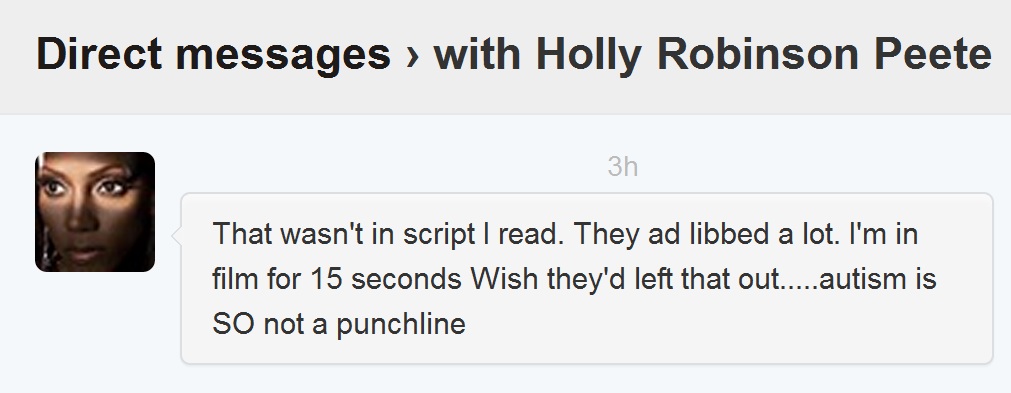
Many parents have also felt let down over the fact that the movie features a cameo by Holly Robinson Peete, who is not only a mother to a child with autism, but also an active member of Autism Speaks, and an advocate for children with autism. Many have wondered how she feels, and why she would be a part of a movie that would try to make fun of autism. She recently responded to this question by saying that the line was not in the script she read, and that the cast ad-libbed a lot of the scenes, she also added that, "autism is SO not a punchline" http://img.fae.ro/d0c1a7.jpeg.
See the Facebook boycott page.

"Political autism" has sometimes cropped up as a term of abuse, mostly in Britain, though sometimes in the United States.

Thursday, March 15, 2012

Canada to Deport Family Because of Autistic Child

The Mississauga News reports:
A man employed by a Mississauga company will be deported from Canada with his family because of the potential health care and social services costs associated with their 12-year-old autistic son.
For Sungsoo Kim, who has lived in Hamilton with his family for nine years, being rejected for permanent residency is devastating. He came to Canada on a student permit and has remained here on work permits.
Kim is working as the IT help assistant administrator for Pattison Outdoor Advertising at its Mississauga headquarters. His work permit expires in July.
Daughter Lisa, 17, and son Taehoon, 12, were 8 and 3, respectively, when the family arrived in Canada. Taehoon was diagnosed with autism in 2005 or 2006, his father says.
Officials informed Kim in January that he doesn’t meet Canada’s immigration requirements because Taehoon “is a person whose health condition, autism, might reasonably be expected to cause excessive demand on health or social services.”
Since his son is inadmissible, so is Kim.
This case is not the first.  See coverage of similar stories in The Star (Toronto) and The Ottawa Citizen.

Wednesday, March 14, 2012

Debate Over Restraint and Seclusion

A few days ago, the Education Department issued a report with data on restraint and seclusion. Last week, the American Association of School Administrators released a new report entitled "Keeping Schools Safe: How Seclusion and Restraint Protects Students and School Personnel."  From the release:
The study documents the importance of preserving school districts’ ability to use seclusion and restraint techniques in situations where a student is in danger of hurting himself, another student, or a school staff member.
“These techniques enable schools to educate students with severe behavioral difficulties in the least restrictive environment possible,” said Daniel Domenech, AASA executive director, in introducing the report. “These are practices that keep everyone safe.
At Education Week, Nirvi Shah reports:
However TASH says the AASA report "is unsubstantiated, ill-informed and reckless." TASH, formerly The Association for the Severely Handicapped, was particularly incensed over a statement in AASA's report that implies that the choice for some students is to either be restrained and/or isolated or institutionalized.
The National Disability Rights Network has a new report of its own, "School Is Not Supposed to Hurt."  From the executive summary:
ED [The US Department of Education] is also in the unique position to pull together a national summit of researchers, educators, mental health professionals and others to discuss whether restraint and seclusion has any therapeutic value and to develop evidence-based best practices to prevent and reduce the use of restraint and seclusion. ED should collaborate with the Substance Abuse and Mental Health Services Administration (SAMHSA) in this effort because SAMHSA has successfully supported efforts over the last decade to reduce the use of restraint and seclusion in mental health facilities. ED should fund demonstration projects to test what works.
ED can prevent future injuries and deaths by investigating restraint and seclusion (even where there is no individual complaint) and requiring school districts to take appropriate corrective action.
Back in January, the Autism National Committee released a report titled "How Safe Is the Schoolhouse?"  From the executive summary:
Today, there are 29 states with statutes and regulations providing meaningful protections against restraint and/or seclusion. (In 2009, there were only 22.) These have the force of
law and must be obeyed. Even the 29 states offer varying protections, with key safeguards present in some states and missing in others. There are 13 states with nonbinding guidelines, but these lack the force of law and can be readily changed by the State Department of Education. They are not the equivalent of statutes or regulations.

Michigan and Iowa Senates Pass Mandates

MLive reports on the Michigan insurance legislation:
The cost of mandating health insurers to cover autism diagnoses and treatment became an issue today in the Michigan Senate, which ultimately approved the idea despite objections from a handful of Republicans.
The three-bill, bipartisan package gathered support from Democrats, though some argued that the coverage should be extended to other mental health disorders.
But a group of Republicans objected, saying the bills could cost too much over time.
Two of the measures passed 29-9 -- and the other 28-10 -- with all objections coming from the GOP side of the aisle.
The bills require insurers to cover an autism diagnosis and treatment. At the same time, they direct the state Licensing and Regulatory Affairs Department to create an autism coverage incentive program through which insurance carriers and third-party administrators could see reimbursement for paid claims.
The cost is expected to come in at $15 million in the first year.
The Fort Dodge Messenger reports on Iowa:
Watching his 10-year-old grandson live with autism inspired state Sen. Daryl Beall to work on making the treatment of that condition more affordable for Iowa families.
The Fort Dodge Democrat's efforts advanced significantly on Tuesday when the state Senate passed a bill requiring insurers to provide coverage for autism treatments.
''It was the proudest vote I've cast in 10 years,'' Beall said Tuesday evening.
The bill that passed 43-7 late Tuesday afternoon is a followup to a measure Beall wrote and successfully worked to pass in 2010 that he called Drew's Law in honor of his grandson, Drew Beall. That law makes insurance coverage of autism treatment available to the children of state government employees. Drew Beall, however, is not eligible for the coverage under that measure.
Beall said his latest proposal had ''tremendous bipartisan support'' in the Senate. He said Sens. Bill Anderson, R-Sioux City; Rick Bertrand, R-Sioux City; and Tom Reilly, D-Oskaloosa; ''all spoke passionately for the bill.'

Tuesday, March 13, 2012

Emken Gets Endorsement

Elizabeth Emken, who created the AutismVotes website for Autism Speaks, is running for the US Senate from California.  The San Jose Mercury News reports:
The California Republican Party on Monday endorsed Elizabeth Emken of Danville over several other GOP contenders to unseat U.S. Sen. Dianne Feinstein, D-Calif.

"This was a humbling experience and a tremendous honor to receive the unanimous support of the board," she said Monday. "I'm looking forward to the challenge ahead, as well as working in partnership with the CRP as we head toward victory together."

As many as half a dozen other Republicans are in the race against Feinstein, including Oceanside businessman Dan Hughes and Santa Monica businessman Al Ramirez.
A couple of weeks ago, Joe Garofoli reported at The San Francisco Chronicle:
Yeah, Feinstein is popular, but according to the latest Field Poll, she’s in slightly worse shape than Sen. Barbara Boxer was in a similar point in her 2010 re-election.
Emken is unafraid She’s spent more than a decade as an advocate for those with autism. Her 19-year-old son, who will join her on the campaign trail, is autistic and she has two younger children. Plus, she’s hired veteran campaign hands with experience on statewide campaigns and said her Washington, D.C. experience advocating for autistic issues will give her a national fundraising base.
Will be interesting to see how this campaign develops and if any national money and names jump on board.

Monday, March 12, 2012

Seclusion Rooms

A recent post involved seclusion in Ohio.  In Columbus, WCMH-TV reports on seclusion rooms in local schools:


Report on Restraint

Recent posts have dealt with incidents of seclusion and restraint.  Such incidents are more common than one might hope, as AP reports:
Tens of thousands of students, most of them disabled, are strapped down or physically restrained in school, and disability advocates hope that a new Education Department report detailing the practice of "seclusion and restraint" will spur federal action to end it.
The report, compiled and made public for the first time by the department's civil rights arm, shows that 70 percent of students subjected to the techniques have disabilities. There are no current federal standards on the use of the techniques in schools.
The American Association of School Administrators says they are a last resort in protecting students and faculty from physical harm and keeping some children with behavioral problems in schools who might otherwise go into residential institutions. Advocates for the disabled say the use of seclusion and restraint is too accepted in schools and has led to abuse. They want Congress or the department to help curtail the practice.
The report is about civil rights data in general, not just seclusion and restraint.  But here is the relevant page (click to enlarge):


Sunday, March 11, 2012

Insurance Legislation in West Virginia and Louisiana

The State Journal reports that the West Virginia Legislature has passed a cleanup to its autism insurance mandate:
It was never a sure thing, but a bill to provide insurance coverage for applied behavioral therapy for autism spectrum disorders will be sent to Gov. Earl Ray Tomblin.
After a few questions in the House of Delegates March 10, the final day of the regular legislative session, members concurred with the amendments the Senate made to the bill.

House Bill 2693 passed during last year's legislative session to provide insurance coverage for children with the disorder. However that bill left a gap in coverage.
A bill introduced during this year's regular session, House Bill 4260, aimed to close that gap. It quickly and unanimously passed the House of Delegates, but stalled in the Senate.
A Thursday  release from Autism Speaks:
Autism Speaks, the world’s largest autism science and advocacy organization, today endorsed HB.771, which would amend Louisiana’s 2008 autism insurance reform law by raising the age cap to 21 and eliminating the $144,000 cap on lifetime benefits. Families paying thousands of dollars a year in insurance premiums would be able to continue coverage for the screening, diagnosis, testing and treatment of autism spectrum disorder (ASD) for individuals aged 16 through 20 if the legislation is enacted.
Sponsored in the Louisiana House of Representatives by Rep. Franklin Foil (R-Baton Rouge), the bill would eliminate any ceiling on lifetime benefits. Under current law, coverage ends once lifetime claims reach $144,000. In addition, the bill would eliminate the current requirement that treatments be supervised by a physician or psychologist.

Saturday, March 10, 2012

Super PACs, Autism, and Massachusetts

The Boston Herald reports on an unusual agreement in Massachusetts:
Scott Brown wrote a $1,000 check to the Autism Consortium after a super PAC launched an ad touting his candidacy, fulfilling his end of the deal he made with U.S. Senate rival Elizabeth Warren to keep big money political action committees out of their campaign.
“I could not be more pleased that Professor Warren has chosen the Autism Consortium,” Brown stated in a press release. “Over the years, I have advocated at both the state and federal level for more funding for autism research and support for children and families impacted by this disease.”
Warren and Brown agreed to ban the use of PAC ads in their campaigns and to donate 50 percent of any such ad’s cost, to the charity of their rival’s choosing. Earlier this week, a super PAC that supports Mitt Romney posted ads for Brown on Google. Brown’s campaign said they asked the group to remove the ads and offered to make a donation. Warren chose the autism advocacy group yesterday.

Friday, March 9, 2012

Insurance Legislation in New Hampshire and West Virginia

In New Hampshire, the Union-Leader reports:
Mothers with babies packed a State House hearing room on Thursday to oppose the elimination of a mandate that insurers cover midwife services.
They were joined by the parents of autistic children and advocates for the hearing impaired at a Senate hearing on House Bill 309.
The bill, approved by the House in January, would make insurance coverage for midwife services optional, and it would place limits on bariatric surgery, hearing aids and early intervention services for children with autism.
Supporters of the bill said eliminating insurance mandates would help reduce the cost of health insurance in the state....
A representative of the state Insurance Department estimated that all of the state’s mandates together make up less than 5 percent of premium costs, and that of the mandates being considering for elimination, hearing aids impose the greatest cost, at about 1.6 percent of premiums.
The bill targets mandates enacted over the last four years. The midwife services is the only mandate that would be eliminated outright. Parts of the other mandates would remain, but there would be limits on coverage.
In the case of early intervention services for children with autism, the benefits would be “subject to utilization review” in line with insurance department rules.
In West Virginia, The State Journal reports: 
The Senate Finance Committee, after some debate, moved a bill to the full Senate to provide insurance coverage for children with the disorder.
House Bill 2693 passed during last year's legislative session to provide insurance coverage for children with the disorder. However that bill left a gap in coverage.
A bill introduced during this year's regular session, House Bill 4260, aimed to close that gap. It quickly and unanimously passed the House of Delegates, but stalled in the Senate.
.... 
Jill Scarboro McLaury, a certified behavior analyst, was moved to tears while speaking to the committee.
"I certainly understand how there is a miscommunication about what the intent was last year if you weren't here for those final meetings," she said. "I don't understand how they can refute their own language that clearly says the caps were for ABA."
McLaury pointed to data from other states, including Missouri, with a population about four times the size of West Virginia, reporting that insurance costs increased about one-tenth of 1 percent.
"Assumptions used by states that have independent fiscal consultants are between 10 and 15 pages," she said. "If you look at PEIA and CHIP's notes, you have about a paragraph of their substantiating, I'm sorry, lack of substantiating evidence."
McLaury said claims data from five states show that increases in premiums range about 15 cents to 31 cents per member per month.

Thursday, March 8, 2012

Action in the Michigan Senate

MLive reports:
Lawmakers said a package of bills requiring autism diagnosis and treatment coverage shouldn't be considered a mandate on insurers, but a “moral public responsibility.”
A series of bipartisan bills sailed through the state Senate’s Health Policy Committee on Thursday with support from both sides of the aisle.
But Democrats and Lt. Gov. Brian Calley – a strong advocate of the package – said the bills are only a first step, and that coverage should someday be extended to other forms of brain disorders.
“This was a time when both parties could rise above the rhetoric and do the right thing for Michigan’s kids,” Calley said after the committee vote. “It’s a good day, and a good first step.”
None of the senators voted against any of the bills, thought Rick Jones, R-Grand Ledge, passed on voting for two because he disagreed with some language.
The bills -- SB 414, 415 and 981 -- would require insurers to cover an autism diagnosis and treatment. They would also direct the state Licensing and Regulatory Affairs Department to create an autism coverage incentive program through which insurance carriers and third-party administrators could seek reimbursement for paid claims.
The bills, sponsored by Sens. Tupac Hunter, D-Detroit, Mike Green, R-Mayville, and Majority Leader Randy Richardville, R-Monroe, are estimated to cost about $15 million a year at first, and supporters said 29 states have similar laws.
The two days of hearings included testimony from high-profile supporters, including Richardville and Calley, who has a daughter with the disorder.

Insurance Action in Kansas and Alabama

Autism Speaks reports:
Kansas Advocates -- Autism insurance reform is on the move! The House Insurance Committee has scheduled the first hearing for MONDAY, MARCH 12 at 3:30 pm on HB 2764 which would expand our 2010 law to cover many more families. The existing law covers only state employees. HB.2764 would extend the same coverage to all state-regulated group plans for individuals with autism through age 18. That includes coverage for the screening, diagnosis, and treatment of autism spectrum disorder (ASD) up to $36,000 a year through age 6, and then $27,000 a year through age 18. It's important that you let your House Representative know you want this bill. If they serve on the House Insurance Committee, you will ask them to vote it out of committee. If they do not serve on the committee, you will ask them to support the bill and urge their colleagues on the Insurance Committee to approve it.
March 7 UpdateSB.283 Voted Out of Senate Committee, Floor Vote Next
MONTGOMERY, AL -- The Senate Health Committee today approved SB.283, the aurtism insurance reform bill, clearing the way for a floor vote before the full Senate.Autism Speaks Endorses Alabama Autism Insurance Reform Bills
SB283/HB345 Would Assure Access to Health Care for Children with Autism by Requiring Coverage of Diagnosis and Treatment
NEW YORK, NY (February 15, 2012) – Autism Speaks, the nation’s largest autism advocacy organization, today announced its support for SB 283 and HB 345, which would bar large group health insurance plans in Alabama from refusing to cover the diagnosis and treatment of treatment of autism.
Families paying thousands of dollars a year in insurance premiums would gain coverage for the screening, diagnosis, and treatment of autism spectrum disorder (ASD). The Senate bill would provide coverage for children through age 9; the House bill would provide coverage through age 18.
Sponsored in the Alabama Senate by Senator Cam Ward and in the House by Rep. Mac McCutcheon, the bills include coverage of behavioral health treatments, such as Applied Behavior Analysis (ABA), an evidence-based autism therapy, for up to $50,000 a year. The bill woulds apply to large group health insurance plans regulated by the state of Alabama.
Senator and Mrs. Ward speak on SB 283: