Search This Blog

Sunday, September 18, 2022

Antivax Code on Facebook

 In The Politics of Autism, I analyze the discredited notion that vaccines cause autism. This bogus idea can hurt people by allowing diseases to spread.   And among those diseases could be COVID-19.

Antivaxxers are sometimes violent, often abusive, and always wrong.  

Zoe Kleinman at BBC:

The BBC has seen several groups, one with hundreds of thousands of members, in which the emoji appears in place of the word "vaccine".

Facebook's algorithms tend to focus on words rather than images.

The groups are being used to share unverified claims of people being either injured or killed by vaccines.

Once the BBC alerted Facebook's parent company, Meta, the groups were removed.

"We have removed this group for violating our harmful misinformation policies and will review any other similar content in line with this policy. We continue to work closely with public health experts and the UK government to further tackle Covid vaccine misinformation," the firm said in a statement.

However, the groups have since re-appeared in our searches.

One group we saw has been around for three years but rebranded itself to focus on vaccine stories, from being a group for sharing "banter, bets and funny videos" in August 2022.

The rules of the very large group state: "Use code words for everything". It adds: "Do not use the c word, v word or b word ever" (covid, vaccine, booster). It was created more than a year ago and has more than 250,000 members.

Thursday, September 15, 2022

Diet Does Not "Cure" Autism

The conventional wisdom is that any kind of treatment is likely to be less effective as the child gets older, so parents of autistic children usually believe that they are working against the clock. They will not be satisfied with the ambiguities surrounding ABA, nor will they want to wait for some future research finding that might slightly increase its effectiveness. They want results now. Because there are no scientifically-validated drugs for the core symptoms of autism, they look outside the boundaries of mainstream medicine and FDA approval. Studies have found that anywhere from 28 to 54 percent of autistic children receive “complementary and alternative medicine” (CAM), and these numbers probably understate CAM usage.

Australian Associated Press:

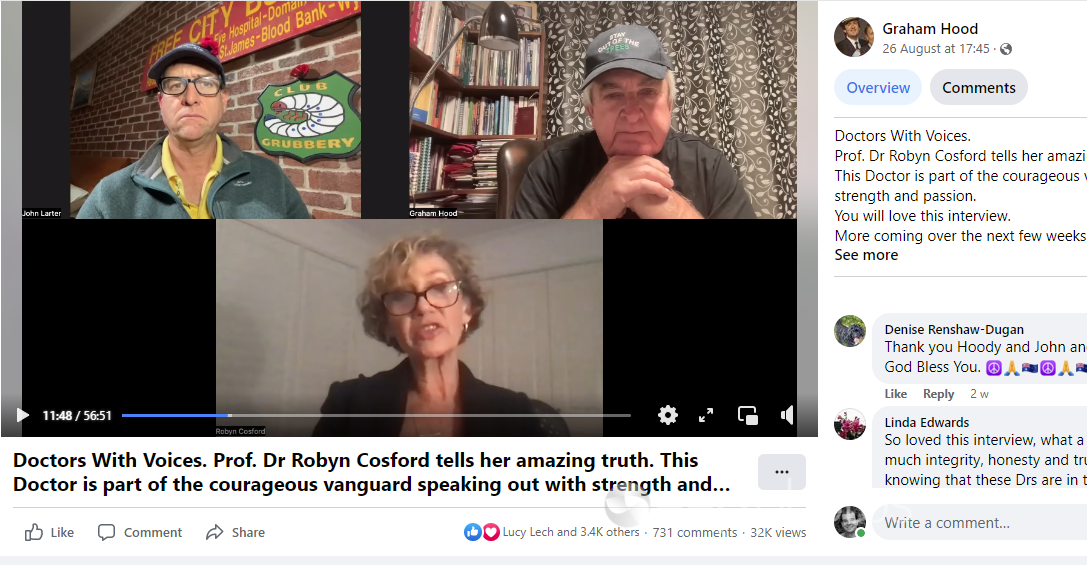
An Australian naturopath claims in a Facebook video that autism in children can be cured with therapeutic healthcare including a change of diet.

The claim is false. Experts say there is no cure for autism. Research into a possible link between nutrition and autism symptoms is inconclusive.

The claim was made by Robyn Cosford, who describes herself as a former medical practitioner and now runs the School of Divine Health.

“A lot of people think, even now, that autism is irreversible. It’s a label, a diagnosis that’s given by the medical profession and people are stuck with it, but that’s not true,” Dr Cosford said in the video (screenshot here).

“In most cases with correct nutritional biochemistry and diet and other allied therapies, in most cases you can bring these children back. You can bring them back into normal behaviour and back into life and functioning” (video mark 11min 20sec).

Tuesday, September 13, 2022

Polio Survivor On the Rise of Antivax Sentiment

 In The Politics of Autism, I analyze the discredited notion that vaccines cause autism. This bogus idea can hurt people by allowing diseases to spread.    Examples include measles, COVID, flu, and polio.

At The Guardian, polio survivor Paul Steiger writes:
[T]he success with polio elimination had helped pave the way in the United States for development and introduction of vaccines for measles in 1963, then for such other diseases as mumps and rubella. The combined “MMR” vaccines became standard for babies in the United States.

Then trouble emerged. Some reports, though definitively discredited, gave rise to the belief in a link between vaccination and autism. When the coronavirus struck, researchers and drug companies rapidly produced safe and effective vaccines to repel several versions of the mutating Covid virus. But the other side of the vaccine-versus-virus equation – getting everyone vaccinated – was no longer so readily achieved.

Whether for politics, religion, fear of side effects, or a prioritization of individualism, some people no longer embraced the collaborative spirit that made other massive vaccination drives so successful.

The commitment to social good necessary to meet public health challenges became apparent not just in the coronavirus, but also in seemingly conquered diseases like polio. An unvaccinated adult in one of New York’s suburbs was diagnosed with the disease. Polio virus samples were detected in the city’s wastewater.

Monday, September 12, 2022

Measles Vaccination Down in Some Places

 In The Politics of Autism, I analyze the discredited notion that vaccines cause autism. This bogus idea can hurt people by allowing diseases to spread.    Examples include measles, COVID, flu, and polio.

Mike D'Donfrio at Axios:

Only 82.2% of kindergarteners in district-run schools had all five mandatory immunizations for illnesses such as mumps and chickenpox during the 2021-22 school year, Christina Clark, spokesperson for the School District of Philadelphia, told Axios. That’s down from an 89.9% immunization rate for kindergarteners during the 2019-20 school year. ... Immunization rates for 7th graders and 12th graders — who require additional vaccines — also dropped last year compared to pre-pandemic times, according to state data released last month.

Ciara McCarthy at The Fort Worth Star-Telegram:

Routine vaccination rates for Fort Worth kindergartners have dropped to worrisome lows in the last school year, with just 86% of youngsters having received the vaccines that protects against measles, mumps and rubella. Fort Worth school district officials say they are stepping up outreach, enlisting campus nurses and principals to remind families that kids need to be up to date on their shots or else submit proof of medical or conscientious exemption to the vaccine.

Jerod MacDonald-Evoy at the Arizona Mirror:
The Maricopa County Department of Public Health recently announced three measles cases in the county as the state has continued to see year-over-year drops in how many children are being vaccinated against the highly contagious viral infection.
...

The vaccine is administered to children. In Arizona, the vaccination rates among children have been dropping every year. In some parts of the state, the number of schools with herd immunity has reached single digits.

...

In Maricopa County, for example, there are 876 childcare or preschool facilities. Just 517 of them — not quite 60% — meet the 95% threshold that protects children in attendance from a severe outbreak.

Other counties are far less protected. In Yavapai County, only 20% of preschool or childcare facilities are protected. The figures are even worse at elementary schools: Just 14% of kindergartens and 17% of 6th grade classrooms have community immunity. A similar trend is seen in Mohave and Gila counties.

Sunday, September 11, 2022

Polio Returns to NYS

 In The Politics of Autism, I analyze the discredited notion that vaccines cause autism. This bogus idea can hurt people by allowing diseases to spread.    Examples include measles, COVID, flu, and polio.

Giavanni Alves at the Staten Island Advance:
Gov. Kathy Hochul declared a state of emergency on Friday, following increased detections of the polio virus in New York.

The virus has been found in wastewater samples in New York City and Nassau, Orange, Rockland and Sullivan Counties.

Most recently, a sequence analysis of a sample collected from Nassau County in August was genetically linked to the first confirmed case of paralytic polio in New York, which was identified in an unvaccinated individual in Rockland County in July.

The New York State Health Department (NYSDOH) said all of the samples are cause for concern, as they reflect an expanding community spread.

Hochul’s executive order allows the state to immediately expand its network of polio vaccine administrators, affording more resources to local health departments and ramping up polio vaccinations.

The State Health Department’s goal is to increase the statewide polio vaccination rate from its current approximate 79% to 90%.

“On polio, we simply cannot roll the dice,” NYSDOH Commissioner Dr. Mary T. Bassett said in a statement. “If you or your child are unvaccinated or not up to date with vaccinations, the risk of paralytic disease is real. I urge New Yorkers to not accept any risk at all.”

Saturday, September 10, 2022

Measuring the Outcomes of Workforce Participation

In The Politics of Autism, I discuss the employment of people on the autism spectrum. Measuring outcomes and evaluating policy can be difficult.

At The Journal of Autism and Developmental Disorders, Elizabeth G. S. Munsell & Wendy J. Coster have an article titled  "How have Participation Outcomes of Autistic Young Adults been Measured? A Scoping Review."  The abstract:

Autistic young adults experience challenges participating in the workforce, post-secondary schooling, and living in the community. We examined how participation outcomes have been measured in autistic young adults. Articles (n = 113) were identified through database searches and citation tracking. Guided by current models in the literature, data were extracted for each measure of participation. Results include a description of the studies in the review, the extent to which participation across life situations has been addressed, and a critical analysis of the measures used to describe participation. While there is some breadth in the investigation of participation across diverse life situations, there is limited depth in what the measures capture and many measures used lack psychometric support.

From the article:

Although there is some breadth in the investigation of participation across diverse life situations, there is limited depth in what the measures capture. Often the same indicators have been used in multiple studies, with much more limited examination of more specifc features of autistic young adults’ participation. For example, employment is most often characterized as a dichotomous outcome, which does not provide insight into such issues as how long the person remains employed, what roles and responsibilities the person has at their job, whether the job matches the individual’s level of education and skill, or whether their compensation is at a level that might support economic independence, all of which are relevant considerations for long-term success.

Friday, September 9, 2022

ADOS Tends to Exclude Women from Autism Studies


Anne Trafton at MIT:
In recent years, researchers who study autism have made an effort to include more women and girls in their studies. However, despite these efforts, most studies of autism consistently enroll small numbers of female subjects or exclude them altogether, according to a new study from MIT.

The researchers found that a screening test commonly used to determine eligibility for studies of autism consistently winnows out a much higher percentage of women than men, creating a “leaky pipeline” that results in severe underrepresentation of women in studies of autism.

This lack of representation makes it more difficult to develop useful interventions or provide accurate diagnoses for girls and women, the researchers say.

“I think the findings favor having a more inclusive approach and widening the lens to end up being less biased in terms of who participates in research,” says John Gabrieli, the Grover Hermann Professor of Health Sciences and Technology and a professor of brain and cognitive sciences at MIT. “The more we understand autism in men and women and nonbinary individuals, the better services and more accurate diagnoses we can provide.”
...

For research studies of autism, it is routine to use a screening test called the Autism Diagnostic Observation Schedule (ADOS) to determine eligibility for the study. This test, which assesses social interaction, communication, play, and repetitive behaviors, provides a quantitative score in each category, and only participants who reach certain scores qualify for inclusion in studies.

While doing a study exploring how quickly the brains of autistic adults adapt to novel events in the environment, scientists in Gabrieli’s lab began to notice that the ADOS appeared to have unequal effects on male and female participation in research. As the study progressed, D’Mello noticed some significant brain differences between the male and female subjects in the study.

To investigate these differences further, D’Mello tried to find more female participants using an MIT database of autistic adults who have expressed interest in participating in research studies. However, when she sorted through the subjects, she found that only about half of the women in the database had met the ADOS cutoff scores typically required for inclusion in autism studies, compared to 80 percent of the males.

“We realized then that there’s a discrepancy and that the ADOS is essentially screening out who eventually participated in research,” D’Mello says. “We were really surprised at how many males we retained and how many females we lost to the ADOS.”

To see if this phenomenon was more widespread, the researchers looked at six publicly available datasets, which include more than 40,000 adults who have been diagnosed as autistic. For some of these datasets, participants were screened with ADOS to determine their eligibility to participate in studies, while for others, a “community diagnosis” — diagnosis from a doctor or other health care provider — was sufficient.

The researchers found that in datasets that required ADOS screening for eligibility, the ratio of male to female participants ended up being around 8:1, while in those that required only a community diagnosis the ratios ranged from about 2:1 to 1:1.
...
Failure to include more women and girls in studies of autism may contribute to shortcomings in the definitions of the disorder, the researchers say.


“The way we think about it is that the field evolved perhaps an implicit bias in how autism is defined, and it was driven disproportionately by analysis of males, and recruitment of males, and so on,” Gabrieli says. “So, the definition doesn't fit as well, on average, with the different expression of autism that seems to be more common in females.”


This implicit bias has led to documented difficulties in receiving a diagnosis for girls and women, even when their symptoms are the same as those presented by autistic boys and men.


“Many females might be missed altogether in terms of diagnoses, and then our study shows that in the research setting, what is already a small pool gets whittled down at a much larger rate than that of males,” D’Mello says.


Thursday, September 8, 2022

Thomas and Friends Franchise Introduces Autistic Character


A release from Mattel:
Mattel, Inc. (NASDAQ: MAT) announced today the introduction of Bruno, the first autistic character in the iconic Thomas & Friends franchise. Mattel Television developed Bruno in collaboration with respected organizations including the Autistic Self Advocacy Network (ASAN) and Easterseals Southern California, as well as writers and spokespeople with autism including Daniel Share-Strom and Aaron Likens. Voiced by Chuck Smith, an autistic actor, the new series regular will make his debut on the Season 26 premiere of Thomas & Friends: All Engines Go on Monday, September 12 at 8:30 am ET/PT on Cartoonito on Cartoon Network in the U.S. and on September 17 at 8:50 am ET/PT on Treehouse and STACKTV in Canada.

Bruno is a joyful, pun-making brake car. He is great at his job and keeps big, heavy cargo steady with his strong brakes—a vital role in Thomas & Friends: All Engines Go. Bruno rolls in reverse at the end of the train, which gives him a unique perspective on the world. Detail-oriented Bruno enjoys schedules, routine, and knows where all the tracks lead on Sodor. Bruno has stairs and a lantern on his bright, red exterior that indicate his emotional state, moving when he is excited or cautious. Bruno’s best day is one spent with his friends, who love and respect him for who he is, just as he loves them back. Through his on-screen presence, Bruno’s rich friendships and important work introduces audiences to a positive, neurodivergent role model. Together with key partners, Mattel carefully curated Bruno’s character to ensure an accurate fictional representation of an autistic child in the real world.

“The most important aspect of Bruno's development was getting autistic input throughout the process of creating the character and his interactions with his world,” said Zoe Gross, Director of Advocacy at the Autistic Self Advocacy Network (ASAN). “It was great to be able to contribute to that as part of a team of consultants from ASAN. Autistic people have been involved in all aspects of creating Bruno, from us as consultants to writers on the show and Bruno's voice actor—this makes Bruno ring true as an autistic character. I hope that Bruno will provide viewers with meaningful examples of inclusion in everyday life."

Experts from ASAN and Easterseals Southern California, alongside the creative and writing team at Mattel Television, leveraged years of experience dedicated to the understanding of autism to respectfully and artistically create an accurate, on-screen representation. Through their hard work, dedication and care, Bruno opens the door for global audiences in a way Thomas & Friends has never done before.

“Our commitment and contributions alongside Mattel have ensured that an honest version of Bruno is what kids and families across the world will experience,” said Dr. Paula Pompa Craven, Chief Clinical Officer at Easterseals Southern California. “Audiences will be able to see the real-life experiences of an autistic child through Bruno, including opportunities to learn and grow alongside him as he demonstrates his ability to give and receive support from his friends.”

While Bruno thoughtfully reflects the traits and preferences of some autistic people, one animated character could never encompass the real-life experience of every autistic person. A key character within the Thomas & Friends franchise, Bruno’s introduction will span across all content with appearances in a YouTube series, music album, the Thomas & Friends Storytime podcast, the upcoming Mystery of Lookout Mountain special, and consumer products set to debut later this year.

“Bruno’s introduction organically embraces a global audience that is underrepresented and deserves to be celebrated in children’s programming,” said Christopher Keenan, Senior Vice President & Executive Producer, Global Content Development and Production at Mattel. “So much care and thought went into the development of his character, and we can’t wait for audiences to meet and love Bruno as much as we do.”

Tuesday, September 6, 2022

Death by Measles

 In The Politics of Autism, I analyze the discredited notion that vaccines cause autism. This bogus idea can hurt people by allowing diseases to spread.    Examples include measles, COVID, flu, and polio.

 Ben Farmer at The Telegraph:

A measles outbreak in Zimbabwe has now killed nearly 700 children, in a rapidly accelerating and “deeply concerning” flare-up of the highly contagious disease.

Health officials told the Telegraph they were alarmed by both the speed of the spread and the high fatality rate of the outbreak, which has seen the recent death toll jump by dozens each day.

The flare-up of one of the world’s most infectious diseases has taken hold among church congregations that have rejected vaccinations for religious reasons.

Deaths had reached 698 by September 4, according to the nation’s health ministry, up from less than a quarter of that a fortnight earlier. Officials reported that 37 children died on September 1 alone.

The outbreak is thought to be the worst for some time in the southern African nation of 15 million. The last outbreak 11 years ago was far less severe, health sources told the Telegraph.

Unicef said that in the worst affected eastern province of Manicaland, nearly one-in-10 of those getting the disease were dying. That rate is higher than in other recent African outbreaks.
...

The country’s Apostolic churches or sects are thought to be followed by around one-in-five of the population. Their teachings regularly include a potent mix of opposition towards Western medicine and belief in faith healing and prayer, meaning the congregations have become a stronghold of anti-vaccination sentiment.


Monday, September 5, 2022

Subminimum

In The Politics of Autism, I discuss the employment of people on the autism spectrum.

Eleanor J. Bader at Truthout:
The subminimum for disabled workers has its roots in another discriminatory policy and rests on the idea that disabled workers — especially those with intellectual limitations — are less competent and need to be isolated from others. Depression-era Labor Secretary Frances Perkins was a proponent of this idea, and urged Congress to allow a lowered wage for shell-shocked World War I veterans who were having trouble reintegrating into the labor force. Those who “by reason of illness or age or something else are not up to normal production” would benefit, she testified. Her position gained traction and when the Fair Labor Standards Act became law in 1938, it included Section 14(c) to enable employers to pay those deemed disabled an unspecified, but lower, salary.

Fast forward 84 years and the average hourly wage for sheltered workshop participants is currently $3.34. As of July 2020, the most recent data available, the Department of Labor counted 67,288 individuals earning a subminimum wage thanks to 14(c).

Not surprisingly, disability rights groups are working to raise the wage and completely eliminate workshops. Their efforts include legislative advocacy at the state and federal levels, among other strategies.

One key element of their work involves support for The Transformation to Competitive Integrated Employment Act, which was introduced by Senators Bob Casey (D-Pennsylvania) and Steve Daines (R-Montana) earlier this year. The act will phase out the subminimum wage for disabled workers in sheltered workshops over a five-year period. A House version, HR 2733, was introduced by Rep. Bobby Scott (D-Virginia).

Sunday, September 4, 2022

Suicide Prevention

In The Politics of Autism, I write about the many challenges facing people on the spectrum.  Among many other things, they are at high risk for suicide. (In July, the United States transitioned from 10-digit National Suicide Prevention Lifeline to 988 – an easy-to-remember three-digit number for 24/7 crisis care. "

In a book titled Youth Suicide Prevention and Intervention: Best Practices and Policy Implications (eds. John P. Ackerman, Lisa M. Horowitz), Katie Johanning-Gray and colleagues have a chapter titled "Preventing Suicide in Youth with Intellectual and Neurodevelopmental Disorders: Lessons Learned and Policy Recommendations."  The abstract:

Preventing suicide in youth with autism spectrum disorder (ASD) and other intellectual and neurodevelopmental disorders (INDs) is a critical issue. In the USA, the overall number of individuals living with ASD and other developmental disabilities has been increasing in prevalence; in 2014 the prevalence of children ever diagnosed with any developmental disability was 5.76%, and this increased to 6.99% by 2016 (Zablotsky et al., 2017). Concurrent with the rise in IND prevalence is a troubling rise in the rates of suicide, with suicide now being the second leading cause of death among those between the ages of 10 and 24 in the USA (CDC, 2020). Due to gaps in our existing knowledge including a lack of validated assessment tools and suicide-specific treatments for these youth, researchers and clinicians alike grapple with how to prevent suicide in individuals with INDs. This chapter explores the evidence regarding the prevalence of suicidal ideation and behavior in this population and discusses lessons learned during the implementation of suicide prevention policies within programs serving patients with INDs at a large pediatric hospital setting.

Saturday, September 3, 2022

"Growth Market"

The Politics of Autism includes an extensive discussion of autism service providers.  Since the book's publication, a big change has consisted of a massive increase in private equity investments.

Dan Feshbach at Barron's:
The good news is investors are, at last, recognizing that autism is a growth market. The bad news is much of that investment is flowing toward services that don’t scale, often overpromise, and frequently underdeliver. In many ways, the complexity of the autism market reflects the disorder itself. It is an immensely complex condition, consisting of countless overlying subtypes and a wide range of obstacles. It’s not autism we are all working to address, but many forms of autism. Even with our growing understanding of the condition, families remain haunted by four questions: What type of autism does my child have? Why can’t my child communicate? How can my child get a job? Who will care for my child after I pass?

New startups and companies are, at last, starting to find the answers. Innovations in diagnostics and big data are on the verge of allowing families to discover the condition earlier, with companies such as BioRosa working to develop a blood test and biomarker for autism. Floreo and other platforms are tapping the power of virtual reality to teach important communication and interpersonal skills, while startups like Daivergent and Mentra are linking individuals with autism to employers and providing them with support in the workplace. Impruvon Health is offering medication management devices and Advasys is creating tools to help identify sexual abuse. The nonprofit I founded has created a global database that now tracks over 500 technology and life sciences companies within the autism and intellectual or developmental disability space.

Meanwhile, autism and intellectual disability impact investors are creating early-stage funds to support these kinds of young companies. The Disability Opportunity Fund, founded 13 years ago, has recently been joined by the Autism Impact Fund, and then by the Difference Fund, Divergent Ventures, K-Ventures, Enable Ventures, Neuvation, Arc Capital Development, and Moai Capital. These initiatives invest in startups that have met key private investor criteria and provide them with funding, mentoring, and a greater understanding of the market.

Thursday, September 1, 2022

COVID and Test Scores

 In The Politics of Autism, I discuss the day-to-day challenges facing autistic people and their families. Those challenges get far more intense during disasters.  And coronavirus is proving to be the biggest disaster of all. 

Mark Schneider, Director of IES: 

Mounting evidence shows just how much damage the COVID-19 pandemic and related school closures wreaked on our nation's students. The recently released results for NAEP's Long Term Trend (LTT) assessment for 9-year-old students adds depth to an already dismal picture.

LTT has been administered to 9-, 13-, and 17-year-old students for decades. Focused on core skills, LTT in reading was first administered in 1971 and math in 1973, giving us a very long trend line. But for now, I am interested in a much shorter (2 year) time frame. NAEP administered LTT for 9-year-olds between January and March in 2020—the data collection ended within days of the nation's schools shutting down. LTT was administered again in January through March of 2022, making it a nationally representative sample of student performance right before the pandemic and (hopefully) at the end of the nation's misery.

What does LTT show?

To paraphrase an old saw and repeating my comments on other NAEP results: If there wasn't bad news, there would be no news at all. Between the pre-pandemic assessment in 2020 and the post-pandemic assessment in 2022, overall scores went down 7 points in math and 5 points in reading—an unprecedented decline. Tapping into LTT's extraordinarily long trend line, math scores this low were last seen in 1999 and reading scores this low in 2004. Decades of progress wiped out in 2 years.
...

' White students, Black students, and Hispanic students all experienced declines, but the declines in math for Black students were particularly large, where the average math score dropped an extraordinary 13 points. In both reading and math, scores for students eligible for free or reduced-priced lunch fell sharply. In math, for example, scores for students eligible for free or reduced-priced lunch declined by 8 points, while the scores of their peers from higher-income families declined by 5 points. Students with disabilities, already performing far below students without disabilities, also declined by 8 points.