Search This Blog

Thursday, August 23, 2018

Autistic Person Pushes Back on Anti-Vaxxers

In The Politics of Autism, I look at the discredited notion that vaccines cause autism.

Karl Knights at The Guardian:
I’m autistic, and I was diagnosed 10 years ago, in 2008. At 12 years old, I had no way of knowing that anti-vaccination was still a live topic around autism. Luckily my parents didn’t engage with such a conversation. They were concerned about my needs, my access to education and employment. But many autistic children and adults were caught up in this bizarre and often harrowing episode – the discussion was too often centred on how to avoid having an autistic child, or what “mistakes” were made that caused the autism, rather than embracing the possibilities of neurodiversity.
The culture of fear that Wakefield aided and abetted has been taken up by far-right political movements, which capitalise on the fears that surround autism. In their narrative, autism is devastating and to be avoided at all costs. Anti-vaxxers point to rising rates as evidence of their outlandish theories. (In fact, as many studies and analyses have shown, the rates have risen because our diagnostic criteria have become more inclusive and more accurate.)
“For autistic people, the timing of Wakefield’s bogus study could not have been worse,” Steve Silberman, author of NeuroTribes: The Legacy of Autism and How to Think Smarter About People Who Think Differently, tells me. “Just at the historical moment when the true prevalence of autism was coming into view because of more public awareness, better screening methods, and so on, Wakefield came along to blame the rising numbers on vaccines. That had a devastating effect on autistic people – who now had to bear the stigma of allegedly being “vaccine-injured” on top of having autism – on parents, and on the direction of research. Instead of arguing about whether or not vaccines cause autism for a decade, society should have been investigating ways of improving the quality of life for autistic people and for their families.”

Wednesday, August 22, 2018

International Opinion on Vaccines and Autism

In The Politics of Autism, I look at the discredited notion that vaccines cause autism..


Bobby Duffy at The Conversation:
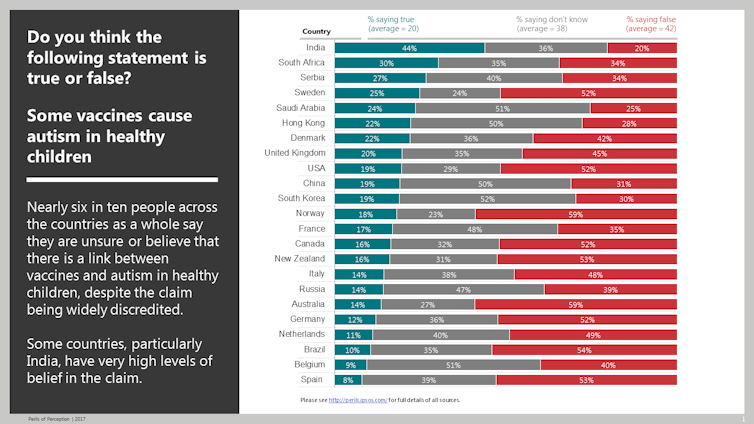
Have these unfounded fears stuck with the public around the world? Our first ever multi-country study, in 38 nations, on vaccine misperceptions suggests they have. Around one in every five people believe that “some vaccines cause autism in healthy children”, and 38% are unsure whether it is true or not.
The proportions positively believing it is true ranged from an incredible 44% in India, down to 8% in Spain.
But there are majorities in many countries who think it’s true or are unsure: in France it’s 65%, in Britain it’s 55%, in Italy it’s 52%. And even in countries where it’s not quite a majority who think it’s true or are unsure, it’s often only just below: in Sweden it’s 49% and in the US and Germany it’s 48%.

Tuesday, August 21, 2018

A Five Billion Dollar Business

 The Politics of Autism includes an extensive discussion of autism service providers.

From Market Research Future:

  • The global autism disorder & treatment market was USD 5,143.6 million in 2016
  • The pervasive developmental disorder is the largest segment, by type which is projected to grow at a CAGR [compound annual growth rate ] of 4.73% during the forecast period from 2017–2023.
  • ABA is the largest segment, by treatment type in global and expected to grow at a rate of CAGR 4.82% during the forecast period
  • The anti-psychotic accounted for the largest market share in global autism disorder & treatment market by drugs and is expected grow with the CAGR of 3.95% for the forecast period.

Monday, August 20, 2018

Measles Case Soar in Europe

In The Politics of Autism, I look at the discredited notion that vaccines cause autism..

Over 41 000 children and adults in the WHO European Region have been infected with measles in the first 6 months of 2018. The total number for this period far exceeds the 12-month totals reported for every other year this decade. So far, the highest annual total for measles cases between 2010 and 2017 was 23 927 for 2017, and the lowest was 5273 for 2016. Monthly country reports also indicate that at least 37 people have died due to measles so far this year.
“Following the decade’s lowest number of cases in 2016, we are seeing a dramatic increase in infections and extended outbreaks,” says Dr Zsuzsanna Jakab, WHO Regional Director for Europe. “We call on all countries to immediately implement broad, context-appropriate measures to stop further spread of this disease. Good health for all starts with immunization, and as long as this disease is not eliminated we are failing to live up to our Sustainable Development Goal commitments.”
Seven countries in the Region have seen over 1000 infections in children and adults this year (France, Georgia, Greece, Italy, the Russian Federation, Serbia and Ukraine). Ukraine has been the hardest hit, with over 23 000 people affected; this accounts for over half of the regional total. Measles-related deaths have been reported in all of these countries, with Serbia reporting the highest number of 14.

Rory Smith at CNN:
And where anti-vaccine sentiment has taken root -- such as in Italy -- measles is generally the first disease to manifest given its contagiousness, according to Heidi Larson, of the London School of Hygiene and Tropical Medicine.
Italy's anti-establishment government recently passed a new amendment that suspends a law requiring parents to provide proof that their children received a series of 10 vaccines -- including the MMR (measles, mumps, and rubella) vaccine -- when enrolling them in nurseries and preschools.
"Now, children who are not vaccinated will endanger other children at school who are too small for vaccines or cannot be vaccinated because they suffer from immunosuppressive diseases," said Dr. Roberto Burioni, a professor of microbiology and virology at San Raffaele University in Milan.
France and Romania, along with Italy, are among European countries with the highest anti-vaccine sentiment, where around 20% of the population believes vaccines are unsafe.
The infamous Wakefield study pubished in 1998 stated that the MMR vaccine caused autism in children who received the vaccine. The results of the study turned out to be untrue and Andrew Wakefield, one of the authors of the study, had his medical license revoked.
Despite the medical fraud, the myth persists, and many vaccine skeptics still believe their children will develop autism if they are immunized.

Sunday, August 19, 2018

Inequities in Age of Treatment Receipt

In The Politics of Autism, I write about the experiences of different economic, ethnic and racial groups. 


From the article:
This study, which is the first to examine inequity in age of treatment receipt among a nationally representative sample of children with ASD, demonstrates inequitable access to treatment. Specifically, we detected relationships between age of treatment receipt and two predisposing social characteristics, or race-ethnicity and perceived neighborhood cohesion. It is concerning that compared to White children, the odds of entering treatment at 3 years and ⩾4 years were much greater for non-Hispanic Black children. This finding aligns with consistent evidence that Black children with ASD are diagnosed later and are initially misdiagnosed (Daniels and Mandell, 2013).
...
After controlling for child race-ethnicity and covariates, children whose parents perceived their neighborhood to be cohesive began treatment earlier than children whose parents did not. Byrnes and Miller (2012) reported that the positive relationship between perceived neighborhood cohesion and effective parenting behaviors is mediated through social support. Thus, parents who perceive neighborhood cohesion might perceive greater social support from and more frequently communicate with neighbors and more often interact with other parents and young children. In turn, these parents might be more likely to compare and discuss their child’s development, including available community resources that promote development. To the contrary, parents who do not perceive  neighborhood cohesion might not receive feedback about their child’s development until preschool or later.

Saturday, August 18, 2018

One in Four Adults Has a Disability

In The Politics of Autism, I discuss the  civil rights of people with autism and other disabilities. 

From CDC:
One in 4 U.S. adults – 61 million Americans – have a disability that impacts major life activities, according to a report in CDC’s Morbidity and Mortality Weekly Report.
The most common disability type, mobility, affects 1 in 7 adults. With age, disability becomes more common, affecting about 2 in 5 adults age 65 and older.
“At some point in their lives, most people will either have a disability or know someone who has a one,” said Coleen Boyle, Ph.D., director of CDC’s National Center on Birth Defects and Developmental Disabilities. “Learning more about people with disabilities in the United States can help us better understand and meet their health needs.”
Six types of disability measured
Using data from the 2016 Behavioral Risk Factor Surveillance System (BRFSS), this is the first CDC report of the percentage of adults across six disability types:

  • Mobility (serious difficulty walking or climbing stairs)
  • Cognition (serious difficulty concentrating, remembering, or making decisions)
  • Hearing (serious difficulty hearing)
  • Vision (serious difficulty seeing)
  • Independent living (difficulty doing errands alone)
  • Self-care (difficulty dressing or bathing)

These data show that disability is more common among women, non-Hispanic American Indians/Alaska Natives, adults with lower income, and adults living in the South Census region of the United States. The report also shows that:

  • After mobility disability, the next most common disability type is cognition, followed by independent living, hearing, vision, and self-care.
  • The percentage of adults with disability increased as income decreased. In fact, mobility disability is nearly five times as common among middle-aged (45- to 64-year old) adults living below the poverty level compared to those whose income is twice the poverty level.
  • It is more common for adults 65 years and older with disabilities to have health insurance coverage, a primary doctor, and receive a routine health checkup during the previous 12 months, compared to middle-aged and younger adults with disabilities.
  • Disability-specific differences in the ability to access health care are common, particularly among adults 18- to 44-years old and middle-aged adults. Generally, adults with vision disability report the least access to health care, while adults with self-care disability report the most access to care.

“People with disabilities will benefit from care coordination and better access to health care and the health services they need, so that they adopt healthy behaviors and have better health,” said Georgina Peacock, M.D., M.P.H., Director of CDC’s Division of Human Development and Disability. “Research showing how many people have a disability and differences in their access to health care can guide efforts by health care providers and public health practitioners to improve access to care for people with disabilities.”
CDC is committed to protecting the health and well-being of people with disabilities throughout their lives. Through its State Disability and Health Programs and national collaborations, CDC will continue to work to lower health differences faced by people with disabilities. To advance this goal, CDC provides information and resources for public health practitioners, doctors, and those who care for people with disabilities.
For more information about CDC’s work to support inclusive settings for people with disabilities, go to http://www.cdc.gov/disabilities.

Friday, August 17, 2018

Measles Redux

In The Politics of Autism, I look at the discredited notion that vaccines cause autism.

From CDC:
From January 1 to July 14, 2018, 107 people from 21 states (Arkansas, California, Connecticut, Florida, Illinois, Indiana, Kansas, Louisiana, Maryland, Michigan, Missouri, Nevada, New Jersey, New York, North Carolina, Oklahoma, Oregon, Pennsylvania, Tennessee, Texas, and Washington) and the District of Colombia were reported to have measles.
In 2017, 118 people from 15 states and the District of Columbia were reported to have measles. In 2016, 86 people from 19 states were reported to have measles. In 2015, 188 people from 24 states and the District of Columbia were reported to have measles. In 2014, the United States experienced a record number of measles cases, with 667 cases from 27 states reported to CDC’s National Center for Immunization and Respiratory Diseases (NCIRD); this is the greatest number of cases since measles elimination was documented in the U.S. in 2000.
  • The majority of people who got measles were unvaccinated.
  • Measles is still common in many parts of the world including some countries in Europe, Asia, the Pacific, and Africa.
  • Travelers with measles continue to bring the disease into the U.S.
  • Measles can spread when it reaches a community in the U.S. where groups of people are unvaccinated.

Thursday, August 16, 2018

DDT and Autism

In The Politics of Autism, I discuss various ideas about what causes the condition. Here is just a partial list of correlates, risk factors, and possible causes that have been the subject of serious studies:


Sara Reardon at Nature:
Mothers with high levels of the pesticide DDT in their blood during pregnancy are more likely to bear children who develop autism, according to a study of blood samples from more than one million pregnant women in Finland.

The World Health Organization estimates that globally, one in 160 children has autism. Any case of autism is likely due to a number of factors, including genetics and other environmental exposures.

Although the authors stress that the findings do not prove that autism is caused by DDT — whose use has been banned in many countries for decades over concerns about its effects on wildlife— it is the first such association using a direct measure of exposure to the pesticide. Researchers who investigate links between environment and disease say that further studies are needed to determine the mechanism, if any, by which DDT exposure could trigger autism.

The study, published on 16 August in the American Journal of Psychiatry, also examined mothers’ exposure to another set of chemicals known as polychlorinated biphenyls (PCBs), and found no association between these substances and autism. That finding deepens questions about whether or how DDT might be linked to autism.

Wednesday, August 15, 2018

Texas Must Spend More for Special Ed


Alejandra Matos at The Houston Chronicle reports that Texas must spend billions more on special education.
A 2016 Houston Chronicle investigation and a subsequent federal auditfound that the Texas Education Agency illegally set up an 8.5 percent benchmark, or de-facto cap, on the number of students receiving special education services. The cap was in place for more than a decade, and was well below the national average of 13 percent.

In eliminating that cap, state officials estimate that it will cost the state billions of dollars to provide special education services to an additional 189,000 students who need them.
The state legislature eliminated caps on special education services last year, and the federal government is requiring school districts to evaluate special needs students and offer compensatory services. As more students are identified, the state will have to pay for those resources. TEA officials told a group of lawmakers Thursday that it estimates the state will need an additional $682 million for special education services in fiscal year 2019, an additional $1 billion in 2020 and $1.55 billion in 2021. That's more than $3.2 billion in the next three years.

Tuesday, August 14, 2018

HEADS UP

The Politics of Autism discusses health care, and explains that autism services can be complicated, creating difficulties for autistic people and their families. 

Last week, to commemorate the 28th anniversary of the passage of the Americans with Disabilities Act (ADA), Congressman Seth Moulton (D-MA), and Congressman Gregg Harper (R-MS), introduced the Healthcare Extension and Accessibility for Developmentally Disabled and Underserved Population (HEADs Up) Act of 2018.[HR 6611] The HEADs Up Act would designate people with Intellectual and Developmental Disabilities (I/DD) as a Medically Underserved Population (MUP) under the Health Services and Resources Administration (HRSA), opening up access to much needed primary care and specialist services, incentivizing new research, and authorizing more favorable reimbursement rates for providers who treat this population.

“The best way to celebrate the 28th anniversary of the signing of the Americans with Disabilities Act and the 50th Anniversary of the Special Olympics is to take the next step towards ensuring that those living with intellectual and developmental disabilities can live full and happy lives,” said Moulton. “Every person with intellectual and developmental disabilities should be fully integrated into our communities. But right now, we’re failing to give them basic healthcare. This needs to stop. We have the opportunity to create a turning point in the way we care for some of the most medically underserved people in our country. Access to healthcare is a human right, and we have an obligation to make sure that those most in need are getting the care they deserve.”
The “Medically Underserved” designation was created with the passage of the Health Centers Consolidation Act of 1996. Despite years of advocacy and ample evidence that people with I/DD qualify as a MUP, they still have not been designated as one. The designation as a special medically underserved population would open up over 25 government programs within the HRSA and other federal agencies for participation by the I/DD population. These programs include:
  • Federal funding for health centers and public health infrastructure such as Federally Qualified Health Centers (FQHC),
  • Eligibility to apply for federal funding to develop and operate Community Health Centers,
  • Access to loan repayment and training programs in HRSA’s Workforce Development and Training Programs including the national Health Service Corps Scholarships,
  • Incentives for physicians to treat this population in the form of higher CMS reimbursement rates for physician services delivered in Health Professional Shortage Areas, a designation closely related to MUP,
  • Preference given to research at federal agencies, including the NIH, that studies medically underserved population.
“Research shows that individuals with Intellectual and Developmental Disabilities (IDD) experience health disparities, as healthcare providers often do not receive the necessary training to provide proper care to the IDD community,” said Harper. “Increasing opportunities and improving the quality of life for IDD individuals has been a priority for me during my service in Congress. I am pleased to work with Representative Moulton on the HEADs Up Act of 2018 to continue this important conversation.”

The following groups have endorsed the HEADs Up Act:
  • American Network of Community Options and Resources (ANCOR)
  • National Council on Disability
  • ARC
  • Autism Society
  • The National Association of State Directors of Developmental Disabilities Services (NASDDDS)
  • Special Olympics
  • National Down Syndrome Congress
  • MENTOR
“Special Olympics strongly supports legislation, like the HEADs UP Act, that advances the rights, participation and integration of people with intellectual disabilities in communities across America,” said Dr. Timothy P. Shriver Ph.D., Chairman, Special Olympics International. “We thank Congressman Moulton and Congressman Gregg Harper for their championship of this bill. Special Olympics looks forward to continuing its work with Congress to end the stigma, stereotypes, isolation and discrimination that Americans with intellectual disabilities face around access to sport, health and education. The HEADs UP Act will go a long way towards ending well documented health disparities for people with Intellectual and Developmental Disabilities by appropriately designating those fellow Americans as a Medically Underserved Population as a result of so many lacking in the health care they desperately need and deserve.”
“Increasing access to dental health services for people with intellectual and developmental disabilities is an incredibly important issue because data overwhelmingly shows the connection between dental health and overall health outcomes, but the issue has flown under the radar for far too long,” said Barbara Merrill, CEO of ANCOR. “We are so grateful that Representative Moulton has asserted himself as a champion for this issue because we know that designating people with I/DD as a medically underserved population will help us make great strides in connecting people with the dental care they need and deserve.”

Monday, August 13, 2018

No Link Between Tdap and Autism

In The Politics of Autism, I look at the discredited notion that vaccines cause autism.

A study of women who received a Tdap vaccination during pregnancy found no increase in risk that their children would later be diagnosed with autism spectrum disorder. The study, “Prenatal Tetanus,Diphtheria, Acellular Pertussis Vaccination and Autism Spectrum Disorder,” will be published in the September 2018 issue of Pediatrics (published online Aug. 13). Researchers reviewed the records of 81,993 pairs of diverse pregnant women and their children who were born between Jan. 1, 2011, and Dec. 31, 2014, at Kaiser Permanente Southern California hospitals. Following up with the mother-child pairs, they identified children who had been diagnosed with autism spectrum disorder after age 1 through June 30, 2017. The incidence rate of autism spectrum disorder was 3.78 per 1,000 people in the Tdap-vaccinated group. The rate of autism spectrum disorder was 4.05 per 1,000 in the unvaccinated group. The Tdap vaccine has been shown in prior research as effective in protecting young infants from pertussis, which has risen in incidence in the past decade. Evidence showed that antibodies are passed along to newborns and that the vaccine was 91.4 percent effective in providing some immunity until newborns reached 2 months of age.

Sunday, August 12, 2018

ABLE Age Adjustment Act

The Politics of Autism includes a discussion of the ABLE Act.

From the Autism Society:
The Autism Society and other national disability groups used the ADA anniversary to spur action on the ABLE Age Adjustment Act. In 2014 Congress passed the ABLE Act, which authorized the creation of savings accounts for people to save money for disability-related expenses without jeopardizing their eligibility for public benefits like Supplemental Security Income (SSI) and Medicaid. These accounts are important because people with disabilities can lose their eligibility for public benefits if they accumulated more than $2,000 in assets if they do not have access to an ABLE account. While the ABLE Act performs a valuable service, only those that acquire a disability before age 26 are eligible. The ABLE Age Adjustment Act increases the age cut-off to 46 years of age which would allow an additional 6 million people with disabilities. Autism Society affiliates are encouraged to reach out to their Members of Congress to urge them to co-sponsor this bill. A sample letter is provided in the ASA Action Center.

Saturday, August 11, 2018

The ADA Is 28

In The Politics of Autism, I discuss the civil rights of people with autism and other disabilities. 

The Autism Society recently observed the 28th anniversary of the Americans with Disabilities Act (ADA). 
The Autism Society published a statement celebrating the civil rights law, acknowledging the history and evolution of disability rights, and pledging to continue its mission to support people with autism and other disabilities and their families. This mission includes protecting the ADA and other civil rights laws that promote the vision of full inclusion of people with autism and other disabilities. The US Department of Health and Human Services (HHS) Administration for Community Living (ACL) also published a statement using the ADA anniversary to reaffirm its commitment to the “fundamental principle that older adults and people of all ages with disabilities should be able to live where they choose, with the people they choose and with the ability to participate fully in their communities
Two years ago, David A. Graham wrote at The Atlantic:
Disability politics used to be bipartisan. The Americans with Disabilities Act was primarily authored by Senator Tom Harkin, an Iowa Democrat. It passed the Senate and House overwhelmingly—91-6 and 377–28, respectively, and was signed into law by President George H.W. Bush in 1990. When he signed the law, Bush said:
Now I sign legislation which takes a sledgehammer to another wall, one which has for too many generations separated Americans with disabilities from the freedom they could glimpse, but not grasp. Once again, we rejoice as this barrier falls for claiming together we will not accept, we will not excuse, we will not tolerate discrimination in America…. To those Members of the House of Representatives with us here today, Democrats and Republicans as well, I salute you. And on your behalf, as well as the behalf of this entire country, I now lift my pen to sign this Americans with Disabilities Act and say: Let the shameful wall of exclusion finally come tumbling down.
Eighteen years later, Bush’s son George W. Bush signed some expansions of the ADA into law.

Since then, however, things have sputtered. In 2012, the Senate failed to ratify a United Nations treaty called the Convention on the Rights of Persons With Disabilities. Democrats supported the treaty, but Republicans were split. On the pro side were George H.W. Bush and Bob Dole, the former Senate GOP leader and presidential candidate who was injured during World War II. On the con side were a bloc who warned on extremely dubious grounds that the treaty would allow the UN to meddle in U.S. courts. In the end, the treaty failed, despite Dole himself appearing on the Senate floor to lobby. It needed two-thirds of votes to pass, but was only able to garner 61